
- Rang BGG
- BGG #22 557
- Note BGG
- 6,1
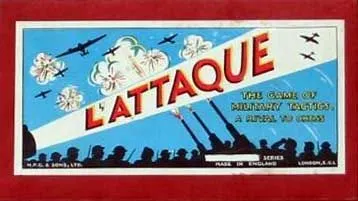
L'Attaque
- 2 joueurs
- 20 min
- Complexité 1,3/5
- 1909
1932
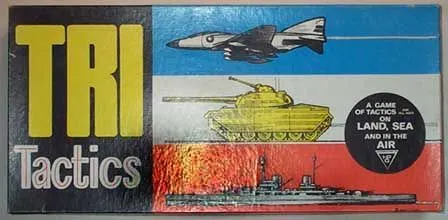
Aide aux règles de Tri-Tactics
Des explications claires des tours, effets de cartes et situations litigieuses, avec des références aux sources officielles et un historique des questions sauvegardé.

Pour 2 joueurs
Que voulez-vous savoir ?
Les réponses viennent du livret officiel, avec la page à vérifier.
Tri-Tactics est un jeu de société sorti en 1932 pour 2 joueurs, avec des parties de 240 minutes et à partir de 12 ans. Il a été conçu par Hermance Edan et Harry Gibson et ses principales mécaniques sont Secret Unit Deployment.








En anglais
Popular and intriguing military air, sea and ground forces tactics game TRI-TACTICS by Harry Gibson History: This board game was launched in 1935 by Gibsons aiming to provide an amalgamation of three other tactical board games: - L'Attaque (1909) - the U.K. rights were acquired by Gibsons in 1925. - Dover Patrol (1911) - Aviation: The Aerial Tactics Game of Attack and Defence (1925) All of these Gibsons games, marketed at the time as Series: The Big Four (Gibsons), predate Stratego (1942) by Jumbo which shares many similar aspects of play, but is now much more well known. Gameplay: The game is played on a special 12x12 board which illustrates land and sea spaces equally for each side, and each with two special squares, an HQ and a Lake containing a Naval Base. Two players, one RED, the other BLACK, command combined Navy, Airforce and Army forces, with a total of 112 prices, each player starting with 56, comprising the following: Infantry 5 Battalions - rank 1 4 Brigades - rank 2 3 Divisions - rank 3 2 Army Corps - rank 4 1 Army - rank 5 Artillery 5 Anti-Aircraft gun - rank AA 4 Field Artillery - rank FA 3 Heavy Artillery - rank HA Naval Force 4 Destoryers - rank 1 3 Cruisers - rank 2 2 Battleships - rank 3 1 Aircraft Carrier - rank 4 1 Submarine - rank SM 4 Flying Boats - rank FB Air Force 4 Reconnaissance Planes - rank 1 3 Bombers - rank 2 2 Two-Seat Fighters - rank 3 Auxiliary 8 Searchlights - rank SL At the beginning of game, these 56 pieces are placed by a player to occupy the first 5 rows of one side (but not on the HQ or Lake), with the other player doing likewise with their 56 on the opposite side’s 5 rows. This leaves two whole rows in the centre of the board empty, as well as the HQ, Lake, and 2 other squares between the two forces facing each other. All types and ranks of the pieces are hidden at the beginning of the game The object of the game is to occupy the opponent’s HQ with an Infantry piece, or the Lake with a Naval piece (not including the FB), which must approach via the river. The players draw lots to decide who commences play, by moving one piece, and thereafter play alternates between the players, by moving one piece per turn. All pieces can move one square at a time, forwards, backwards or sideways, with the exception of the Searchlight which can move multiple squares in a single direction (but only when attacking), as long as the squares are unoccupied. To attack, a player must move a piece adjacent to an opponent’s piece and announce ‘Attack’. They may choose not to, in which case they state ‘No Attack’. In that case, the opponent cannot on their turn attack that adjacent piece without first moving another of his pieces. The two adjacent pieces of each player are then revealed. The attacks are resolved by consulting the Value Table; as a general rule, the highest rank wins, but there are various combinations that apply, particularly when comparing land, sea and air pieces on land, sea or over a coastline. If successful, the attacker remains where they are, and the defender’s square becomes empty as the defender’s piece is removed. If the attacker loses, their piece is removed, and the defender’s piece remains where it is. If the pieces are the same rank, both are removed. It is allowed to place Land pieces on the sea and Naval pieces on the land, but with the risk that when attacked, any such piece found to be operating ‘out of their element’ will immediately forfeit and removed. Excluded from this rule is the FB as well as all Air Force pieces and the Searchlights. The River is a special area which is classified as Land or Sea depending on which piece is occupying it. When a Naval piece does so, the square is designated Sea, and when a Land price occupies it, then it is classified as Land. On the rest of the board, where land and sea meet, then the spaces are classified as Sea or Land depending on which is in the majority. The coastline in each case separates these defined areas of Land and Sea. Should there be an attack between a Ship and a Land piece over a coastline, the attacker is forfeit, except for HA and AA when the ordinary ruling applies. Also, Bombers and FB destroy Infantry and FA. The HQ and Lake must not be occupied but a piece may be move over these squares in consecutive turns or else be forfeit. Only Ships (not FB) may attack and capture the Lake, and to do so must move up the River (it cannot capture the Lake by entering via Land, or then it must exit via the river to sea); in doing so, in this special case it captures all Land pieces in attacks, except HA. Similarly, only Infantary pieces (not Artillery) may attack and capture the HQ. Similar to: L'Attaque Dover Patrol Aviation: The Aerial Tactics Game of Attack and Defence Stratego
Selon le catalogue, Tri-Tactics se joue à 2 personnes. C’est le nombre de joueurs indiqué par l’éditeur : le jeu est donc conçu pour exactement ce nombre de participants. Les variantes pour d’autres tailles de groupe, s’il en existe, sont décrites dans la règle de votre édition ; consultez-la avant d’installer une autre configuration.
La durée indiquée pour Tri-Tactics est de 240 minutes, selon l’estimation de l’éditeur pour une partie complète. La durée réelle dépend du groupe, de l’effectif et de la connaissance des règles : les premières parties sont plus longues, les groupes expérimentés terminent plus vite. Mise en place et explication des règles ne sont pas comprises.
Le catalogue indique Tri-Tactics à partir de 12 ans. C’est la recommandation de l’éditeur ; elle tient compte de la lecture nécessaire, de la complexité des règles et des petits composants, pas seulement du thème. Les plus jeunes peuvent souvent participer avec l’aide d’un adulte : vérifiez l’âge indiqué sur votre édition et tenez compte de l’expérience de votre groupe.
Tri-Tactics obtient une note de complexité de 2,5 sur 5 auprès des joueurs de BoardGameGeek, ce qui en fait un jeu plutôt léger. Cette note reflète la quantité de règles, de planification et de décisions qu’exige une partie typique. Prévoyez une explication plus longue pour les jeux exigeants et utilisez un guide de préparation avant la soirée.
Tri-Tactics appartient à ces catégories : Wargame et World War II. Ses principales mécaniques sont Secret Unit Deployment. Les catégories décrivent le thème et l’univers d’un jeu, tandis que les mécaniques décrivent ce que les joueurs font réellement pendant leur tour. Chaque mécanique mène à une page du catalogue avec des jeux similaires.
Les auteurs crédités pour Tri-Tactics sont : Hermance Edan et Harry Gibson. Ces crédits proviennent des données publiées du jeu et désignent les personnes responsables de sa conception, et non les illustrateurs ou les éditeurs. Les pages d’auteurs sur MeepleRules regroupent les autres titres des mêmes auteurs, ce qui est utile lorsqu’un jeu vous plaît et que vous en cherchez de similaires.
Le catalogue présente Tri-Tactics comme un jeu de base. Il se joue seul avec le matériel contenu dans la boîte et ne nécessite aucun autre titre. Les extensions, s’il en existe, y ajoutent du contenu ou des règles et sont répertoriées séparément dans le catalogue, avec un lien vers ce jeu de base.