

- Rang BGG
- BGG #7 195
- Note BGG
- 6,8
Cobra: Game of the Normandy Breakout
- 2 joueurs
- 120–480 min
- Complexité 2,8/5
- 1977
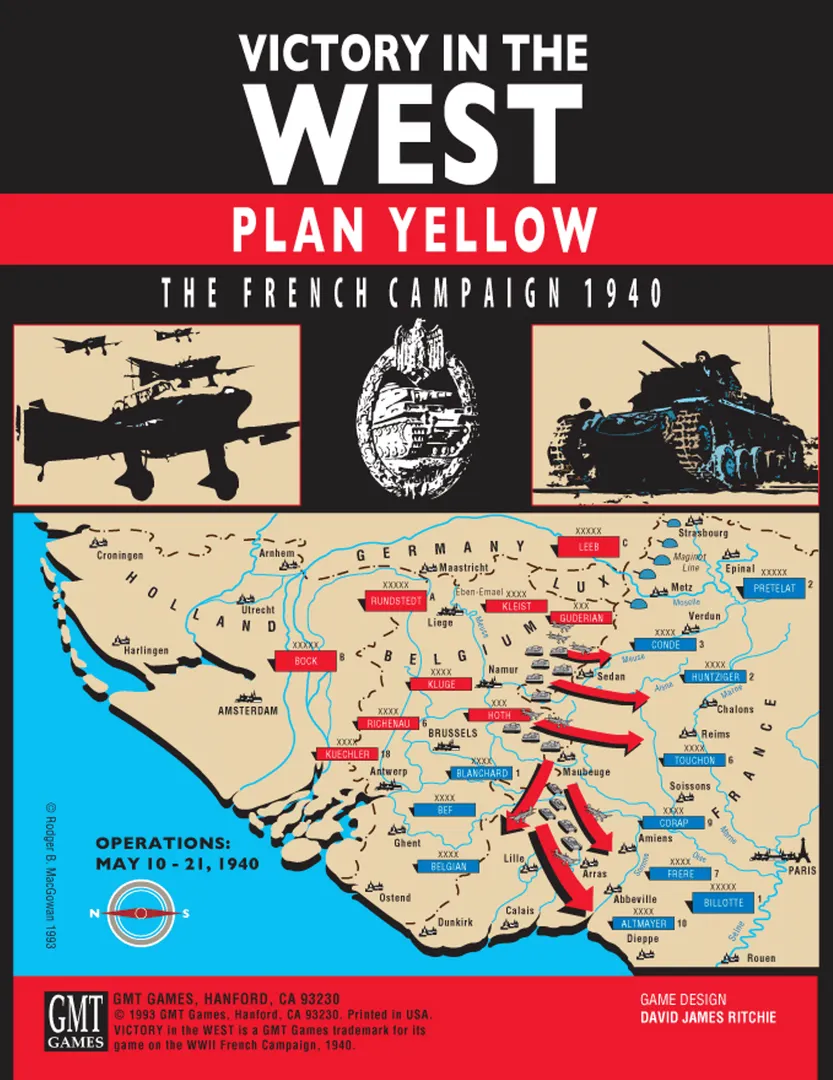
1993
Aide aux règles de Victory in the West: Plan Yellow, The French Campaign 1940
Des explications claires des tours, effets de cartes et situations litigieuses, avec des références aux sources officielles et un historique des questions sauvegardé.
Pour 2 joueurs
Que voulez-vous savoir ?
Les réponses viennent du livret officiel, avec la page à vérifier.
Victory in the West: Plan Yellow, The French Campaign 1940 est un jeu de société sorti en 1993 pour 2 joueurs, avec des parties de 360 minutes et à partir de 14 ans. Il a été conçu par David James Ritchie et ses principales mécaniques sont Dice Rolling, Variable Set-up et Hexagon Grid.






En anglais
Victory in the West: Plan Yellow, The French Campaign 1940, is a realistic two-player game that accurately recreates the 1940 campaign in all its aspects except one: the outcome is totally up to you. The game's centerpiece is an options system that lets the Allied player trade Victory Points for changes to his armies and policies that might (or might not) have changed history. Can you, as the Allied commander, repel the Germans with the forces on hand in 1940? How about if you train them better? Or give them a better command structure? Or provide them with more and better anti-aircraft an anti-tank guns? What do you think is the key to victory in the west? Can you, as the German commander, still beat the Allies if the French Army is motorized like the BEF? And how does your strategy change if the French don't build their Maginot Line, but do build a bigger and better air force? Do you still try to sneak through the Ardennes forest with your Panzers? Or do you ignore Allied bombers and wheel across the open plains of northern Belgium in a repeat of the 1914 Schlieffen Plan? Or do you do the unexpected and land a left hook through the Alsace? Your commanders await your orders. The future of Europe is in your hands. 10 May, 1940 ... The German Wehrmacht opened its long-awaited campaign in the West by smashing across the frontiers of Belgium and Holland. For the German High Command, it was seen as a daring move. Hitler's fledgling legions faced the combined armies of France, Britain, Belgium and the Netherlands. These Allied forces had more and better weapons of almost every type, and at least two of the opposing armies, those of France and Britain, were considered to be the best in the world. The Germans had the element of surprise and the new Blitzkrieg tactics of mobile warfare. Six weeks later, it was all over. The British Expeditionary Force (BEF) had been driven from the continent and the French, Belgians, and Dutch had all capitulated. Hitler had achieved a victory in the west, and the world would never be the same. But, what if? It didn't have to happen that way ... Bad generalship and correctable flaws in their armies hastened the Allied defeat. What if the High Command had bothered to stay in radio contact with its armies on the frontier? And had then reacted promptly to the developing situation? What if the Maginot Line had been extended to cover the Meuse crossings at Sedan where Guderian's Panzers broke into the Allied rear? What if the BEF had included a strong British mobile corps that could have fought Rommel's Panzers on even terms at Arras? What if the French had prepared to meet the Blitzkrieg by building eight tank divisions instead of three? Or by mechanizing their cavalry the way the Germans did after the Polish campaign? Or even by developing their own blitzkrieg doctrine? The Allies could have taken any or all of these actions, and any of them would have altered the campaign's course. But which ones would have changed the outcome? Game Scale: Game Turn: 2 days Hex: 6.8 miles / 11 kilometer Units: Battalion to Army Game Inventory: One 22 x 34" full color mapsheet One 17 x 22" full color mapsheet Three dual-side printed countersheets (720 1/2" counters) One 32-page Victory in the West rulebook One 8-page Victory in the West Example of Play booklet One 4-page Victory in the West Design Notes booklet Five dual-side printed Player Aid Cards One 10-sided dice Solitaire Playability: High Complexity Level: Medium Players: 2 or more Playing Time: 2-20 hours DESIGNER: David James Ritchie DEVELOPER: Kevin Boylan and Gene Billingsley ART DIRECTOR: Rodger B. MacGowan MAP ART: Mark Simonitch
Selon le catalogue, Victory in the West: Plan Yellow, The French Campaign 1940 se joue à 2 personnes. C’est le nombre de joueurs indiqué par l’éditeur : le jeu est donc conçu pour exactement ce nombre de participants. Les variantes pour d’autres tailles de groupe, s’il en existe, sont décrites dans la règle de votre édition ; consultez-la avant d’installer une autre configuration.
La durée indiquée pour Victory in the West: Plan Yellow, The French Campaign 1940 est de 360 minutes, selon l’estimation de l’éditeur pour une partie complète. La durée réelle dépend du groupe, de l’effectif et de la connaissance des règles : les premières parties sont plus longues, les groupes expérimentés terminent plus vite. Mise en place et explication des règles ne sont pas comprises.
Le catalogue indique Victory in the West: Plan Yellow, The French Campaign 1940 à partir de 14 ans. C’est la recommandation de l’éditeur ; elle tient compte de la lecture nécessaire, de la complexité des règles et des petits composants, pas seulement du thème. Les plus jeunes peuvent souvent participer avec l’aide d’un adulte : vérifiez l’âge indiqué sur votre édition et tenez compte de l’expérience de votre groupe.
Victory in the West: Plan Yellow, The French Campaign 1940 obtient une note de complexité de 3,4 sur 5 auprès des joueurs de BoardGameGeek, ce qui en fait un jeu de complexité moyenne. Cette note reflète la quantité de règles, de planification et de décisions qu’exige une partie typique. Prévoyez une explication plus longue pour les jeux exigeants et utilisez un guide de préparation avant la soirée.
Victory in the West: Plan Yellow, The French Campaign 1940 appartient à ces catégories : Wargame et World War II. Ses principales mécaniques sont Dice Rolling, Variable Set-up et Hexagon Grid. Les catégories décrivent le thème et l’univers d’un jeu, tandis que les mécaniques décrivent ce que les joueurs font réellement pendant leur tour. Chaque mécanique mène à une page du catalogue avec des jeux similaires.
Les auteurs crédités pour Victory in the West: Plan Yellow, The French Campaign 1940 sont : David James Ritchie. Ces crédits proviennent des données publiées du jeu et désignent les personnes responsables de sa conception, et non les illustrateurs ou les éditeurs. Les pages d’auteurs sur MeepleRules regroupent les autres titres des mêmes auteurs, ce qui est utile lorsqu’un jeu vous plaît et que vous en cherchez de similaires.
Le catalogue présente Victory in the West: Plan Yellow, The French Campaign 1940 comme un jeu de base. Il se joue seul avec le matériel contenu dans la boîte et ne nécessite aucun autre titre. Les extensions, s’il en existe, y ajoutent du contenu ou des règles et sont répertoriées séparément dans le catalogue, avec un lien vers ce jeu de base.