
- Posizione BGG
- BGG #11.680
- Valutazione BGG
- 7,8
Proud Monster Deluxe
- 2–6 giocatori
- 1500 min
- Complessità 3,5/5
- 2011
2010
Aiuto con le regole di 1940: What If Germany Went East?
Spiegazioni chiare di turni, effetti delle carte e situazioni dubbie, con riferimenti alle fonti ufficiali e cronologia delle domande salvata.
Cosa vuoi sapere?
Le risposte vengono dal regolamento ufficiale, con la pagina da verificare.
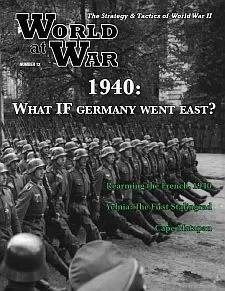
1940: What If Germany Went East? è un gioco da tavolo pubblicato nel 2010 per 2–4 giocatori, con partite da 240 minuti e dai 12 anni in su. È stato ideato da Ty Bomba e le sue meccaniche principali sono Hexagon Grid, Simulation e Ratio / Combat Results Table.


In inglese
The conjectured departure from the historic timeline that resulted in this alternative history wargame is assumed to have taken place in mid-September 1939. At that time, as his forces are completing the conquest of Poland, Hitler receives a flash of intuition. That is, he can’t help but notice the strategic paralysis of the Anglo-French, who do nothing to try to prevent the downfall of their fast-disappearing eastern ally Poland. From that he concludes it would be a waste of time to redeploy the Wehrmacht to the western front in 1940. He tells his generals: “The time will never be better to destroy the Bolshevik power than in the coming year. We will continue to have nothing to fear in the west. The British and French simply do not want war; they are afraid of it. Once we’ve taken Moscow, we’ll take Paris and London by telephone.” Accordingly, he also tells his foreign minister to drop all negotiations aimed at revising the original territorial split set out in the accords with the USSR the previous month. Most importantly, Lithuania, originally in the German “sphere of interest,” is not traded for a further slice of Polish territory. All of which has resulted in this low-complexity, strategic-level, alternative history wargame. In it, two to four players can investigate the possibilities inherent in a changed German strategy for 1940. The West Front map is scaled at 16 miles per hexagon. The Eastern Front map is scaled at 25 miles per hex. All Soviet units are armies; all other forces in the game are corps. Each game turn on both maps equals half a month. This game can be played by two, three or four. If two play, one commands the Germans, while the other commands both the Anglo-French and Soviets. If played by three, one player commands the Germans, one player commands the Anglo-French, and the third commands the Soviets. If four play, one player commands the Germans on the west map; the second commands the Germans on the east map; the third commands the Soviets, and the fourth commands the Anglo-French. The rules contain some 17,000 words, which means experienced players can finish it in about four hours. Rules cover such things as: neutrals, fog of war, airpower, 7th Flieger Corps, Soviet 1st Shock Army, fortifications, and more. The turn sequence is as follows. German Player Turn A. German Airpower & Strategic Transfer Phase B. German West Front Movement Phase C. German West Front Combat Phase D. German East Front Movement or Combat Phase E. German East Front Combat or Movement Phase F. German Replacement Phase G. German Moscow-Capture Resolution Phase H. German Terminal Supply Check Phase Soviet Player Turn A. Soviet Movement Phase B. Soviet Combat Phase C. Soviet Grand-Strategy Phase 1. Resolve Far East Front 2. Resolve Arctic Front 3. Resolve Southwest Front D. Soviet Terminal Supply Check Phase E. Soviet Reinforcement & Replacement Placement Phase Anglo-French Player Turn A. Anglo-French Armor Doctrine Phase B. Anglo-French Movement Phase C. Anglo-French Combat Phase D. Anglo-French Terminal Supply Check Phase E. Anglo-French Replacement Phase
Secondo il catalogo, 1940: What If Germany Went East? supporta da 2 a 4 giocatori. L’intervallo corrisponde al numero di giocatori indicato dall’editore, quindi il gioco si può preparare per qualsiasi gruppo entro quei limiti. Preparazione, alcune regole e punteggio possono comunque variare in base al numero di giocatori: controlla la configurazione esatta nel regolamento della tua edizione.
La durata indicata per 1940: What If Germany Went East? è di 240 minuti, la stima dell’editore per una partita completa. La durata effettiva dipende dal gruppo, dal numero di giocatori e dalla conoscenza delle regole: le prime partite durano di più, i gruppi esperti finiscono prima. Preparazione e spiegazione delle regole non sono comprese nella stima.
Il catalogo indica 1940: What If Germany Went East? dai 12 anni in su. È la raccomandazione dell’editore e tiene conto della lettura richiesta, della complessità delle regole e dei componenti piccoli, non solo del tema. I più giovani spesso possono giocare con l’aiuto di un adulto: controlla l’età consigliata sulla tua edizione e l’esperienza del tuo gruppo con i giochi da tavolo.
1940: What If Germany Went East? ha un punteggio di complessità di 2,0 su 5 secondo i giocatori di BoardGameGeek, il che lo rende un gioco piuttosto leggero. Il punteggio riflette quanta conoscenza delle regole, pianificazione e decisioni richiede una partita tipica. I giochi impegnativi richiedono una prima spiegazione più lunga, quindi conviene usare una guida di preparazione.
1940: What If Germany Went East? appartiene a queste categorie: Wargame e World War II. Le sue meccaniche principali sono Hexagon Grid, Simulation e Ratio / Combat Results Table. Le categorie descrivono il tema e l’ambientazione di un gioco, mentre le meccaniche descrivono ciò che i giocatori fanno davvero nel proprio turno. Ogni meccanica porta a una pagina del catalogo con giochi simili.
Gli autori accreditati di 1940: What If Germany Went East? sono: Ty Bomba. Questi crediti provengono dai dati pubblicati del gioco e indicano le persone responsabili della sua progettazione, non gli illustratori o gli editori. Le pagine degli autori su MeepleRules raccolgono altri titoli degli stessi autori, utili quando un gioco ti piace e ne cerchi di simili.
Il catalogo classifica 1940: What If Germany Went East? come gioco base. Si gioca da solo con i componenti presenti nella scatola e non richiede altri titoli. Le espansioni, se esistono, aggiungono nuovo contenuto o nuove regole e sono elencate separatamente nel catalogo con un collegamento a questo gioco base.