- Posizione BGG
- BGG #2362
- Valutazione BGG
- 6,4
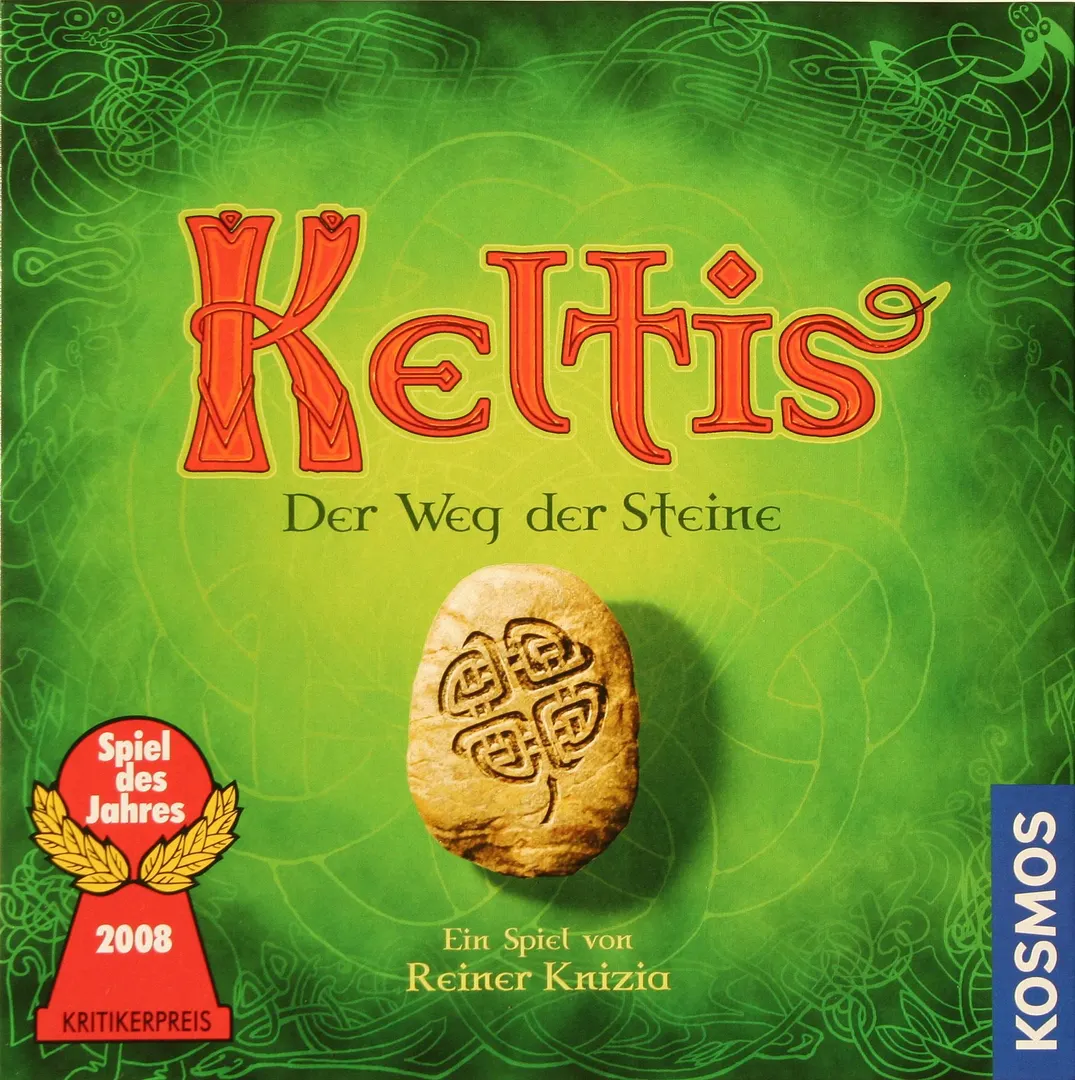
Keltis
2008
Aiuto con le regole di Keltis
Spiegazioni chiare di turni, effetti delle carte e situazioni dubbie, con riferimenti alle fonti ufficiali e cronologia delle domande salvata.
- 2–4 giocatori
- 30 min
- 10+
- Complessità 1,6/5

Informazioni sul gioco
Keltis is a multi-player game based on Lost Cities, with some rules changes, later published with Knizia's original rules and theme as Lost Cities: The Board Game. Players play cards to move their playing pieces along stone paths. Cards show one of five different colors/symbols, each corresponding to one path; in addition, each card shows a number (0-10, twice each). In each color, each player can play his cards in either ascending or descending order. As in Lost Cities, it's better to concentrate on a few paths since the final spaces on a path grant high points, but ending early gives negative ones. The active player plays one card (out of a hand of eight) or discards one, then moves the corresponding playing piece on the path. Many of the spaces have a token that grants some bonus: either immediate points (counted on the scoring track), an extra move on a path, or wishing stones that are needed at game end to avoid negative points. The game ends when five playing pieces (from any combination of players) have reached the seventh (or higher) space on their respective paths. Now, scoring happens: Pieces that moved only 1-3 steps earn negative points (-4, -3, -2). Pieces with 4+ steps earn points (1, 2, 3, 6, 7, 10). One piece of each player twice the height of other pieces scores double, either positive or negative. Holding fewer than two wish stones earns negative points (-3 / -4), while a collection of five or more stones yields a bonus of 10 points. All endgame points are added to any scored during the game. The player with the highest score wins! Primary differences between Lost Cities: The Board Game and Keltis: 1. In LCBG you play 3 rounds, scoring at the end of all 3 for the monuments you collect. (Normal scoring occurs each round.) In Keltis, you only play 1 round, and score everything each round. This is not just a rule difference, as the scoring is different for the monuments/stones based on the number collected. 2. In Keltis, you may play your cards in either order, high to low, or low to high. In LCBG, you must go low to high. Note: the rules for LCBG have the Keltis rules as variants, and have the board elements necessary for #1 above. Keltis does not have the rules nor board elements to play LCBG. There are more differences that are non-substantive. (Art, points in LCBG multiplied by 5, etc.)
Autori
Editori
- Devir
- Kaissa Chess & Games
- Wargames Club Publishing
- Korea Boardgames
- Piatnik
- Galakta
- KOSMOS
- 999 Games
- Competo / Marektoy
- Laser plus
- Stupor Mundi
- Filosofia Éditions
Domande e risposte
L’assistente alle regole di Keltis aiuterà a chiarire turni, effetti delle carte e situazioni dubbie, con fonti ufficiali verificate e cronologia delle domande salvata. Non è ancora pronto; le fonti verificate per la tua edizione sono ancora in preparazione.
Secondo il catalogo, Keltis supporta da 2 a 4 giocatori.
La durata indicata per Keltis è di 30 minuti. La durata effettiva dipende dal gruppo e dalla sua conoscenza del gioco.
Il catalogo indica Keltis dai 10 anni in su. Controlla l’età consigliata sulla tua edizione.
Gli autori accreditati di Keltis sono: Reiner Knizia.
Il catalogo classifica Keltis come gioco base.
Assistente delle regole di Keltis
Caricamento…