

- Posizione BGG
- BGG #3216
- Valutazione BGG
- 7,7
The Great Battles of Alexander: Deluxe Edition
- 1–4 giocatori
- 240 min
- Complessità 3,6/5
- 1995
Aiuto con le regole di Salamis
Spiegazioni chiare di turni, effetti delle carte e situazioni dubbie, con riferimenti alle fonti ufficiali e cronologia delle domande salvata.
Cosa vuoi sapere?
Le risposte vengono dal regolamento ufficiale, con la pagina da verificare.
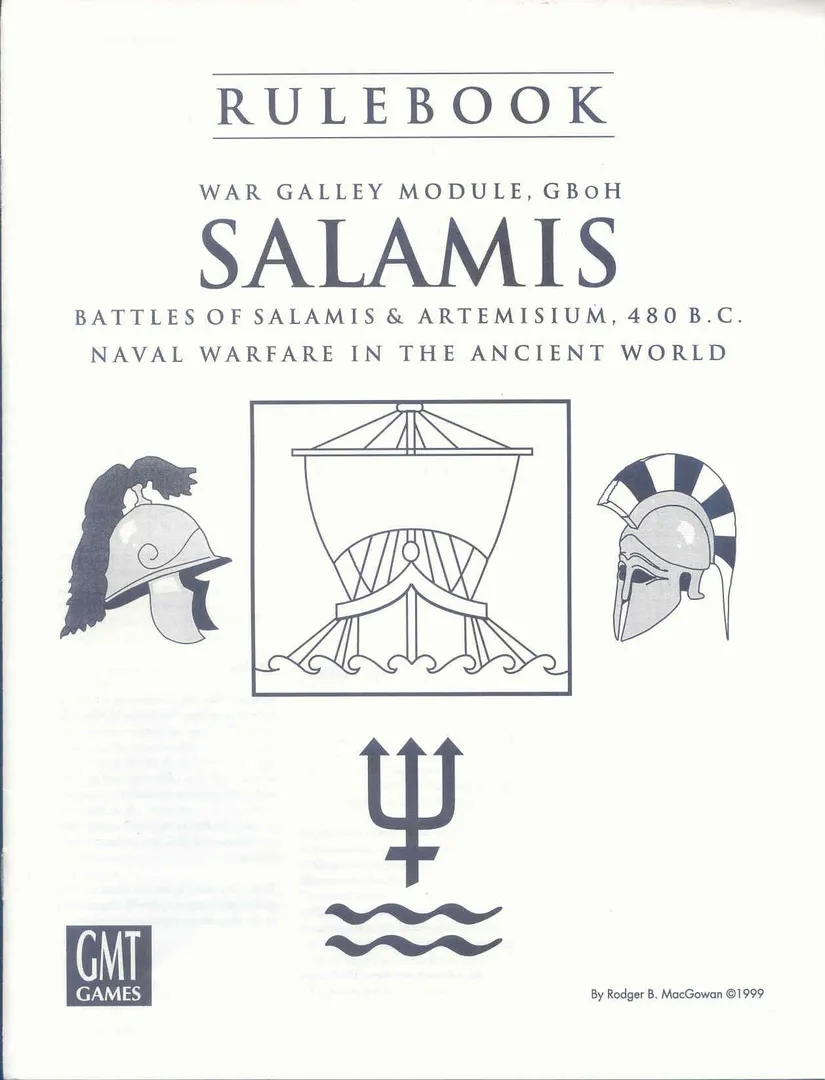
Salamis è un’espansione di War Galley: Naval Warfare in the Ancient World pubblicata nel 1999 per 2 giocatori, con partite da 360 minuti e dai 12 anni in su. È stato ideato da Richard H. Berg e Mark Herman e le sue meccaniche principali sono Hexagon Grid.









In inglese
Add-on module for War Galley: Naval Warfare in the Ancient World. Salamis, one of the most famous naval battles in history, was a direct result of the Persian need to keep their large, invading army supplied by controlling the sea lanes. With Xerxes' army temporarily delayed at Thermopylae, the Greek fleet, based at Artemisium, some 50 miles or so directly east of Thermopylae, took the opportunity to attempt to stop the Persians from extending this Line of Communications. In a battle that appears to have extended over two or three days, the Greeks managed to eke out a slim tactical win. However, when Thermopylae fell, Themistocles' position became untenable, and the Greek fleet retreated to anchorage in the narrow channel of the Bay of Eleusis, west of Athens, at Salamis. With her naval flanks secured, the Persians rolled into lower Greece, capturing Athens and razing the town. However, to complete his subjugation of Greece, Xerxes had to destroy their fleet. To that end, the Persians sailed to a position south of Salamis. At Artemisium the Greeks had learned that, while their crews and marines were superior, the huge disparity in numbers could be telling. Unless they could neutralize this Persian strength. To that end, Themistocles lured the huge Persian fleet to attack the Greeks in the Bay of Eleusis, whose entrances were so restrictive as to negate any numerical superiority. There were two entrances to the bay. To plug up the western escape hatch, Xerxes dispatched his crack Egyptian squadron. Upon hearing this, Adeimantus and his Corinthians peeled off from the main fleet and sailed to the western mouth to block any Egyptian attempt to gain entrance. This "action" appears to have been a stand off, with both sides "blockading" and not fighting. At the eastern entrance, the Greeks deployed in three lines, along a narrow front of about 1800 yards, thus negating Persian numerical superiority. The Persians entered the bay in three long lines astern, which they then turned into nine lines abreast. The result was a boarding battle, and this was where the Greeks shone. Despite having half the manpower per ship of the Persians, their weaponry, armor and land-based tactics were superior to that of the Persians. And that superiority resulted in a smashing Greek victory. Xerxes retired to Thessaly, to try again the next year. The result was a great Greek victory, on land, at Plataea, followed by the Greek victory that completely cut Persian Lines of Communication, at Mycale. (from GMT website)
Secondo il catalogo, Salamis supporta 2 giocatori. È il numero di giocatori indicato dall’editore, quindi il gioco è pensato esattamente per quel numero di partecipanti. Le varianti per gruppi di altre dimensioni, se esistono, sono descritte nel regolamento della tua edizione: consultalo prima di preparare una configurazione diversa.
La durata indicata per Salamis è di 360 minuti, la stima dell’editore per una partita completa. La durata effettiva dipende dal gruppo, dal numero di giocatori e dalla conoscenza delle regole: le prime partite durano di più, i gruppi esperti finiscono prima. Preparazione e spiegazione delle regole non sono comprese nella stima.
Il catalogo indica Salamis dai 12 anni in su. È la raccomandazione dell’editore e tiene conto della lettura richiesta, della complessità delle regole e dei componenti piccoli, non solo del tema. I più giovani spesso possono giocare con l’aiuto di un adulto: controlla l’età consigliata sulla tua edizione e l’esperienza del tuo gruppo con i giochi da tavolo.
Salamis ha un punteggio di complessità di 3,1 su 5 secondo i giocatori di BoardGameGeek, il che lo rende un gioco di media complessità. Il punteggio riflette quanta conoscenza delle regole, pianificazione e decisioni richiede una partita tipica. I giochi impegnativi richiedono una prima spiegazione più lunga, quindi conviene usare una guida di preparazione.
Salamis appartiene a queste categorie: Wargame, Nautical e Ancient. Le sue meccaniche principali sono Hexagon Grid. Le categorie descrivono il tema e l’ambientazione di un gioco, mentre le meccaniche descrivono ciò che i giocatori fanno davvero nel proprio turno. Ogni meccanica porta a una pagina del catalogo con giochi simili.
Gli autori accreditati di Salamis sono: Richard H. Berg e Mark Herman. Questi crediti provengono dai dati pubblicati del gioco e indicano le persone responsabili della sua progettazione, non gli illustratori o gli editori. Le pagine degli autori su MeepleRules raccolgono altri titoli degli stessi autori, utili quando un gioco ti piace e ne cerchi di simili.
Il catalogo classifica Salamis come espansione di War Galley: Naval Warfare in the Ancient World. Le espansioni aggiungono contenuti, regole o scenari al gioco base e di solito non si possono giocare da sole, quindi per usarla ti serve War Galley: Naval Warfare in the Ancient World. Controlla che la tua edizione di War Galley: Naval Warfare in the Ancient World sia compatibile, perché alcune espansioni sono state riviste tra un’edizione e l’altra.