
- Posizione BGG
- BGG #1899
- Valutazione BGG
- 7,7
Conflict of Heroes: Storms of Steel! – Kursk 1943
- 1–4 giocatori
- 120 min
- Complessità 3,1/5
- 2009

1979
Aiuto con le regole di Streets of Stalingrad
Spiegazioni chiare di turni, effetti delle carte e situazioni dubbie, con riferimenti alle fonti ufficiali e cronologia delle domande salvata.
Per 2 giocatori
Cosa vuoi sapere?
Le risposte vengono dal regolamento ufficiale, con la pagina da verificare.
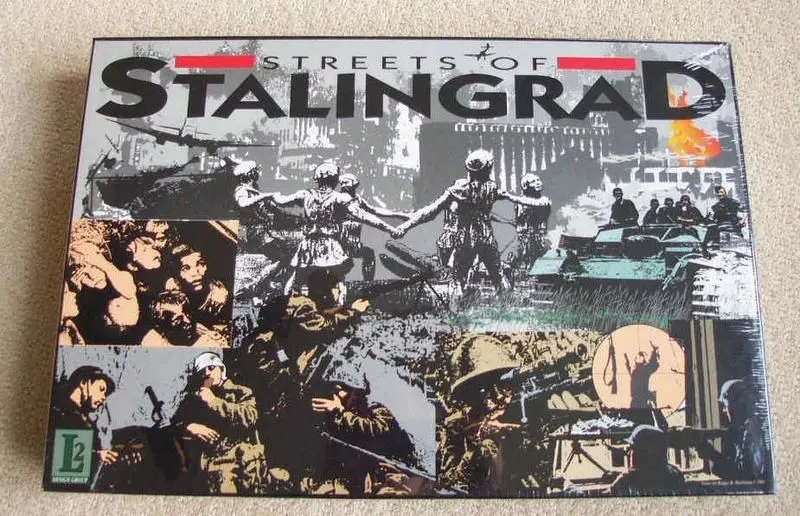
Streets of Stalingrad è un gioco da tavolo pubblicato nel 1979 per 2 giocatori, con partite da 180 minuti e dai 12 anni in su. È stato ideato da Dana Lombardy e David Parham e le sue meccaniche principali sono Dice Rolling e Hexagon Grid.





In inglese
"Streets of Stalingrad" is a World War 2 East Front wargame that models the fight for the city of Stalingrad, September-October, 1942, at the company level. It employs a scale of 300 meters per hex, with daily turns and 2160 counters. The two designers spent years researching the orders of battle and aerial maps to produce a game that is possibly the most researched and arguably the most accurate depiction of a battle, mechanics aside. The large, fairly thin but sturdy counters are the shades of the uniforms of the armies according to the designers. Instead of the usual American style designations on the counters to depict what type of unit it is, the designers used the actual designations used by the separate armies. This could be confusing except for the wonderful large player aids supplied with actual photos of the unit types. Labels and ziplock bag are even supplied for sorting purposes although sorting can be confusing. Moves mag put out an issue in the late '70's, early '80's with an article that fixed the problem. The 3 large maps are taken straight from aerial photos. You see the city block by block and outside the city individual buildings can even be seen. There is very little color on the maps but they are beautiful and very functional. The terrain effects chart once again has actual photos of the terrain so you can get an idea of exactly what the soldiers were facing. There are many scenarios available so you can tailor the game for time and room as some only use 1 map or a portion of a map. Each scenario has a separate set up sheet for both sides that are large enough to put all the counters on the sheets. Each scenario has a miniature version of the map to be used with set up information. For a monster game it is very easy to set up and get into a game. There are 3 rulebooks included, 2 basic game and 1 advanced game. When learning the game it is fantastic that they included a rulebook for each player. This is the kind of detail that is evident throughout the game. The rule books are detailed without being overbearing, as a lot of Avalon Hill's and SPI's were from the time period. They are chock full of examples to clear up ambiguities. The game is difficult because of the scale only. It is actually a fairly simple game, mechanics wise, and can be played by anyone with some wargame experience. This game shows that it has been designed to play, by wargamers, in every detail.
Secondo il catalogo, Streets of Stalingrad supporta 2 giocatori. È il numero di giocatori indicato dall’editore, quindi il gioco è pensato esattamente per quel numero di partecipanti. Le varianti per gruppi di altre dimensioni, se esistono, sono descritte nel regolamento della tua edizione: consultalo prima di preparare una configurazione diversa.
La durata indicata per Streets of Stalingrad è di 180 minuti, la stima dell’editore per una partita completa. La durata effettiva dipende dal gruppo, dal numero di giocatori e dalla conoscenza delle regole: le prime partite durano di più, i gruppi esperti finiscono prima. Preparazione e spiegazione delle regole non sono comprese nella stima.
Il catalogo indica Streets of Stalingrad dai 12 anni in su. È la raccomandazione dell’editore e tiene conto della lettura richiesta, della complessità delle regole e dei componenti piccoli, non solo del tema. I più giovani spesso possono giocare con l’aiuto di un adulto: controlla l’età consigliata sulla tua edizione e l’esperienza del tuo gruppo con i giochi da tavolo.
Streets of Stalingrad ha un punteggio di complessità di 4,3 su 5 secondo i giocatori di BoardGameGeek, il che lo rende un gioco impegnativo. Il punteggio riflette quanta conoscenza delle regole, pianificazione e decisioni richiede una partita tipica. I giochi impegnativi richiedono una prima spiegazione più lunga, quindi conviene usare una guida di preparazione.
Streets of Stalingrad appartiene a queste categorie: Wargame e World War II. Le sue meccaniche principali sono Dice Rolling e Hexagon Grid. Le categorie descrivono il tema e l’ambientazione di un gioco, mentre le meccaniche descrivono ciò che i giocatori fanno davvero nel proprio turno. Ogni meccanica porta a una pagina del catalogo con giochi simili.
Gli autori accreditati di Streets of Stalingrad sono: Dana Lombardy e David Parham. Questi crediti provengono dai dati pubblicati del gioco e indicano le persone responsabili della sua progettazione, non gli illustratori o gli editori. Le pagine degli autori su MeepleRules raccolgono altri titoli degli stessi autori, utili quando un gioco ti piace e ne cerchi di simili.
Il catalogo classifica Streets of Stalingrad come gioco base. Si gioca da solo con i componenti presenti nella scatola e non richiede altri titoli. Le espansioni, se esistono, aggiungono nuovo contenuto o nuove regole e sono elencate separatamente nel catalogo con un collegamento a questo gioco base.