

- Posizione BGG
- BGG #15.219
- Valutazione BGG
- 6,3
Highlander: The Card Game
- 2 giocatori
- 20 min
- Complessità 2,2/5
- 1996
1994
Aiuto con le regole di Towers in Time
Spiegazioni chiare di turni, effetti delle carte e situazioni dubbie, con riferimenti alle fonti ufficiali e cronologia delle domande salvata.
Per 2 giocatori
Cosa vuoi sapere?
Le risposte vengono dal regolamento ufficiale, con la pagina da verificare.
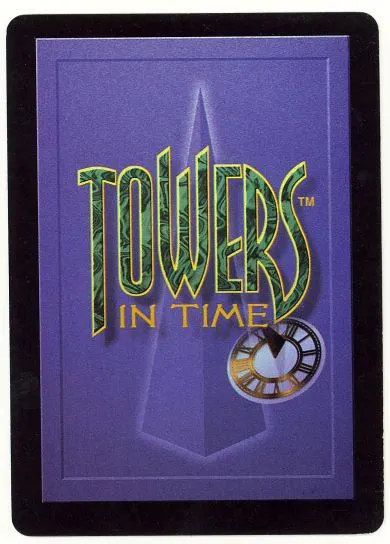
Towers in Time è un gioco da tavolo pubblicato nel 1994 per 2 giocatori, con partite da 30 minuti e dai 12 anni in su. È stato ideato da Mike Sager e le sue meccaniche principali sono Hand Management.

In inglese
From the box: In the beginning those that could master going between dimensions thought of it as novelty. There were worlds to discover, creatures to see and most importantly magic to master. But with all these things to keep them busy there was one thing they did not forget, Power. Soon it was easier to take from others than to find it on your own. The only place to hide was in great magical towers that they built between dimensions. All times in your world and in the others are at your disposal. Will you be the last to Reign in Towers in Time? Play overview: Each player represents a spellcaster, dueling with the other players for control of an abstractly defined extradimensional space. Each player has five shields, represented by cards from that player's deck, that serve to anchor the player the dimension within the game's story, and as the player's presence in the game mechanically. The goal is to eliminate the shields of all other players; when a player has no shields remaining, they are banished from the pocket dimension, and out of the game. Victory goes to the last player with shields in play. To combat one another, players play Source cards, representing connections to various natural locations, be they landforms, weather phenomena, or natural disasters. These resource cards allow the player to access Temper, the main resource in Towers in Time, themed to the four elements. Using Temper, players pay the costs to summon creatures to wage war, conjure magical objects and artifacts to enhance the effectiveness of recruited creatures, and cast spells to strengthen their minions and weaken the opposing armies. Additionally, once creatures are in play, most of them can provide Temper as well, although typically less than Source cards; most cards in Towers in Time are resource generators in addition to their other game effects. Source cards serve as the base for the titular Towers of Towers in Time. Each Source has a default file of three ranks atop it, each space of which can be occupied by creatures and the cards they carry. Creatures enter play within Towers, and must match the element represented by the Source atop which it stands (except for Neutral creatures, which may be played into any Tower). There are rules to determine which creatures can enter play in which locations within a Tower, but once in play, most creatures can move between Towers, taking attached cards with them when they move. Turns do not follow the turn format common to many contemporary CCGs. Instead, several phases are completed simultaneously by all players, then players alternate initiating and resolving a single action until both players have passed. Action resolution varies depending on their effect, with some actions initiating a separate resolution phase with its own actions and timing (such as combat) and others are single-step actions (such as playing a card). Additionally, a number of supplemental actions ("free" actions) facilitate utility functions, such as drawing Temper to pay for spells. The opportunity to act first during the action round is determined by the player who won initiative during game setup (for the first turn only), or the player who did not take the last pass action on the previous turn.
Secondo il catalogo, Towers in Time supporta 2 giocatori. È il numero di giocatori indicato dall’editore, quindi il gioco è pensato esattamente per quel numero di partecipanti. Le varianti per gruppi di altre dimensioni, se esistono, sono descritte nel regolamento della tua edizione: consultalo prima di preparare una configurazione diversa.
La durata indicata per Towers in Time è di 30 minuti, la stima dell’editore per una partita completa. La durata effettiva dipende dal gruppo, dal numero di giocatori e dalla conoscenza delle regole: le prime partite durano di più, i gruppi esperti finiscono prima. Preparazione e spiegazione delle regole non sono comprese nella stima.
Il catalogo indica Towers in Time dai 12 anni in su. È la raccomandazione dell’editore e tiene conto della lettura richiesta, della complessità delle regole e dei componenti piccoli, non solo del tema. I più giovani spesso possono giocare con l’aiuto di un adulto: controlla l’età consigliata sulla tua edizione e l’esperienza del tuo gruppo con i giochi da tavolo.
Towers in Time ha un punteggio di complessità di 2,3 su 5 secondo i giocatori di BoardGameGeek, il che lo rende un gioco piuttosto leggero. Il punteggio riflette quanta conoscenza delle regole, pianificazione e decisioni richiede una partita tipica. I giochi impegnativi richiedono una prima spiegazione più lunga, quindi conviene usare una guida di preparazione.
Towers in Time appartiene a queste categorie: Card Game, Fantasy e Collectible Components. Le sue meccaniche principali sono Hand Management. Le categorie descrivono il tema e l’ambientazione di un gioco, mentre le meccaniche descrivono ciò che i giocatori fanno davvero nel proprio turno. Ogni meccanica porta a una pagina del catalogo con giochi simili.
Gli autori accreditati di Towers in Time sono: Mike Sager. Questi crediti provengono dai dati pubblicati del gioco e indicano le persone responsabili della sua progettazione, non gli illustratori o gli editori. Le pagine degli autori su MeepleRules raccolgono altri titoli degli stessi autori, utili quando un gioco ti piace e ne cerchi di simili.
Il catalogo classifica Towers in Time come gioco base. Si gioca da solo con i componenti presenti nella scatola e non richiede altri titoli. Le espansioni, se esistono, aggiungono nuovo contenuto o nuove regole e sono elencate separatamente nel catalogo con un collegamento a questo gioco base.