
- Posizione BGG
- BGG #22.557
- Valutazione BGG
- 6,1
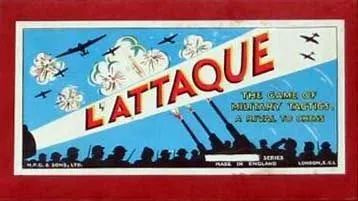
L'Attaque
- 2 giocatori
- 20 min
- Complessità 1,3/5
- 1909
1932
Aiuto con le regole di Tri-Tactics
Spiegazioni chiare di turni, effetti delle carte e situazioni dubbie, con riferimenti alle fonti ufficiali e cronologia delle domande salvata.
Per 2 giocatori
Cosa vuoi sapere?
Le risposte vengono dal regolamento ufficiale, con la pagina da verificare.
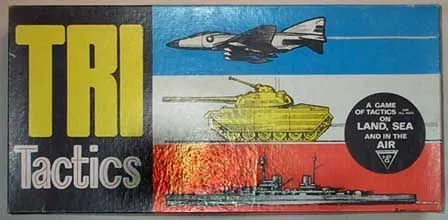
Tri-Tactics è un gioco da tavolo pubblicato nel 1932 per 2 giocatori, con partite da 240 minuti e dai 12 anni in su. È stato ideato da Hermance Edan e Harry Gibson e le sue meccaniche principali sono Secret Unit Deployment.

In inglese
Popular and intriguing military air, sea and ground forces tactics game TRI-TACTICS by Harry Gibson History: This board game was launched in 1935 by Gibsons aiming to provide an amalgamation of three other tactical board games: - L'Attaque (1909) - the U.K. rights were acquired by Gibsons in 1925. - Dover Patrol (1911) - Aviation: The Aerial Tactics Game of Attack and Defence (1925) All of these Gibsons games, marketed at the time as Series: The Big Four (Gibsons), predate Stratego (1942) by Jumbo which shares many similar aspects of play, but is now much more well known. Gameplay: The game is played on a special 12x12 board which illustrates land and sea spaces equally for each side, and each with two special squares, an HQ and a Lake containing a Naval Base. Two players, one RED, the other BLACK, command combined Navy, Airforce and Army forces, with a total of 112 prices, each player starting with 56, comprising the following: Infantry 5 Battalions - rank 1 4 Brigades - rank 2 3 Divisions - rank 3 2 Army Corps - rank 4 1 Army - rank 5 Artillery 5 Anti-Aircraft gun - rank AA 4 Field Artillery - rank FA 3 Heavy Artillery - rank HA Naval Force 4 Destoryers - rank 1 3 Cruisers - rank 2 2 Battleships - rank 3 1 Aircraft Carrier - rank 4 1 Submarine - rank SM 4 Flying Boats - rank FB Air Force 4 Reconnaissance Planes - rank 1 3 Bombers - rank 2 2 Two-Seat Fighters - rank 3 Auxiliary 8 Searchlights - rank SL At the beginning of game, these 56 pieces are placed by a player to occupy the first 5 rows of one side (but not on the HQ or Lake), with the other player doing likewise with their 56 on the opposite side’s 5 rows. This leaves two whole rows in the centre of the board empty, as well as the HQ, Lake, and 2 other squares between the two forces facing each other. All types and ranks of the pieces are hidden at the beginning of the game The object of the game is to occupy the opponent’s HQ with an Infantry piece, or the Lake with a Naval piece (not including the FB), which must approach via the river. The players draw lots to decide who commences play, by moving one piece, and thereafter play alternates between the players, by moving one piece per turn. All pieces can move one square at a time, forwards, backwards or sideways, with the exception of the Searchlight which can move multiple squares in a single direction (but only when attacking), as long as the squares are unoccupied. To attack, a player must move a piece adjacent to an opponent’s piece and announce ‘Attack’. They may choose not to, in which case they state ‘No Attack’. In that case, the opponent cannot on their turn attack that adjacent piece without first moving another of his pieces. The two adjacent pieces of each player are then revealed. The attacks are resolved by consulting the Value Table; as a general rule, the highest rank wins, but there are various combinations that apply, particularly when comparing land, sea and air pieces on land, sea or over a coastline. If successful, the attacker remains where they are, and the defender’s square becomes empty as the defender’s piece is removed. If the attacker loses, their piece is removed, and the defender’s piece remains where it is. If the pieces are the same rank, both are removed. It is allowed to place Land pieces on the sea and Naval pieces on the land, but with the risk that when attacked, any such piece found to be operating ‘out of their element’ will immediately forfeit and removed. Excluded from this rule is the FB as well as all Air Force pieces and the Searchlights. The River is a special area which is classified as Land or Sea depending on which piece is occupying it. When a Naval piece does so, the square is designated Sea, and when a Land price occupies it, then it is classified as Land. On the rest of the board, where land and sea meet, then the spaces are classified as Sea or Land depending on which is in the majority. The coastline in each case separates these defined areas of Land and Sea. Should there be an attack between a Ship and a Land piece over a coastline, the attacker is forfeit, except for HA and AA when the ordinary ruling applies. Also, Bombers and FB destroy Infantry and FA. The HQ and Lake must not be occupied but a piece may be move over these squares in consecutive turns or else be forfeit. Only Ships (not FB) may attack and capture the Lake, and to do so must move up the River (it cannot capture the Lake by entering via Land, or then it must exit via the river to sea); in doing so, in this special case it captures all Land pieces in attacks, except HA. Similarly, only Infantary pieces (not Artillery) may attack and capture the HQ. Similar to: L'Attaque Dover Patrol Aviation: The Aerial Tactics Game of Attack and Defence Stratego
Secondo il catalogo, Tri-Tactics supporta 2 giocatori. È il numero di giocatori indicato dall’editore, quindi il gioco è pensato esattamente per quel numero di partecipanti. Le varianti per gruppi di altre dimensioni, se esistono, sono descritte nel regolamento della tua edizione: consultalo prima di preparare una configurazione diversa.
La durata indicata per Tri-Tactics è di 240 minuti, la stima dell’editore per una partita completa. La durata effettiva dipende dal gruppo, dal numero di giocatori e dalla conoscenza delle regole: le prime partite durano di più, i gruppi esperti finiscono prima. Preparazione e spiegazione delle regole non sono comprese nella stima.
Il catalogo indica Tri-Tactics dai 12 anni in su. È la raccomandazione dell’editore e tiene conto della lettura richiesta, della complessità delle regole e dei componenti piccoli, non solo del tema. I più giovani spesso possono giocare con l’aiuto di un adulto: controlla l’età consigliata sulla tua edizione e l’esperienza del tuo gruppo con i giochi da tavolo.
Tri-Tactics ha un punteggio di complessità di 2,5 su 5 secondo i giocatori di BoardGameGeek, il che lo rende un gioco piuttosto leggero. Il punteggio riflette quanta conoscenza delle regole, pianificazione e decisioni richiede una partita tipica. I giochi impegnativi richiedono una prima spiegazione più lunga, quindi conviene usare una guida di preparazione.
Tri-Tactics appartiene a queste categorie: Wargame e World War II. Le sue meccaniche principali sono Secret Unit Deployment. Le categorie descrivono il tema e l’ambientazione di un gioco, mentre le meccaniche descrivono ciò che i giocatori fanno davvero nel proprio turno. Ogni meccanica porta a una pagina del catalogo con giochi simili.
Gli autori accreditati di Tri-Tactics sono: Hermance Edan e Harry Gibson. Questi crediti provengono dai dati pubblicati del gioco e indicano le persone responsabili della sua progettazione, non gli illustratori o gli editori. Le pagine degli autori su MeepleRules raccolgono altri titoli degli stessi autori, utili quando un gioco ti piace e ne cerchi di simili.
Il catalogo classifica Tri-Tactics come gioco base. Si gioca da solo con i componenti presenti nella scatola e non richiede altri titoli. Le espansioni, se esistono, aggiungono nuovo contenuto o nuove regole e sono elencate separatamente nel catalogo con un collegamento a questo gioco base.