
- Pozycja w BGG
- BGG #11 383
- Ocena BGG
- 7,1
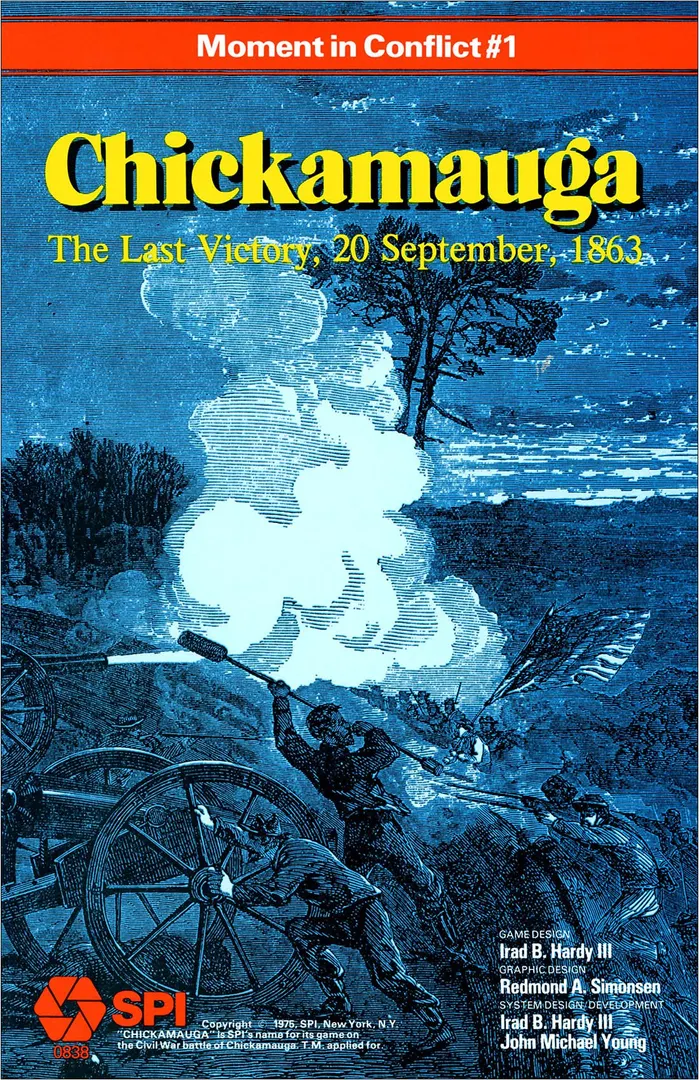
Chickamauga: The Last Victory, 20 September 1863
- 2 graczy
- 120 min
- Złożoność 2,1/5
- 1975
1977
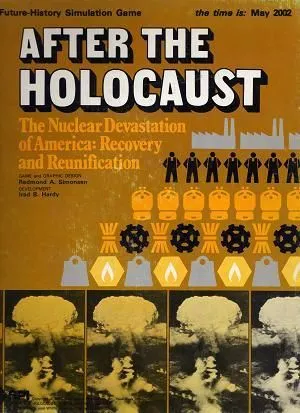
Pomoc w zasadach gry After the Holocaust: The Nuclear Devastation of America – Recovery and Reunification
Zrozumiałe wyjaśnienia tur, efektów kart i spornych sytuacji z odnośnikami do oficjalnych źródeł i zapisaną historią pytań.
Dla 3 graczy
Co chcesz wiedzieć?
Odpowiedzi pochodzą z oficjalnej instrukcji, ze stroną do sprawdzenia.
After the Holocaust: The Nuclear Devastation of America – Recovery and Reunification to gra planszowa wydana w 1977 roku dla 3–5 graczy, z rozgrywką trwającą 180 minut i dla osób od 12 lat. Projekt gry: Redmond Aksel Simonsen i Irad B. Hardy. Główne mechaniki: Hexagon Grid i Worker Placement.


Po angielsku
After the Holocaust is an economic, military, and political simulation of events in the United States, twenty years after a large-scale thermonuclear exchange with the Soviet Union. The game is ten turns long, and is designed for four players, each of whom controls a different region of North America and part of Canada. These regions are the Northeast, the Midwest, the Southwest, and the Far West. It is reminsicent of the works of Stafford Beer and Proyecto Synco. Each game turn consists of five distinct rounds. The first is the Production Round, which includes a basic production phase, a secondary production phase, and a mobilization phase. Second is the Trade Round. Third is the Consumption Round, during which a player expends food points, expends consumer points, calculates and declares social status, and provides military supply for any combat units under his control. Fourth is the Military/Political Round, which begins with the political placement phase, followed by initial military movement, secondary military movement, combat, and elections. The fifth and last round of the game turn is the Finance Round, which includes the political disassociation phase, the stockpile/labour reallocation phase, industrial investment phase, taxation, the industrial capacity adjustment phase, the industrial labour reallocation phase, and finally, the depreciation and shrinkage phase. In addition, immediately before the fourth and eighth game turns, the Population Growth Cycle occurs during which the labour population of each region increases by 10%. Inside the Box: Two 17” x 22” hard-backed hexagonal grid Map Boards (with Turn Record Track, Terrain Key, Four Regional Sets of Six Economic Sector Tracks, and Abbreviated Turn Sequence incorporated) 400 ½” cardboard Counters One 8½” x 11” Rules Booklet (with Scenario Instructions included) Four 11” x 17” back-printed, folded combined Charts and Tables Sheets (each with an Initial Resources Chart, Food Table, Secondary Production Costs Table, Trade Transport Movement Point Cost Chart, Strike Table, Political Control Table, Subversion Table, Terrain Effects Chart, Combat Results Table, Unemployment Table, Starvation Table, Stockpiling Cost Chart, Investment Chart, Corruption Table, Depreciation Table, Shrinkage Table, Research and Development Table, Tax Table, and photocopy masters for Tax Forms Eight 8½” x 11” perforated, back-printed sheets of Game Money (144 pieces) Two small six-sided Dice One 20 compartment plastic counter tray
Według katalogu After the Holocaust: The Nuclear Devastation of America – Recovery and Reunification obsługuje od 3 do 5 graczy. Ten zakres odpowiada liczbie graczy podanej przez wydawcę, więc grę można przygotować dla dowolnej grupy w jego granicach. Przygotowanie, niektóre zasady i punktacja mogą jednak różnić się w zależności od liczby graczy; dokładną konfigurację sprawdź w instrukcji swojego wydania.
Podany czas rozgrywki w After the Holocaust: The Nuclear Devastation of America – Recovery and Reunification wynosi 180 minut. To szacunek wydawcy dla pełnej partii. Rzeczywisty czas zależy od grupy, liczby graczy i znajomości zasad: pierwsze partie zwykle trwają dłużej, a doświadczone grupy kończą szybciej. Przygotowanie gry i tłumaczenie zasad nie są wliczone w ten szacunek.
Katalog podaje dla After the Holocaust: The Nuclear Devastation of America – Recovery and Reunification wiek od 12 lat. To zalecenie wydawcy, które uwzględnia wymagania dotyczące czytania, złożoność zasad i drobne elementy, a nie tylko tematykę. Młodsi gracze często mogą dołączyć z pomocą dorosłego; sprawdź zalecenie wiekowe swojego wydania i weź pod uwagę doświadczenie grupy z grami planszowymi.
After the Holocaust: The Nuclear Devastation of America – Recovery and Reunification ma ocenę złożoności 4,0 na 5 według graczy BoardGameGeek, co czyni ją grą ciężką. Ocena pokazuje, ile znajomości zasad, planowania i podejmowania decyzji wymaga typowa rozgrywka. Cięższe gry wymagają dłuższego pierwszego tłumaczenia, dlatego przed wieczorem z grami warto skorzystać z przewodnika przygotowania.
After the Holocaust: The Nuclear Devastation of America – Recovery and Reunification należy do tych kategorii: Economic i Negotiation. Główne mechaniki to Hexagon Grid i Worker Placement. Kategorie opisują temat i świat gry, a mechaniki to, co gracze faktycznie robią w swojej turze. Każda mechanika prowadzi do strony katalogu z podobnymi grami, co pomaga znaleźć coś porównywalnego na kolejny wieczór.
Autorzy wymienieni przy After the Holocaust: The Nuclear Devastation of America – Recovery and Reunification to: Redmond Aksel Simonsen i Irad B. Hardy. Te informacje pochodzą z opublikowanych danych gry i wskazują osoby odpowiedzialne za jej projekt, a nie ilustratorów czy wydawców. Strony autorów w MeepleRules zbierają inne tytuły tych samych twórców, co pomaga, gdy gra ci się podoba i szukasz podobnych.
W katalogu After the Holocaust: The Nuclear Devastation of America – Recovery and Reunification figuruje jako gra podstawowa. Można w nią grać samodzielnie, korzystając z elementów z pudełka, bez żadnego innego tytułu. Dodatki, jeśli istnieją, dokładają nową zawartość lub zasady i są wymienione w katalogu osobno, z odnośnikiem do tej gry podstawowej.