
- Pozycja w BGG
- BGG #10 978
- Ocena BGG
- 6,3
Talat
- 2–3 graczy
- 33 min
- Złożoność 2,0/5
- 2008
1968
Pomoc w zasadach gry Djambi
Zrozumiałe wyjaśnienia tur, efektów kart i spornych sytuacji z odnośnikami do oficjalnych źródeł i zapisaną historią pytań.
Dla 3 graczy
Co chcesz wiedzieć?
Odpowiedzi pochodzą z oficjalnej instrukcji, ze stroną do sprawdzenia.
Djambi to gra planszowa wydana w 1968 roku dla 3–4 graczy i z rozgrywką trwającą 60 minut. Projekt gry: Jean Anesto. Główne mechaniki: Square Grid, Grid Movement i Pattern Movement.




Po angielsku
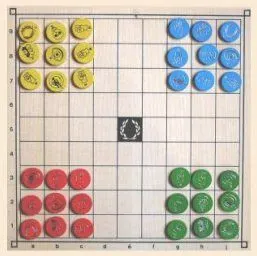
Djambi, or Chess of Machiavelli is a game for 4 players that can be played with only 3. There also exists a 5-player version called Pentachiavel. It is a game of treason. Each player is the leader of a political party composed of 9 pieces: 1 Leader 1 Journalist 1 Assassin 1 Provoker 1 Necromobile 4 Activists who roam a 9x9square board where all squares are the same except the central one, called The Labyrinth. All counters move as the Queen in Chess, except the Activist who moves the same but only for two squares. A piece cannot move through another piece, whether alive or dead. Object of the game: gaining absolute power, that is killing all other leaders. "To do this, all players have the weapons of the actual politics: manipulation, provocation, activism, recuperation, scandal and political crime. The course to power is not a gala dinner, so all pieces can be physically eliminated. In politics, a dead is as encumbrant as a living person, so all dead pieces are kept on the board, face down." Dead pieces have no color. The Labyrinth is the basement of the Legal Power, the road to Absolute Power. Only a Leader may stay on this square. It makes its parti play after each opponent. But there, it can be killed by nearly all other pieces. The Leader: can kill any piece on the board by taking its place. The taken piece is placed on any other adjacent free square of the board, dead. The Journalist kills a piece that is adjacent to any one of the 4 squares that share a common border with its square. It does this just after having moved. The body lies dead where it was killed. He must move at least one square before killing. The Assassin, can kill any piece by taking its place. The piece is placed, dead on the place the Assassin was before moving. The Provoker, mover of the living: can move any living piece if it takes its position. The taken piece is placed on any other free square of the board, alive. The Necromobile, mover of the dead: can move any dead piece if it takes its position. The taken piece is placed on any other free square of the board, dead. The Activists can kill a piece by taking its place. The taken piece is placed on any other free square of the board, dead. They CAN'T kill a leader in The Labyrinth. These are most of the rules. You can find the rest (in French, sorry) at the link below.
Według katalogu Djambi obsługuje od 3 do 4 graczy. Ten zakres odpowiada liczbie graczy podanej przez wydawcę, więc grę można przygotować dla dowolnej grupy w jego granicach. Przygotowanie, niektóre zasady i punktacja mogą jednak różnić się w zależności od liczby graczy; dokładną konfigurację sprawdź w instrukcji swojego wydania.
Podany czas rozgrywki w Djambi wynosi 60 minut. To szacunek wydawcy dla pełnej partii. Rzeczywisty czas zależy od grupy, liczby graczy i znajomości zasad: pierwsze partie zwykle trwają dłużej, a doświadczone grupy kończą szybciej. Przygotowanie gry i tłumaczenie zasad nie są wliczone w ten szacunek.
Djambi ma ocenę złożoności 2,6 na 5 według graczy BoardGameGeek, co czyni ją grą raczej lekką. Ocena pokazuje, ile znajomości zasad, planowania i podejmowania decyzji wymaga typowa rozgrywka. Cięższe gry wymagają dłuższego pierwszego tłumaczenia, dlatego przed wieczorem z grami warto skorzystać z przewodnika przygotowania.
Djambi należy do tych kategorii: Abstract Strategy, Political i Negotiation. Główne mechaniki to Square Grid, Grid Movement i Pattern Movement. Kategorie opisują temat i świat gry, a mechaniki to, co gracze faktycznie robią w swojej turze. Każda mechanika prowadzi do strony katalogu z podobnymi grami, co pomaga znaleźć coś porównywalnego na kolejny wieczór.
Autorzy wymienieni przy Djambi to: Jean Anesto. Te informacje pochodzą z opublikowanych danych gry i wskazują osoby odpowiedzialne za jej projekt, a nie ilustratorów czy wydawców. Strony autorów w MeepleRules zbierają inne tytuły tych samych twórców, co pomaga, gdy gra ci się podoba i szukasz podobnych.
W katalogu Djambi figuruje jako gra podstawowa. Można w nią grać samodzielnie, korzystając z elementów z pudełka, bez żadnego innego tytułu. Dodatki, jeśli istnieją, dokładają nową zawartość lub zasady i są wymienione w katalogu osobno, z odnośnikiem do tej gry podstawowej.