
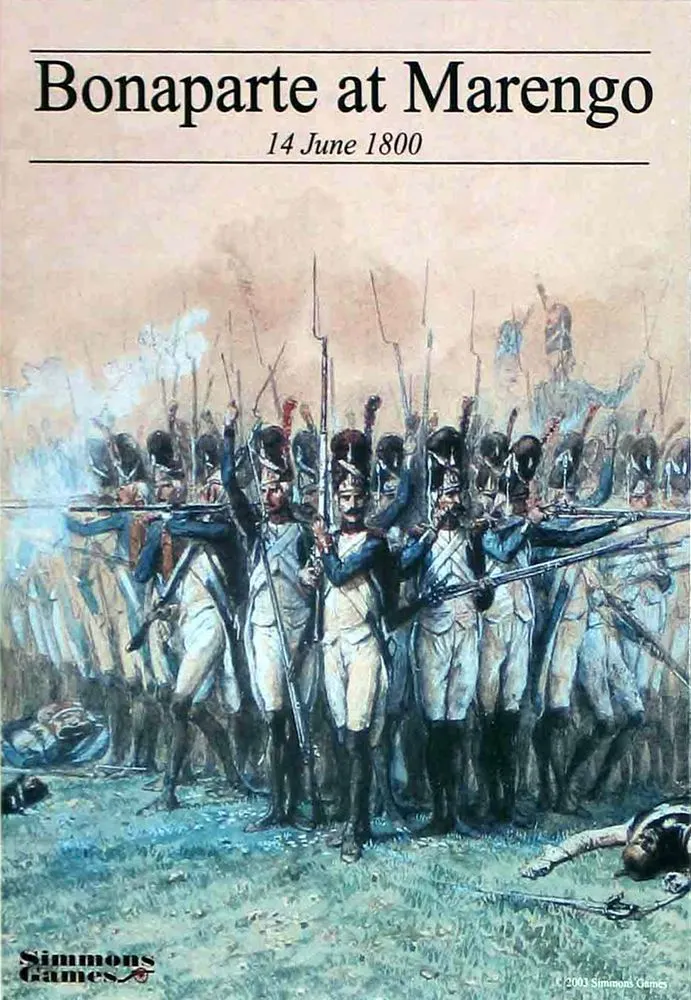
- Pozycja w BGG
- BGG #3170
- Ocena BGG
- 7,4
Bonaparte at Marengo
- 2 graczy
- 120 min
- Złożoność 3,2/5
- 2003
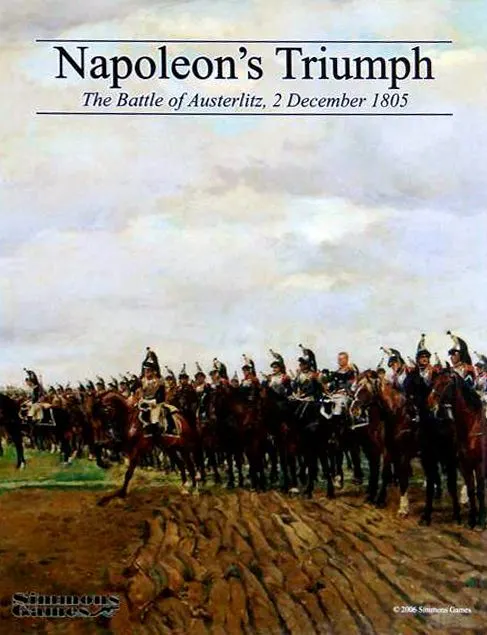
2007
Pomoc w zasadach gry Napoleon's Triumph: The Battle of Austerlitz, 2 December 1805
Zrozumiałe wyjaśnienia tur, efektów kart i spornych sytuacji z odnośnikami do oficjalnych źródeł i zapisaną historią pytań.
Dla 2 graczy
Co chcesz wiedzieć?
Odpowiedzi pochodzą z oficjalnej instrukcji, ze stroną do sprawdzenia.
Napoleon's Triumph: The Battle of Austerlitz, 2 December 1805 to gra planszowa wydana w 2007 roku dla 2 graczy, z rozgrywką trwającą 180 minut i dla osób od 12 lat. Projekt gry: Bowen Simmons. Główne mechaniki: Area Movement, Secret Unit Deployment i Simulation.


Po angielsku
(From the publisher) Napoleon’s Triumph is built on the same foundations as its acclaimed predecessor, Bonaparte at Marengo, but is bigger and grander in scale. It uses two boards to make a double-size 44" x 34" map of the Austerlitz battlefield and has twice as many pieces as the earlier game, but defying the tradition that big wargames must also take a long time to play, Napoleon’s Triumph can be played from start to finish in a single evening. From Back of Box On December 2, 1805, on the battlefield of Austerlitz, an outnumbered French army led by their newly crowned emperor, Napoleon, waited to receive an expected attack by a Russian and Austrian army commanded by the Russian Czar, Alexander. Napoleon lured the Allies into attacking with their left wing, and when the Allies did so, a surprise French counter-attack smashed the Allied right and centre, and then surrounded and destroyed the Allied left in one of the most famous and decisive battles in military history. Napoleon's Triumph re-creates that historic battle. Befitting its epic subject, Napoleon's Triumph is played on a double-sized 44" x34" map of the battlefield. In spite of the game's size, it is easy to learn and fast to play. The rules are only nine pages long, and the playing time is only two hours. Napoleon's Triumph is unique among big wargames in that players can learn the game, set it up, and play it to completion in a single evening. The game system is derived from its award-winning forebear, Bonaparte at Marengo. Like that game, Napoleon's Triumph breaks with almost all of the standard wargame conventions. It has no hex grid and terrain effects chart; terrain effects are designed into the map itself. It has no combat results table; combat is resolved through strength differential. It has no dice; tension comes from limited information and the outcome only depends on the players' decisions. Napoleon's Triumph is a unique wargame experience. It is large, yet fast-playing. It has simple rules, but deep game play that rewards both boldness of conception and attention to detail. It stays close enough to history to engross wargamers and other students of the period, while still being entertaining enough for even non-wargamers to enjoy. Napoleon's Triumph is not only easy to learn and fast and exciting to play, it also is a great looking game due to its exceptional component quality. The map is mounted on a heavy board cut in the German style so that the playing surface is durable, stable, and flat, without the valleys of American-style mounted boards or the buckling of paper boards. To represent opposing armies, the game comes with 140 wooden blocks, blue for the French and red for the Allies. Painted on each block are symbols that identify the type and strengths of the unit. The senior commanders of the opposing armies are represented by 18 metal flags; stickers are applied to mark the nationality and name of each commander. In play, Napoleon's Triumph combines the visual appeal of 19th century battle maps and military minatures, with columns and rows of units lined for movement and attack, accented by flags to indicate corps. The effect is simply stunning.
Według katalogu Napoleon's Triumph: The Battle of Austerlitz, 2 December 1805 obsługuje 2 graczy. To liczba graczy podana przez wydawcę, więc gra jest zaprojektowana dokładnie dla takiej liczby uczestników. Warianty dla grup innej wielkości, jeśli w ogóle istnieją, opisano w instrukcji twojego wydania; sprawdź ją uważnie, zanim przygotujesz inną konfigurację stołu.
Podany czas rozgrywki w Napoleon's Triumph: The Battle of Austerlitz, 2 December 1805 wynosi 180 minut. To szacunek wydawcy dla pełnej partii. Rzeczywisty czas zależy od grupy, liczby graczy i znajomości zasad: pierwsze partie zwykle trwają dłużej, a doświadczone grupy kończą szybciej. Przygotowanie gry i tłumaczenie zasad nie są wliczone w ten szacunek.
Katalog podaje dla Napoleon's Triumph: The Battle of Austerlitz, 2 December 1805 wiek od 12 lat. To zalecenie wydawcy, które uwzględnia wymagania dotyczące czytania, złożoność zasad i drobne elementy, a nie tylko tematykę. Młodsi gracze często mogą dołączyć z pomocą dorosłego; sprawdź zalecenie wiekowe swojego wydania i weź pod uwagę doświadczenie grupy z grami planszowymi.
Napoleon's Triumph: The Battle of Austerlitz, 2 December 1805 ma ocenę złożoności 3,7 na 5 według graczy BoardGameGeek, co czyni ją grą średnio złożoną. Ocena pokazuje, ile znajomości zasad, planowania i podejmowania decyzji wymaga typowa rozgrywka. Cięższe gry wymagają dłuższego pierwszego tłumaczenia, dlatego przed wieczorem z grami warto skorzystać z przewodnika przygotowania.
Napoleon's Triumph: The Battle of Austerlitz, 2 December 1805 należy do tych kategorii: Wargame i Napoleonic. Główne mechaniki to Area Movement, Secret Unit Deployment i Simulation. Kategorie opisują temat i świat gry, a mechaniki to, co gracze faktycznie robią w swojej turze. Każda mechanika prowadzi do strony katalogu z podobnymi grami, co pomaga znaleźć coś porównywalnego na kolejny wieczór.
Autorzy wymienieni przy Napoleon's Triumph: The Battle of Austerlitz, 2 December 1805 to: Bowen Simmons. Te informacje pochodzą z opublikowanych danych gry i wskazują osoby odpowiedzialne za jej projekt, a nie ilustratorów czy wydawców. Strony autorów w MeepleRules zbierają inne tytuły tych samych twórców, co pomaga, gdy gra ci się podoba i szukasz podobnych.
W katalogu Napoleon's Triumph: The Battle of Austerlitz, 2 December 1805 figuruje jako gra podstawowa. Można w nią grać samodzielnie, korzystając z elementów z pudełka, bez żadnego innego tytułu. Dodatki, jeśli istnieją, dokładają nową zawartość lub zasady i są wymienione w katalogu osobno, z odnośnikiem do tej gry podstawowej.