

- Pozycja w BGG
- BGG #2265
- Ocena BGG
- 7,3
Set & Match
- 2–4 graczy
- 15–30 min
- Złożoność 1,2/5
- 2017
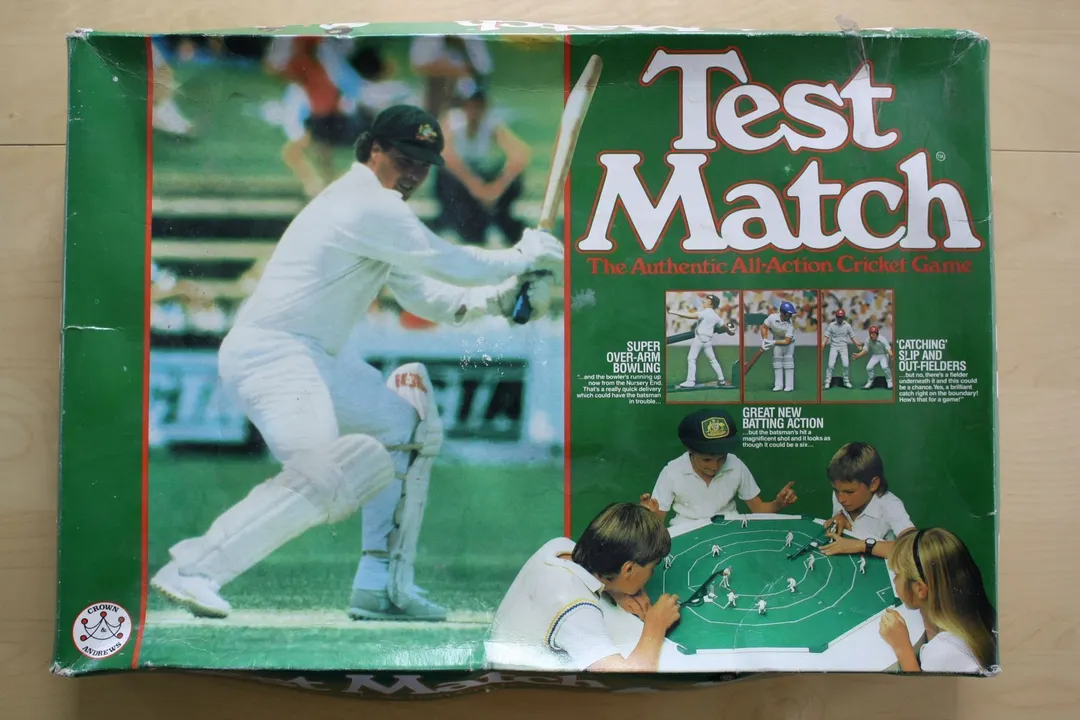
1977
Pomoc w zasadach gry Test Match
Zrozumiałe wyjaśnienia tur, efektów kart i spornych sytuacji z odnośnikami do oficjalnych źródeł i zapisaną historią pytań.
Dla 2 graczy
Co chcesz wiedzieć?
Odpowiedzi pochodzą z oficjalnej instrukcji, ze stroną do sprawdzenia.
Test Match to gra planszowa wydana w 1977 roku dla 2 graczy i z rozgrywką trwającą 90 minut. Główne mechaniki: Simulation.



Po angielsku
Players play out a live-action cricket game with miniature figures on a fabric playing field. One player 'bowls' a small ball from a bowler while the other player operates the batsman. Fielders are placed throughout the board to 'catch' the ball in the base between their feet. A classic and beloved family game originally released in 1977 and immensely popular in the UK, Australia, India and South Africa in particular. The game has undergone a number of changes and additions over the years, but basically layout and game play has stayed the same. In some versions, the Bowler figure has a long tilting 'chute' that the ball rolls down after pushing on the bowlers arm. In others the figure is spring loaded and pressing a lever makes the figure 'throw' the ball, with a setting for fast or slow bowling. The balls themselves have changed from small metal ball bearings to two sizes/weights - for both variety in play and for easier game play for younger players. The Batsman figure in some editions has a string with which you pull back the bat to release it to hit the ball, others have a slide mechanism and some have a trigger mechanism to move the bat. The fielding player figures are a variety of colours in different versions and may be white, yellow or blue. Additionally in a couple of versions (like Super Cricket) they had magnetic bases to further help 'field' the ball. The player figures in one version (One Day Cricket) came entirely unpainted and could be painted the colours of your favourite teams. Later editions include an actual Wicket Keeper figure rather than a 'W' shape part of the batter mechanism. The playing 'field' also has changed shape and fabric. In some editions it is very thin light fabric (and in older games, the flocking on the underside completely disintegrates and moults off!) in others it is thicker, crease resistant neoprene. The boundary 'fence' is either white L shaped angled plastic flat or picket shaped strips with green joiner pieces or in more recent versions, a simple rope length. In the different versions players can simulate a one-day international, a Twenty/20 series or a full five-day test match. As well as being featured on box graphics, some well known cricket players have even lent their names to some versions, like Freddie Truman, Mike Atherton, AB De Villiers & Jonty Rhodes. It is very difficult to date many of the earlier games accurately as there are no dates on the boxes (very annoying). The date '1977' on the included rule sheet ACTUALLY refers to the copyright date of the ORIGINAL games release by Peter Pan Playthings and NOT that particular versions release. Guesstimates can be made by the box imagery, design and playing piece inclusions. World Cup Cricket is touted as "The original action-packed table-top cricket game!" for Ages 4 and up. In the box (decorated with action shots of late 80s / early 90s players including Alec Stewart and Jack Russell) comes with a green baize playing area which is laid out on a table, with six boundary fence sections which Velcro around the edge to act as the boundary and prevent the ball flying off around the room. The batsman attached at one end and the bowler to the other. The pitch (although octagonal) resembles an archery target -the closer to the boundary and further from the batsmen, the higher the ring value. Directly in front of the batsmen is an area worth no runs, outside of that 1 run, then a ring worth 2 runs and the outer area worth 3 runs. Hitting the fence gets 4 runs and there are four small areas jutting out of the boundary worth 6 runs. The bowling player places fielders (with a catching 'cup' between their legs) around the field in an attempt to 'catch' the batsman out. Bowling is achieved by loading the ball into the bowler's cupped hand and pushing down on the front arm, causing the ball to roll down a ramp towards the batsman. The batsman is controlled with cord attached to the bat. The batting player pulls back the cord, releasing it in time to hit the approaching ball. Whichever area the ball is hit to is the number of runs the player gets. Batsmen can be out by being caught by the bowler, by hitting the ball between the legs of the fielders into their 'cups', by the ball hitting the stumps behind the batsmen or by the batsman edging the ball into the "wicket keeper" which is attached to the batting stand. There are earlier versions of the game where the batting action is different and the players less detailed.
Według katalogu Test Match obsługuje 2 graczy. To liczba graczy podana przez wydawcę, więc gra jest zaprojektowana dokładnie dla takiej liczby uczestników. Warianty dla grup innej wielkości, jeśli w ogóle istnieją, opisano w instrukcji twojego wydania; sprawdź ją uważnie, zanim przygotujesz inną konfigurację stołu.
Podany czas rozgrywki w Test Match wynosi 90 minut. To szacunek wydawcy dla pełnej partii. Rzeczywisty czas zależy od grupy, liczby graczy i znajomości zasad: pierwsze partie zwykle trwają dłużej, a doświadczone grupy kończą szybciej. Przygotowanie gry i tłumaczenie zasad nie są wliczone w ten szacunek.
Test Match ma ocenę złożoności 1,0 na 5 według graczy BoardGameGeek, co czyni ją grą lekką. Ocena pokazuje, ile znajomości zasad, planowania i podejmowania decyzji wymaga typowa rozgrywka. Cięższe gry wymagają dłuższego pierwszego tłumaczenia, dlatego przed wieczorem z grami warto skorzystać z przewodnika przygotowania.
Test Match należy do tych kategorii: Children's Game, Action / Dexterity i Sports. Główne mechaniki to Simulation. Kategorie opisują temat i świat gry, a mechaniki to, co gracze faktycznie robią w swojej turze. Każda mechanika prowadzi do strony katalogu z podobnymi grami, co pomaga znaleźć coś porównywalnego na kolejny wieczór.
W katalogu Test Match figuruje jako gra podstawowa. Można w nią grać samodzielnie, korzystając z elementów z pudełka, bez żadnego innego tytułu. Dodatki, jeśli istnieją, dokładają nową zawartość lub zasady i są wymienione w katalogu osobno, z odnośnikiem do tej gry podstawowej.