

- Pozycja w BGG
- BGG #1423
- Ocena BGG
- 7,5
Ambush!
- 1 gracz
- 180–240 min
- Złożoność 3,3/5
- 1983
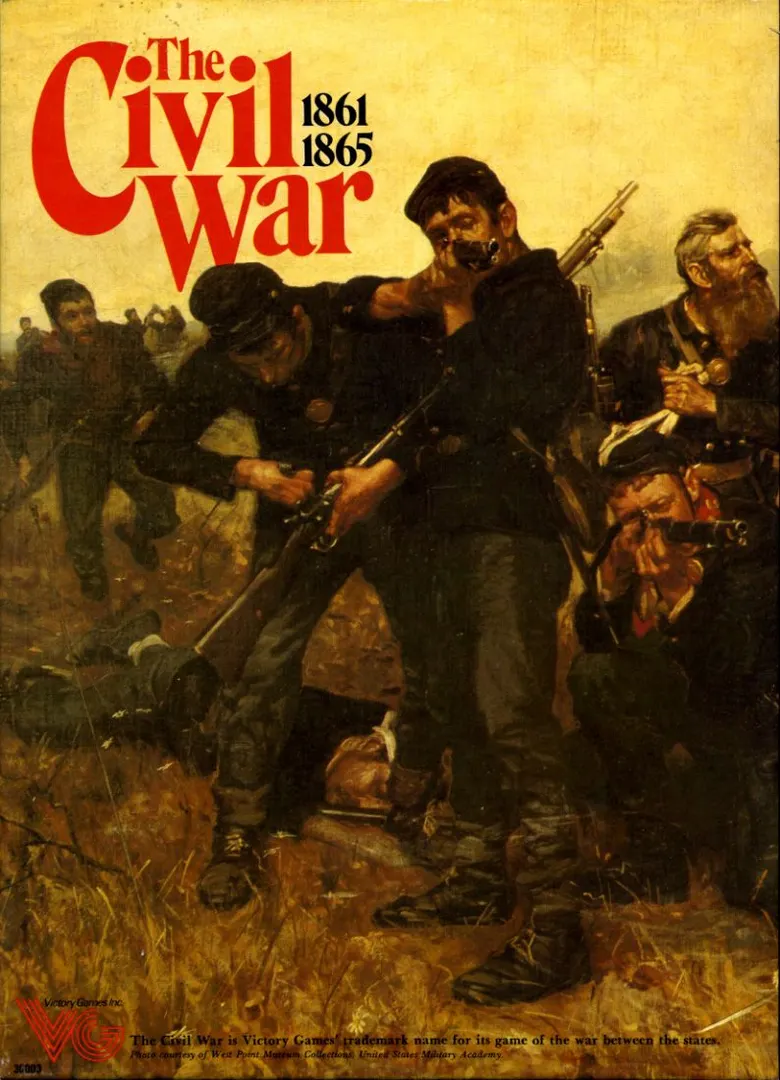
1983
Pomoc w zasadach gry The Civil War 1861-1865
Zrozumiałe wyjaśnienia tur, efektów kart i spornych sytuacji z odnośnikami do oficjalnych źródeł i zapisaną historią pytań.
Dla 1 gracza
Co chcesz wiedzieć?
Odpowiedzi pochodzą z oficjalnej instrukcji, ze stroną do sprawdzenia.
The Civil War 1861-1865 to gra planszowa wydana w 1983 roku dla 1–2 graczy, z rozgrywką trwającą 120–1200 minut i dla osób od 12 lat. Projekt gry: Eric Lee Smith. Główne mechaniki: Dice Rolling, Variable Set-up i Grid Movement.






Po angielsku
This sprawling rendition of the American Civil War tries to fit in everything, from Grant and Lee down to Indian raids in the Western territories. It also includes the most extensive treatment of naval and riverine warfare of any strategic Civil War game. The map covers the theater of the war from the Eastern seaboard to the middle of Texas at 25 miles per hex. An optional second map extends to New Mexico. There are five turns per year, four of two months each and a four-month Winter turn. Each turn consists of an indefinite number of "pulses" and may last a long, long time. Troops are represented by generic Strength Points (about 5,000 men per SP, or one or two ironclads with escorting naval vessels). The key concepts in the game are Theaters, Command Points, Pulses and Leaders. There are three Theaters: East, West and Trans-Mississippi. Players must prioritize them each turn as primary, secondary and tertiary. These designations are made a turn in advance, requiring a modest degree of foresight. Higher priority Theaters receive larger allocations of Command Points and thus will see more activity. Command Points are needed to perform most of the game's functions, such as moving SP's, consolidating SP's into Armies, constructing fortifications, adding naval SP's, sacking unwanted generals, etc. Players obtain them by dice rolls at the start of each turn. In addition to CP's assigned to individual theaters, they receive an allotment of "discretionary" CP's that can be used in any Theater. The Union also gets Naval CP's. Additional CP's may be generated during a turn, as noted below. Each turn is divided into an indefinite number of Pulses. To begin a Pulse, each player rolls two dice. The difference between the results is the number of actions each must take in that Pulse (high roller first). Actions may be used to expend Command Points, to muster SP reinforcements or to bring inew or newly promoted Leaders into play. If the dice rolls are equal, either the turn ends immediately or each player receives additional Command Points. The likelihood of an immediate end rises with the number of tied rolls and is a certainty on the fourth tie. If the turn doesn't end in this fashion, it continues until all Command Points have been used and available reinforcements and Leaders entered. While Strength Points are abstract, the game includes more than 60 historical Leaders, who enter play at about the time that they rose to prominence in real life. Each Leader has a rank (one to four stars) and ratings for Initiative, Tactical Combat and Army Command. Many begin at lower ranks and can be promoted. Sherman, for instance, has a single star when he appears but can rise to four. Like Presidents Lincoln and Davis in real life, players don't have absolute control over promotions, nor does every Leader perform better at a higher rank. A Leader's rank determines the number of SP's he can command - up to two for a one star, up to six for higher ranks. Assigning as many SP's as permitted to a Leader (preferably a capable one) is economical, since he can move his entire force by expending Command Points equal to his Initiative. (Lower Initiative numbers are better in this game.) Without Leaders, SP's cost one CP each to move, rendering them all but static. Better yet are Armies, which can be as large as 25 SP's and must be commanded by a three or four star Leader. (Each Army has its own maximum size, based on its historical counterpart.) The game has much more: an elaborate combat resolution procedure, somewhat less elaborate supply rules, a naval system that is a game in itself, cavalry, railroads, militia, neutral states and a chrome-laden option to add the Far West map and Theater. Players gain Victory Points primarily by capturing major enemy and neutral cities and winning neutral states to their side. The South also gets VP's for successful commerce raiding and for isolating or capturing Washington, D.C. It wins at once if it captures Washington at a moment when it has more VP's than the North. Otherwise, VP's are checked in November 1864 and April 1865, when the game comes to a definitive end. For those who lack time or patience for the full war, scenarios are provided with the historical setups as of the start of 1862, 1863 and 1864. The Civil War isn't the biggest game ever produced on that dreadful conflict, but it is certainly among the most ambitious in its scope and degree of detail. Includes 520 counters.
Według katalogu The Civil War 1861-1865 obsługuje od 1 do 2 graczy. Ten zakres odpowiada liczbie graczy podanej przez wydawcę, więc grę można przygotować dla dowolnej grupy w jego granicach. Przygotowanie, niektóre zasady i punktacja mogą jednak różnić się w zależności od liczby graczy; dokładną konfigurację sprawdź w instrukcji swojego wydania.
Podany czas rozgrywki w The Civil War 1861-1865 wynosi 120–1200 minut. To szacunek wydawcy dla pełnej partii. Rzeczywisty czas zależy od grupy, liczby graczy i znajomości zasad: pierwsze partie zwykle trwają dłużej, a doświadczone grupy kończą szybciej. Przygotowanie gry i tłumaczenie zasad nie są wliczone w ten szacunek.
Katalog podaje dla The Civil War 1861-1865 wiek od 12 lat. To zalecenie wydawcy, które uwzględnia wymagania dotyczące czytania, złożoność zasad i drobne elementy, a nie tylko tematykę. Młodsi gracze często mogą dołączyć z pomocą dorosłego; sprawdź zalecenie wiekowe swojego wydania i weź pod uwagę doświadczenie grupy z grami planszowymi.
The Civil War 1861-1865 ma ocenę złożoności 3,8 na 5 według graczy BoardGameGeek, co czyni ją grą ciężką. Ocena pokazuje, ile znajomości zasad, planowania i podejmowania decyzji wymaga typowa rozgrywka. Cięższe gry wymagają dłuższego pierwszego tłumaczenia, dlatego przed wieczorem z grami warto skorzystać z przewodnika przygotowania.
The Civil War 1861-1865 należy do tych kategorii: Wargame, Civil War i Post-Napoleonic. Główne mechaniki to Dice Rolling, Variable Set-up i Grid Movement. Kategorie opisują temat i świat gry, a mechaniki to, co gracze faktycznie robią w swojej turze. Każda mechanika prowadzi do strony katalogu z podobnymi grami, co pomaga znaleźć coś porównywalnego na kolejny wieczór.
Autorzy wymienieni przy The Civil War 1861-1865 to: Eric Lee Smith. Te informacje pochodzą z opublikowanych danych gry i wskazują osoby odpowiedzialne za jej projekt, a nie ilustratorów czy wydawców. Strony autorów w MeepleRules zbierają inne tytuły tych samych twórców, co pomaga, gdy gra ci się podoba i szukasz podobnych.
W katalogu The Civil War 1861-1865 figuruje jako gra podstawowa. Można w nią grać samodzielnie, korzystając z elementów z pudełka, bez żadnego innego tytułu. Dodatki, jeśli istnieją, dokładają nową zawartość lub zasady i są wymienione w katalogu osobno, z odnośnikiem do tej gry podstawowej.