

- Pozycja w BGG
- BGG #12 662
- Ocena BGG
- 7,7
Tornio '44
- 1–2 graczy
- 360–600 min
- Złożoność 2,9/5
- 2015
2014
Pomoc w zasadach gry The Finnish Trilogy 1939-1945: Winter War 1939-1940 (Vol. 1)
Zrozumiałe wyjaśnienia tur, efektów kart i spornych sytuacji z odnośnikami do oficjalnych źródeł i zapisaną historią pytań.
Dla 2 graczy
Co chcesz wiedzieć?
Odpowiedzi pochodzą z oficjalnej instrukcji, ze stroną do sprawdzenia.
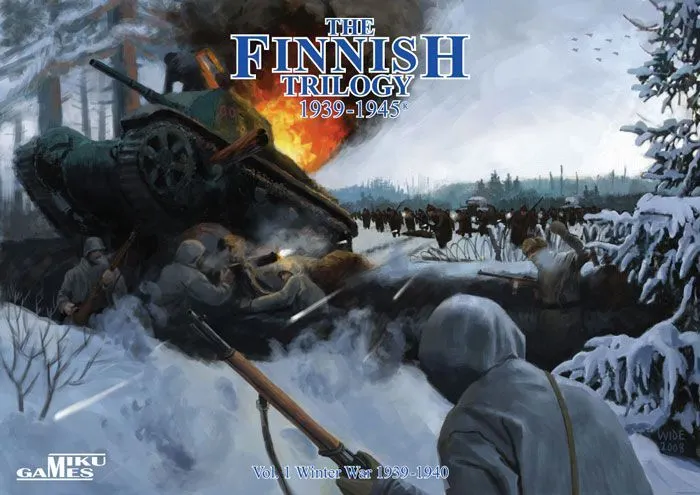
The Finnish Trilogy 1939-1945: Winter War 1939-1940 (Vol. 1) to gra planszowa wydana w 2014 roku dla 2 graczy i z rozgrywką trwającą 240–960 minut. Projekt gry: Mikael Grönroos. Główne mechaniki: Hexagon Grid.





Po angielsku
(from Mikugames website:) On November 30th, 1939 the Soviet Red Army crossed the Finnish border in attempt to conquer the whole country within a few weeks. Quite soon, it became evident that the Finns, despite totally outnumbered, were not an easy match. They were better equipped for the cold winter to come than the opponent. Ski capability was high and moving in deep forest was no problem. On the other hand, the Soviet troops were scared to death of the forest and stayed as close as possible to the few roads. The Motti (Finnish term for “encirclement”) tactic became famous around the world and a great sympathy for the small country up in the north grew in many countries as the war went on. Soon, places like Suomussalmi, Tolvajärvi, Kuhmo and Kollaa, to name a few, became famous for the heroic Finns fighting against overwhelming odds. The situation was not good for Stalin and his communist regime. Allied intervention was very possible and the prestige over the greatest army to date, The Red Army, was shaking. He also knew that Hitler was studying the campaign very carefully, making notes for every weakness in the old and poor doctrine of the RKKA. On March 13th, 1940, Finland had no other choice but to agree on the tough peace terms to follow. The Winter War had ended, but who won, or was it a stalemate? However, Finland kept its independence because the mighty neighbour in the east failed to take Helsinki among other vital objects, as planned. The Game The first game of the trilogy to be released is the famous Winter War between Finland and Soviet Union, which is often referred to as an epic battle between David and Goliath. Historically the campaign lasted for 105 days, but will you as the Finnish side be able to last that long, or maybe longer? The game can last up to 16 turns (Dec. I '39 - Mar. IV '40), but in the 3rd volume (The Lapland War), there will be an extended option with a possible Allied Intervention. Vol.1 Winter War will include special features like Soviet Prestige and Finnish Morale. The object for the Soviet side is to capture as many important cities and factories as possible, as well as destroy the Finnish Army in an attempt to make the Finnish Morale Status plunge, which means the onset of peace negotiations. But time is not on the Red Army's side, a slow advance lowers the Soviet prestige, which can cause a negative outcome. Unit Counters The game will include eight countersheets in a total of 2.128 die-cut unit counters. Ground units are written in standard Nato symbols, while Air and Naval units have correct silhouettes. The Mapboard The mapboard will be 100 cm x 140 cm (39” x 55”) in four pieces, depicting Finland and its' vicinity in a "Winterized" colour. The Rules A 48-page coloured rule book includes basic, advanced and optional game rules. Order of Battle (OOB) Two OOB’s are included, one Finnish and one Soviet. Both in full colour. A lot of sources have been used to make them as historically correct as possible. Also, four Small Scenarios have been included: (1) Salla, (2) Kuhmo-Suomussalmi, (3) Ladoga Karelia, and (4) Karelian Isthmus. For added feeling, the OOB's are written in their native language (Soviet with Cyrillic) with usually the correct unit abbreviation and then translated into English in parenthesis. Production Volume 460 boxed copies were produced. Scenarios: Main Campaign Extended Campaign (longer play and with Foreign Intervention) 4 Small Scenarios (#1 Kuusamo-Salla; #2 Kuhmo-Suomussalmi; #3 Ladoga Karelia; and #4 Karelian Isthmus)
Według katalogu The Finnish Trilogy 1939-1945: Winter War 1939-1940 (Vol. 1) obsługuje 2 graczy. To liczba graczy podana przez wydawcę, więc gra jest zaprojektowana dokładnie dla takiej liczby uczestników. Warianty dla grup innej wielkości, jeśli w ogóle istnieją, opisano w instrukcji twojego wydania; sprawdź ją uważnie, zanim przygotujesz inną konfigurację stołu.
Podany czas rozgrywki w The Finnish Trilogy 1939-1945: Winter War 1939-1940 (Vol. 1) wynosi 240–960 minut. To szacunek wydawcy dla pełnej partii. Rzeczywisty czas zależy od grupy, liczby graczy i znajomości zasad: pierwsze partie zwykle trwają dłużej, a doświadczone grupy kończą szybciej. Przygotowanie gry i tłumaczenie zasad nie są wliczone w ten szacunek.
The Finnish Trilogy 1939-1945: Winter War 1939-1940 (Vol. 1) ma ocenę złożoności 4,1 na 5 według graczy BoardGameGeek, co czyni ją grą ciężką. Ocena pokazuje, ile znajomości zasad, planowania i podejmowania decyzji wymaga typowa rozgrywka. Cięższe gry wymagają dłuższego pierwszego tłumaczenia, dlatego przed wieczorem z grami warto skorzystać z przewodnika przygotowania.
The Finnish Trilogy 1939-1945: Winter War 1939-1940 (Vol. 1) należy do tych kategorii: Wargame i World War II. Główne mechaniki to Hexagon Grid. Kategorie opisują temat i świat gry, a mechaniki to, co gracze faktycznie robią w swojej turze. Każda mechanika prowadzi do strony katalogu z podobnymi grami, co pomaga znaleźć coś porównywalnego na kolejny wieczór.
Autorzy wymienieni przy The Finnish Trilogy 1939-1945: Winter War 1939-1940 (Vol. 1) to: Mikael Grönroos. Te informacje pochodzą z opublikowanych danych gry i wskazują osoby odpowiedzialne za jej projekt, a nie ilustratorów czy wydawców. Strony autorów w MeepleRules zbierają inne tytuły tych samych twórców, co pomaga, gdy gra ci się podoba i szukasz podobnych.
W katalogu The Finnish Trilogy 1939-1945: Winter War 1939-1940 (Vol. 1) figuruje jako gra podstawowa. Można w nią grać samodzielnie, korzystając z elementów z pudełka, bez żadnego innego tytułu. Dodatki, jeśli istnieją, dokładają nową zawartość lub zasady i są wymienione w katalogu osobno, z odnośnikiem do tej gry podstawowej.