

- Pozycja w BGG
- BGG #15 219
- Ocena BGG
- 6,3
Highlander: The Card Game
- 2 graczy
- 20 min
- Złożoność 2,2/5
- 1996
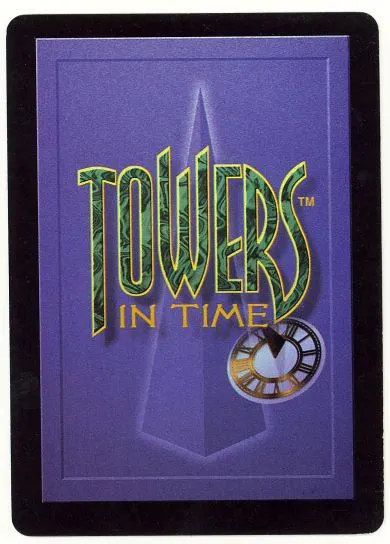
1994
Pomoc w zasadach gry Towers in Time
Zrozumiałe wyjaśnienia tur, efektów kart i spornych sytuacji z odnośnikami do oficjalnych źródeł i zapisaną historią pytań.
Dla 2 graczy
Co chcesz wiedzieć?
Odpowiedzi pochodzą z oficjalnej instrukcji, ze stroną do sprawdzenia.
Towers in Time to gra planszowa wydana w 1994 roku dla 2 graczy, z rozgrywką trwającą 30 minut i dla osób od 12 lat. Projekt gry: Mike Sager. Główne mechaniki: Hand Management.
Po angielsku
From the box: In the beginning those that could master going between dimensions thought of it as novelty. There were worlds to discover, creatures to see and most importantly magic to master. But with all these things to keep them busy there was one thing they did not forget, Power. Soon it was easier to take from others than to find it on your own. The only place to hide was in great magical towers that they built between dimensions. All times in your world and in the others are at your disposal. Will you be the last to Reign in Towers in Time? Play overview: Each player represents a spellcaster, dueling with the other players for control of an abstractly defined extradimensional space. Each player has five shields, represented by cards from that player's deck, that serve to anchor the player the dimension within the game's story, and as the player's presence in the game mechanically. The goal is to eliminate the shields of all other players; when a player has no shields remaining, they are banished from the pocket dimension, and out of the game. Victory goes to the last player with shields in play. To combat one another, players play Source cards, representing connections to various natural locations, be they landforms, weather phenomena, or natural disasters. These resource cards allow the player to access Temper, the main resource in Towers in Time, themed to the four elements. Using Temper, players pay the costs to summon creatures to wage war, conjure magical objects and artifacts to enhance the effectiveness of recruited creatures, and cast spells to strengthen their minions and weaken the opposing armies. Additionally, once creatures are in play, most of them can provide Temper as well, although typically less than Source cards; most cards in Towers in Time are resource generators in addition to their other game effects. Source cards serve as the base for the titular Towers of Towers in Time. Each Source has a default file of three ranks atop it, each space of which can be occupied by creatures and the cards they carry. Creatures enter play within Towers, and must match the element represented by the Source atop which it stands (except for Neutral creatures, which may be played into any Tower). There are rules to determine which creatures can enter play in which locations within a Tower, but once in play, most creatures can move between Towers, taking attached cards with them when they move. Turns do not follow the turn format common to many contemporary CCGs. Instead, several phases are completed simultaneously by all players, then players alternate initiating and resolving a single action until both players have passed. Action resolution varies depending on their effect, with some actions initiating a separate resolution phase with its own actions and timing (such as combat) and others are single-step actions (such as playing a card). Additionally, a number of supplemental actions ("free" actions) facilitate utility functions, such as drawing Temper to pay for spells. The opportunity to act first during the action round is determined by the player who won initiative during game setup (for the first turn only), or the player who did not take the last pass action on the previous turn.
Według katalogu Towers in Time obsługuje 2 graczy. To liczba graczy podana przez wydawcę, więc gra jest zaprojektowana dokładnie dla takiej liczby uczestników. Warianty dla grup innej wielkości, jeśli w ogóle istnieją, opisano w instrukcji twojego wydania; sprawdź ją uważnie, zanim przygotujesz inną konfigurację stołu.
Podany czas rozgrywki w Towers in Time wynosi 30 minut. To szacunek wydawcy dla pełnej partii. Rzeczywisty czas zależy od grupy, liczby graczy i znajomości zasad: pierwsze partie zwykle trwają dłużej, a doświadczone grupy kończą szybciej. Przygotowanie gry i tłumaczenie zasad nie są wliczone w ten szacunek.
Katalog podaje dla Towers in Time wiek od 12 lat. To zalecenie wydawcy, które uwzględnia wymagania dotyczące czytania, złożoność zasad i drobne elementy, a nie tylko tematykę. Młodsi gracze często mogą dołączyć z pomocą dorosłego; sprawdź zalecenie wiekowe swojego wydania i weź pod uwagę doświadczenie grupy z grami planszowymi.
Towers in Time ma ocenę złożoności 2,3 na 5 według graczy BoardGameGeek, co czyni ją grą raczej lekką. Ocena pokazuje, ile znajomości zasad, planowania i podejmowania decyzji wymaga typowa rozgrywka. Cięższe gry wymagają dłuższego pierwszego tłumaczenia, dlatego przed wieczorem z grami warto skorzystać z przewodnika przygotowania.
Towers in Time należy do tych kategorii: Card Game, Fantasy i Collectible Components. Główne mechaniki to Hand Management. Kategorie opisują temat i świat gry, a mechaniki to, co gracze faktycznie robią w swojej turze. Każda mechanika prowadzi do strony katalogu z podobnymi grami, co pomaga znaleźć coś porównywalnego na kolejny wieczór.
Autorzy wymienieni przy Towers in Time to: Mike Sager. Te informacje pochodzą z opublikowanych danych gry i wskazują osoby odpowiedzialne za jej projekt, a nie ilustratorów czy wydawców. Strony autorów w MeepleRules zbierają inne tytuły tych samych twórców, co pomaga, gdy gra ci się podoba i szukasz podobnych.
W katalogu Towers in Time figuruje jako gra podstawowa. Można w nią grać samodzielnie, korzystając z elementów z pudełka, bez żadnego innego tytułu. Dodatki, jeśli istnieją, dokładają nową zawartość lub zasady i są wymienione w katalogu osobno, z odnośnikiem do tej gry podstawowej.