
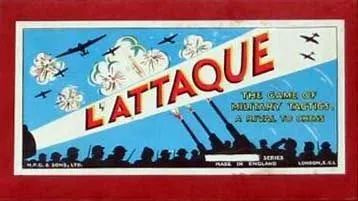
- Pozycja w BGG
- BGG #22 557
- Ocena BGG
- 6,1
L'Attaque
- 2 graczy
- 20 min
- Złożoność 1,3/5
- 1909
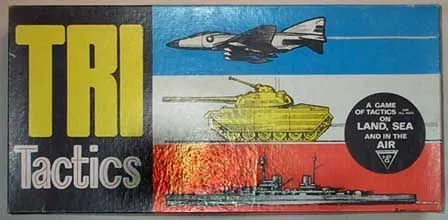
1932
Pomoc w zasadach gry Tri-Tactics
Zrozumiałe wyjaśnienia tur, efektów kart i spornych sytuacji z odnośnikami do oficjalnych źródeł i zapisaną historią pytań.
Dla 2 graczy
Co chcesz wiedzieć?
Odpowiedzi pochodzą z oficjalnej instrukcji, ze stroną do sprawdzenia.
Tri-Tactics to gra planszowa wydana w 1932 roku dla 2 graczy, z rozgrywką trwającą 240 minut i dla osób od 12 lat. Projekt gry: Hermance Edan i Harry Gibson. Główne mechaniki: Secret Unit Deployment.

Po angielsku
Popular and intriguing military air, sea and ground forces tactics game TRI-TACTICS by Harry Gibson History: This board game was launched in 1935 by Gibsons aiming to provide an amalgamation of three other tactical board games: - L'Attaque (1909) - the U.K. rights were acquired by Gibsons in 1925. - Dover Patrol (1911) - Aviation: The Aerial Tactics Game of Attack and Defence (1925) All of these Gibsons games, marketed at the time as Series: The Big Four (Gibsons), predate Stratego (1942) by Jumbo which shares many similar aspects of play, but is now much more well known. Gameplay: The game is played on a special 12x12 board which illustrates land and sea spaces equally for each side, and each with two special squares, an HQ and a Lake containing a Naval Base. Two players, one RED, the other BLACK, command combined Navy, Airforce and Army forces, with a total of 112 prices, each player starting with 56, comprising the following: Infantry 5 Battalions - rank 1 4 Brigades - rank 2 3 Divisions - rank 3 2 Army Corps - rank 4 1 Army - rank 5 Artillery 5 Anti-Aircraft gun - rank AA 4 Field Artillery - rank FA 3 Heavy Artillery - rank HA Naval Force 4 Destoryers - rank 1 3 Cruisers - rank 2 2 Battleships - rank 3 1 Aircraft Carrier - rank 4 1 Submarine - rank SM 4 Flying Boats - rank FB Air Force 4 Reconnaissance Planes - rank 1 3 Bombers - rank 2 2 Two-Seat Fighters - rank 3 Auxiliary 8 Searchlights - rank SL At the beginning of game, these 56 pieces are placed by a player to occupy the first 5 rows of one side (but not on the HQ or Lake), with the other player doing likewise with their 56 on the opposite side’s 5 rows. This leaves two whole rows in the centre of the board empty, as well as the HQ, Lake, and 2 other squares between the two forces facing each other. All types and ranks of the pieces are hidden at the beginning of the game The object of the game is to occupy the opponent’s HQ with an Infantry piece, or the Lake with a Naval piece (not including the FB), which must approach via the river. The players draw lots to decide who commences play, by moving one piece, and thereafter play alternates between the players, by moving one piece per turn. All pieces can move one square at a time, forwards, backwards or sideways, with the exception of the Searchlight which can move multiple squares in a single direction (but only when attacking), as long as the squares are unoccupied. To attack, a player must move a piece adjacent to an opponent’s piece and announce ‘Attack’. They may choose not to, in which case they state ‘No Attack’. In that case, the opponent cannot on their turn attack that adjacent piece without first moving another of his pieces. The two adjacent pieces of each player are then revealed. The attacks are resolved by consulting the Value Table; as a general rule, the highest rank wins, but there are various combinations that apply, particularly when comparing land, sea and air pieces on land, sea or over a coastline. If successful, the attacker remains where they are, and the defender’s square becomes empty as the defender’s piece is removed. If the attacker loses, their piece is removed, and the defender’s piece remains where it is. If the pieces are the same rank, both are removed. It is allowed to place Land pieces on the sea and Naval pieces on the land, but with the risk that when attacked, any such piece found to be operating ‘out of their element’ will immediately forfeit and removed. Excluded from this rule is the FB as well as all Air Force pieces and the Searchlights. The River is a special area which is classified as Land or Sea depending on which piece is occupying it. When a Naval piece does so, the square is designated Sea, and when a Land price occupies it, then it is classified as Land. On the rest of the board, where land and sea meet, then the spaces are classified as Sea or Land depending on which is in the majority. The coastline in each case separates these defined areas of Land and Sea. Should there be an attack between a Ship and a Land piece over a coastline, the attacker is forfeit, except for HA and AA when the ordinary ruling applies. Also, Bombers and FB destroy Infantry and FA. The HQ and Lake must not be occupied but a piece may be move over these squares in consecutive turns or else be forfeit. Only Ships (not FB) may attack and capture the Lake, and to do so must move up the River (it cannot capture the Lake by entering via Land, or then it must exit via the river to sea); in doing so, in this special case it captures all Land pieces in attacks, except HA. Similarly, only Infantary pieces (not Artillery) may attack and capture the HQ. Similar to: L'Attaque Dover Patrol Aviation: The Aerial Tactics Game of Attack and Defence Stratego
Według katalogu Tri-Tactics obsługuje 2 graczy. To liczba graczy podana przez wydawcę, więc gra jest zaprojektowana dokładnie dla takiej liczby uczestników. Warianty dla grup innej wielkości, jeśli w ogóle istnieją, opisano w instrukcji twojego wydania; sprawdź ją uważnie, zanim przygotujesz inną konfigurację stołu.
Podany czas rozgrywki w Tri-Tactics wynosi 240 minut. To szacunek wydawcy dla pełnej partii. Rzeczywisty czas zależy od grupy, liczby graczy i znajomości zasad: pierwsze partie zwykle trwają dłużej, a doświadczone grupy kończą szybciej. Przygotowanie gry i tłumaczenie zasad nie są wliczone w ten szacunek.
Katalog podaje dla Tri-Tactics wiek od 12 lat. To zalecenie wydawcy, które uwzględnia wymagania dotyczące czytania, złożoność zasad i drobne elementy, a nie tylko tematykę. Młodsi gracze często mogą dołączyć z pomocą dorosłego; sprawdź zalecenie wiekowe swojego wydania i weź pod uwagę doświadczenie grupy z grami planszowymi.
Tri-Tactics ma ocenę złożoności 2,5 na 5 według graczy BoardGameGeek, co czyni ją grą raczej lekką. Ocena pokazuje, ile znajomości zasad, planowania i podejmowania decyzji wymaga typowa rozgrywka. Cięższe gry wymagają dłuższego pierwszego tłumaczenia, dlatego przed wieczorem z grami warto skorzystać z przewodnika przygotowania.
Tri-Tactics należy do tych kategorii: Wargame i World War II. Główne mechaniki to Secret Unit Deployment. Kategorie opisują temat i świat gry, a mechaniki to, co gracze faktycznie robią w swojej turze. Każda mechanika prowadzi do strony katalogu z podobnymi grami, co pomaga znaleźć coś porównywalnego na kolejny wieczór.
Autorzy wymienieni przy Tri-Tactics to: Hermance Edan i Harry Gibson. Te informacje pochodzą z opublikowanych danych gry i wskazują osoby odpowiedzialne za jej projekt, a nie ilustratorów czy wydawców. Strony autorów w MeepleRules zbierają inne tytuły tych samych twórców, co pomaga, gdy gra ci się podoba i szukasz podobnych.
W katalogu Tri-Tactics figuruje jako gra podstawowa. Można w nią grać samodzielnie, korzystając z elementów z pudełka, bez żadnego innego tytułu. Dodatki, jeśli istnieją, dokładają nową zawartość lub zasady i są wymienione w katalogu osobno, z odnośnikiem do tej gry podstawowej.