
- Pozycja w BGG
- BGG #5418
- Ocena BGG
- 6,5
UGO!
- 2–4 graczy
- 40 min
- Złożoność 1,6/5
- 2013
2004
Pomoc w zasadach gry UWO
Zrozumiałe wyjaśnienia tur, efektów kart i spornych sytuacji z odnośnikami do oficjalnych źródeł i zapisaną historią pytań.
Dla 2 graczy
Co chcesz wiedzieć?
Odpowiedzi pochodzą z oficjalnej instrukcji, ze stroną do sprawdzenia.
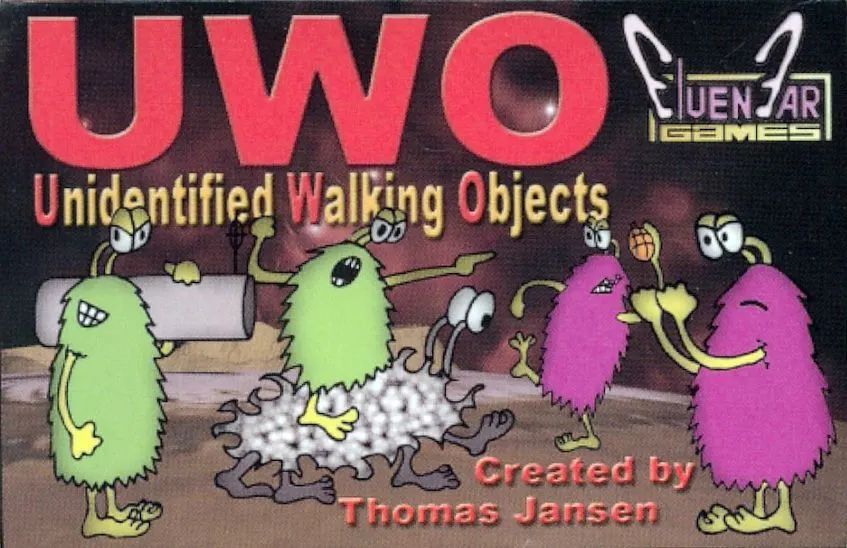
UWO to gra planszowa wydana w 2004 roku dla 2 graczy, z rozgrywką trwającą 45 minut i dla osób od 10 lat. Projekt gry: Thomas Jansen. Główne mechaniki: Hand Management, Square Grid i Grid Movement.


Po angielsku
UWO's (unidentified walking objects) are residents of the planet Znorf. There are two kinds of UWO; The Gnorfs and the Pnorfs. Both of them are able to morf. But that is something that will be explained later on. The Gnorfs think that the Pnorfs are a group of ugly creatures and that feeling is completely mutual. All the more reason for them to start a war! beginning of the game UWO is a cardgame and a boardgame at the same time. Both players have six energy cards. The playing field is formed by the energy cards of both players. One player places them horizontally, directly in front of him. The other player does this at the side vertically, just like on the photo. The playing field is between these energy cards. Both players place their ten 'regular' UWO's of their own color in front of them in two rows of five each. The players shuffle their pack of cards and place them both upside down in front of them. energy Just like life on our planet, life on Znorf is expensive too. Everything you do will cost you "Energy". you have to pay it for morfing, walking or fighting. Strong UWO's use much energy. If both players used all of their six energy, then a round is over. Everyone gets back his energy. But beware! If you're out of energy and your opponent isn't yet, he will play several turns at once! And for your opponent, weak (and cheap) UWO's come in handy now. They can do a lot of damage to you! many different UWO's There are no less than eight different UWO's in the game. Some are riding Knorfs (strange animails). They can trample everyone. Others are cowards, hiding in bunkers, etc. UWO's carry many different weapons. Lasers, dynamite, granades, bazooka's, etc. The bazooka UWO for instance, is one of the coolest of the gang and he himself thinks so too. He is extremely powerful. He can even blow up tanks! Unfortunately, such a bazooka is a great danger to our tiny UWO. Each time he has shot someone, he will be knocked out until the end of your next turn! UWO's are specialists. Every UWO has protection against a specific other UWO. For instance, a UWO in a tank has protection against one who fights with his bare hands. dynamite UWO Well, let's just say there's only one of it on each side. One who can be quite important to both players... morfing UWO's can morf in exchange for one energy point: UWO cards may be placed on UWO's that are already in the game. This way, a regular UWO can be morfed into anything you want to, just like that! This can be very useful. Imagine a laser UWO threatening you. Your opponent announces that it's going to attack!! Don't panic, his UWO can never hit you when you are hiding in a bunker! So, when you have this card, just morf your furry alien into one and shoot back...and hope your opponent doesn't morf his UWO into a grenade UWO... the pack of cards At the end of each turn each player may refill his/her cards to 3. But beware, players can run out of cards. The game still goes on untill all UWO's of one player in the battlefield are destroyed. It is very easy for an opponent to adapt his army to yours, when you are not able to morf anymore! Imagine your opponent creating a small army of laser UWO's to attack your last bazooka UWO! They have protection against this weapon. You may panic now, cause your lost. In the pack of cards, there are also nine "miss cards." When you play this card, the shot will automatically be declared "missed" and of course you will have the chance to shoot back with this UWO. But don't play these cards to fast! Smart opponents remember how many you have left. When you lost them all, your opponent knows that every shot will be a hit. Sometimes it's smarter to just sacrifice a UWO, than to play a miss card.
Według katalogu UWO obsługuje 2 graczy. To liczba graczy podana przez wydawcę, więc gra jest zaprojektowana dokładnie dla takiej liczby uczestników. Warianty dla grup innej wielkości, jeśli w ogóle istnieją, opisano w instrukcji twojego wydania; sprawdź ją uważnie, zanim przygotujesz inną konfigurację stołu.
Podany czas rozgrywki w UWO wynosi 45 minut. To szacunek wydawcy dla pełnej partii. Rzeczywisty czas zależy od grupy, liczby graczy i znajomości zasad: pierwsze partie zwykle trwają dłużej, a doświadczone grupy kończą szybciej. Przygotowanie gry i tłumaczenie zasad nie są wliczone w ten szacunek.
Katalog podaje dla UWO wiek od 10 lat. To zalecenie wydawcy, które uwzględnia wymagania dotyczące czytania, złożoność zasad i drobne elementy, a nie tylko tematykę. Młodsi gracze często mogą dołączyć z pomocą dorosłego; sprawdź zalecenie wiekowe swojego wydania i weź pod uwagę doświadczenie grupy z grami planszowymi.
UWO ma ocenę złożoności 1,7 na 5 według graczy BoardGameGeek, co czyni ją grą lekką. Ocena pokazuje, ile znajomości zasad, planowania i podejmowania decyzji wymaga typowa rozgrywka. Cięższe gry wymagają dłuższego pierwszego tłumaczenia, dlatego przed wieczorem z grami warto skorzystać z przewodnika przygotowania.
UWO należy do tych kategorii: Card Game, Humor i Abstract Strategy. Główne mechaniki to Hand Management, Square Grid i Grid Movement. Kategorie opisują temat i świat gry, a mechaniki to, co gracze faktycznie robią w swojej turze. Każda mechanika prowadzi do strony katalogu z podobnymi grami, co pomaga znaleźć coś porównywalnego na kolejny wieczór.
Autorzy wymienieni przy UWO to: Thomas Jansen. Te informacje pochodzą z opublikowanych danych gry i wskazują osoby odpowiedzialne za jej projekt, a nie ilustratorów czy wydawców. Strony autorów w MeepleRules zbierają inne tytuły tych samych twórców, co pomaga, gdy gra ci się podoba i szukasz podobnych.
W katalogu UWO figuruje jako gra podstawowa. Można w nią grać samodzielnie, korzystając z elementów z pudełka, bez żadnego innego tytułu. Dodatki, jeśli istnieją, dokładają nową zawartość lub zasady i są wymienione w katalogu osobno, z odnośnikiem do tej gry podstawowej.