
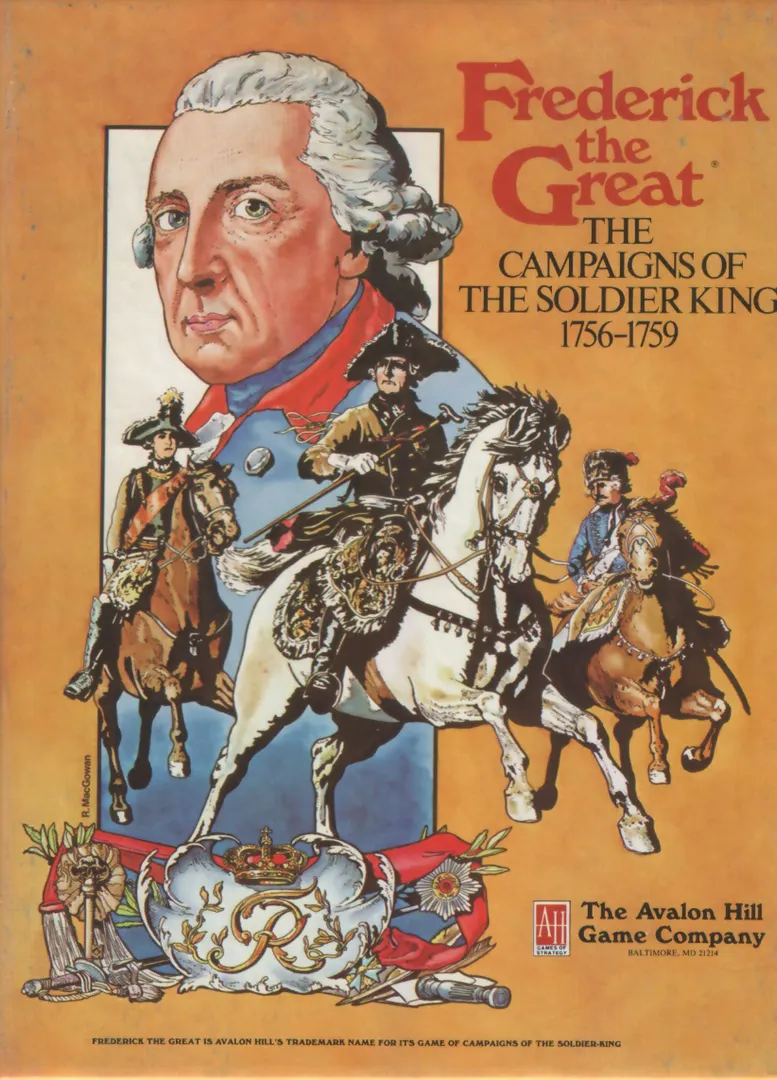
- Pozycja w BGG
- BGG #5638
- Ocena BGG
- 7,0
Frederick the Great: The Campaigns of The Soldier King 1756-1759
- 2–4 graczy
- 180–240 min
- Złożoność 2,7/5
- 1975
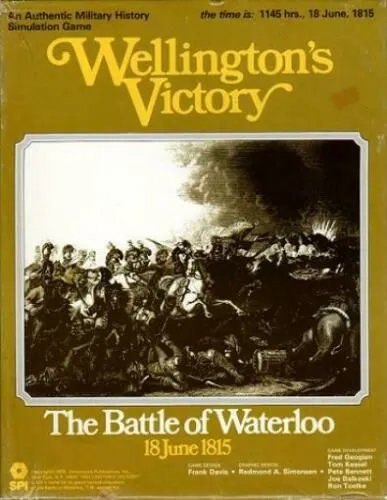
1976
Pomoc w zasadach gry Wellington's Victory: Battle of Waterloo Game – June 18th, 1815
Zrozumiałe wyjaśnienia tur, efektów kart i spornych sytuacji z odnośnikami do oficjalnych źródeł i zapisaną historią pytań.
Dla 2 graczy
Co chcesz wiedzieć?
Odpowiedzi pochodzą z oficjalnej instrukcji, ze stroną do sprawdzenia.
Wellington's Victory: Battle of Waterloo Game – June 18th, 1815 to gra planszowa wydana w 1976 roku dla 2 graczy, z rozgrywką trwającą 240 minut i dla osób od 12 lat. Projekt gry: Frank Davis. Główne mechaniki: Dice Rolling, Hexagon Grid i Ratio / Combat Results Table.






Po angielsku
[from the back of the flatpack edition] Wellington's Victory : The Battle of Waterloo - Four-color 68” x 44” contour map in four sections - Innovative Fire and Shock Combat mechanics - Line, Column, Square, Skirmish and Cavalry formations - Hougomont, La Haye Sainte and Plancenoit Scenarios - 40 Game-Turn Grand Battle Scenario Wellington's Victory is a grand tactical simulation of the Battle of Waterloo which occurred on June 18, 1815, at a minor crossroads south of Brussels, Belgium. The battle marked the first and only encounter of history's two most renowned generals, Sir Arthur Wellesley, Duke of Wellington, and Napoleon Bonaparte, Emperor of France. A brutal day-long French assault against the British held ridge brought Wellington's army to the brink of defeat. By later afternoon, however, the arrival of Wellington's allies tipped the odds decisively against the French; Napoleon chose to stake his empire on the outcome of a final attack by his most trusted troops – the Imperial Guard. Wellington's Victory is played on an innovative game map composed of four 34” x 22” map sections on which significant differences in ground contours are differentiated by color. There are five distinct contour levels depicted on the map as well as an extremely accurate survey of all battle field terrain features including Hougomont, La Haye Sainte, and almost every other farm and dwelling, woods and orchards, streams and ponds, and raised and sunken roads. Each of more than 500 French, Prussian and Anglo-Dutch combat and command units are fully identified by battalion, regiment, brigade, division and corps designations as well as numerical game values which differentiate each unit's strength, effectiveness, and mobility. The game utilizes a fifteen minute Game-Turn. Each mapsheet hex represents a distance of 100 yards. Each Strength Point represents 100 infantry or cavalry troops or one gun or howitzer within an artillery battery. Each Game-Turn employs a unique, asymmetrical, sequence of play in which Players alternately participate in a series of Phases covering activities which include the execution of chain of command mechanics (such as activating and committing reserve formations and initiating cavalry charges), rallying disordered and routed units, executing facing and formation changes (including a repertoire of infantry formations such as column, line, square and open order or skirmish formation), regular and grand tactical movement, and finally executing artillery and small arms fire as well as infantry and cavalry shock command. The Fire and Shock Combat mechanics which decide the battle were also designed to yield realistic results without sacrificing playability. Fire resolution requires no arithmetic calculation since each unit fires separately. The Relative Firepower Table used to resolve Fire Combat is a new type of CRT which directly interrelates the strength, formation and quality of the firing unit with the formation and terrain cover employed by the defending unit. The Shock Combat Table is also unique in that it employs an “odds” comparison to account for Troop strength differences between the attacker and defender and a “differential” comparison to account for any qualitative difference between the opposing forces. Losses, which are recorded directly on the map by placing a Strength marker under the unit suffering casualties, may result from either Fire or Shock combat. In general, however, Shock Combat is depicted as a “morale showdown” more useful for gaining ground than inflicting casualties. Morale, which Napoleon deemed to be three times as important as numerical strength on the battlefield, is accurately accounted for in the Effectiveness Rating assigned to every infantry battalion, cavalry regiment and artillery battery crew. Buyer's Guide for WELLINGTON'S VICTORY The following ratings are based on at least 100 player-replies to surveys conducted through Strategy & Tactics Magazine. Ratings are on a 1 (worst) to 9 (best) scale. Average ratings (for over 60 historical games in print) are: Acceptability-6.00, Complexity-5.00. Acceptability Rating: New Game Complexity Rating: (est.) 7.8 Avg. Playing Time [hrs.] (est.) 6.0 “Acceptability” depends a lot on which historical period interests you the most. “Complexity” ratings for other games are, for example, Monopoly – 2.34; Afrika Korps – 3.48; Diplomacy – 4.51; France, 1940 – 5.78; PanzerBlitz – 7.01. Most games average 2-3 hours playing time.
Według katalogu Wellington's Victory: Battle of Waterloo Game – June 18th, 1815 obsługuje 2 graczy. To liczba graczy podana przez wydawcę, więc gra jest zaprojektowana dokładnie dla takiej liczby uczestników. Warianty dla grup innej wielkości, jeśli w ogóle istnieją, opisano w instrukcji twojego wydania; sprawdź ją uważnie, zanim przygotujesz inną konfigurację stołu.
Podany czas rozgrywki w Wellington's Victory: Battle of Waterloo Game – June 18th, 1815 wynosi 240 minut. To szacunek wydawcy dla pełnej partii. Rzeczywisty czas zależy od grupy, liczby graczy i znajomości zasad: pierwsze partie zwykle trwają dłużej, a doświadczone grupy kończą szybciej. Przygotowanie gry i tłumaczenie zasad nie są wliczone w ten szacunek.
Katalog podaje dla Wellington's Victory: Battle of Waterloo Game – June 18th, 1815 wiek od 12 lat. To zalecenie wydawcy, które uwzględnia wymagania dotyczące czytania, złożoność zasad i drobne elementy, a nie tylko tematykę. Młodsi gracze często mogą dołączyć z pomocą dorosłego; sprawdź zalecenie wiekowe swojego wydania i weź pod uwagę doświadczenie grupy z grami planszowymi.
Wellington's Victory: Battle of Waterloo Game – June 18th, 1815 ma ocenę złożoności 4,2 na 5 według graczy BoardGameGeek, co czyni ją grą ciężką. Ocena pokazuje, ile znajomości zasad, planowania i podejmowania decyzji wymaga typowa rozgrywka. Cięższe gry wymagają dłuższego pierwszego tłumaczenia, dlatego przed wieczorem z grami warto skorzystać z przewodnika przygotowania.
Wellington's Victory: Battle of Waterloo Game – June 18th, 1815 należy do tych kategorii: Wargame i Napoleonic. Główne mechaniki to Dice Rolling, Hexagon Grid i Ratio / Combat Results Table. Kategorie opisują temat i świat gry, a mechaniki to, co gracze faktycznie robią w swojej turze. Każda mechanika prowadzi do strony katalogu z podobnymi grami, co pomaga znaleźć coś porównywalnego na kolejny wieczór.
Autorzy wymienieni przy Wellington's Victory: Battle of Waterloo Game – June 18th, 1815 to: Frank Davis. Te informacje pochodzą z opublikowanych danych gry i wskazują osoby odpowiedzialne za jej projekt, a nie ilustratorów czy wydawców. Strony autorów w MeepleRules zbierają inne tytuły tych samych twórców, co pomaga, gdy gra ci się podoba i szukasz podobnych.
W katalogu Wellington's Victory: Battle of Waterloo Game – June 18th, 1815 figuruje jako gra podstawowa. Można w nią grać samodzielnie, korzystając z elementów z pudełka, bez żadnego innego tytułu. Dodatki, jeśli istnieją, dokładają nową zawartość lub zasady i są wymienione w katalogu osobno, z odnośnikiem do tej gry podstawowej.