
- Место в рейтинге BGG
- BGG #30 491
- Оценка BGG
- 5,3
Free Parking
- 2–4 игрока
- 30 мин
- Сложность 1,1/5
- 1988
1985
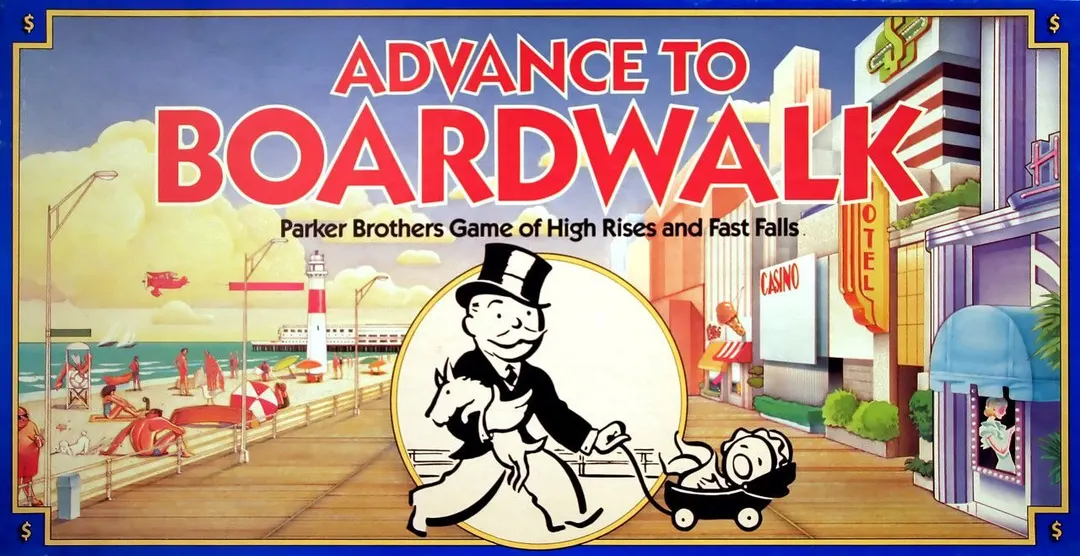
Помощник по правилам Advance to Boardwalk
Понятные объяснения ходов, эффектов карт и спорных ситуаций со ссылками на официальные источники и сохранённой историей вопросов.
Что хотите уточнить?
Отвечаю по официальным правилам и показываю страницу для проверки.
«Advance to Boardwalk» — настольная игра 1985 года: для 2–4 игроков, 60 минут на партию и возраст от 8 лет. Авторы игры — Charles Phillips; основные механики — Hand Management, Take That и Dice Rolling.








На английском
Don't let the name fool you. The game has nothing to do with Monopoly. The name was obviously chosen in an attempt to capitalize on that mega-selling monster. There are four tracts of land illustrated on the board, which depicts an ocean-front boardwalk. Each tract of land contains five properties valued from $1 million to $8 million. Each turn, a player rolls two regular dice and one special die. The special die has four sides depicting a color matching one of the land tracts, with the other two sides depicting a 'W' and 'F' respectively. The number rolled on the regular two dice is the amount of money the player can spend on development, while the color depicted on the special die is the tract of land he may build on. Thus, if a player rolled an 8 and a red, he has $8 million to spend on developing buildings in the red tract. He can split this $8 million as he sees fit. For example, he may build a building on the $5 million plot and one on the $3 million plot; or he may opt to build one building on the $8 million plot. Quite a few building options here. The 'W' on the special die is a 'wild' color. If it was rolled instead of a color, the player may select which tract he wishes to build on. The 'F' means that a player draws a Fortune card and does not build that turn. Fortune cards allow a player to perform a variety of actions, including constructing extra buildings, moving one of his already placed buildings, removing an opponent's building, etc. A player may play one of these Fortune cards per turn. When a player constructs a building and obtains the most buildings on a particular plot, he takes the deed to that property and moves his token along the boardwalk an amount equal to the value of the deed. If a player wrested control of the deed from an opponent, the opponent is then moved back that number of spaces. Buildings are placed on the board in a fashion identical to that used in Manhattan...they are stacked on top of existing buildings. If there is a tie for the most buildings, the player who built first on that plot possesses the deed. Some have described this game as 'Manhattan lite', and they're not far off. One certainly has similar thought processes and must constantly keep an eye out for optimum plays which will wrest control of deeds (control of buildings in Manhattan) from opponents. There's another planning element thrown in, too. Certain spaces along the boardwalk are marked with an 'F'. If a player advances his token to one of these locations, he draws a Fortune card. These cards can be extremely powerful and cause a severe swing in deed controls. Thus, it is not always wise to go for the largest deed acquisition if a lesser gain would allow you to move your token onto an 'F' location. Clever. The game continues until one player has placed all of his buildings (sounds a bit like Rheinländer, doesn't it?) or until one player has reached the end of the boardwalk. The player with the highest total value of deeds is the victor.
По данным каталога, «Advance to Boardwalk» рассчитана на 2–4 игроков. Этот диапазон соответствует числу игроков, указанному издателем, поэтому игру можно подготовить для любого состава в его пределах. Подготовка, отдельные правила и подсчёт очков всё же могут зависеть от числа игроков; точную конфигурацию проверьте в правилах своего издания.
В каталоге для «Advance to Boardwalk» указано время партии 60 минут — это оценка издателя для полной партии. Фактическая длительность зависит от состава, числа игроков и знакомства с правилами: первые партии обычно идут дольше, опытные компании заканчивают быстрее. Подготовка и объяснение правил в эту оценку не входят.
В каталоге для «Advance to Boardwalk» указан возраст от 8 лет. Это рекомендация издателя: она учитывает необходимость чтения, сложность правил и мелкие компоненты, а не только тему. Младшие игроки часто могут участвовать с помощью взрослого; проверьте возрастную рекомендацию на своём издании и учтите опыт вашей компании в настольных играх.
Сложность «Advance to Boardwalk» — 1,5 из 5 по оценкам игроков BoardGameGeek, это лёгкая игра. Оценка отражает, сколько знания правил, планирования и решений требует типичная партия. Сложные игры дольше объяснять в первый раз, поэтому перед игровым вечером пригодится руководство по подготовке.
Категории игры «Advance to Boardwalk»: Economic. Основные механики: Hand Management, Take That и Dice Rolling. Категории описывают тему и сеттинг игры, а механики — то, что игроки на самом деле делают в свой ход. Каждая механика ведёт в раздел каталога с похожими играми, и так проще найти что-то подобное для следующей партии.
В каталоге авторами «Advance to Boardwalk» указаны: Charles Phillips. Эти данные взяты из опубликованной информации об игре и называют людей, ответственных за её дизайн, а не иллюстраторов или издателей. Страницы авторов на MeepleRules собирают другие игры тех же авторов — это удобно, когда игра понравилась и хочется найти похожие.
В каталоге «Advance to Boardwalk» отмечена как самостоятельная игра. В неё можно играть отдельно, используя компоненты из коробки, и никакая другая игра для этого не нужна. Дополнения, если они существуют, добавляют новый контент или правила и указаны в каталоге отдельно со ссылкой на эту базовую игру.