
- Оценка BGG
- 7,8
Next War: Series Supplement #1
- 2 игрока
- Сложность 4,3/5
- 2017
2015
Помощник по правилам Next War: India-Pakistan
Понятные объяснения ходов, эффектов карт и спорных ситуаций со ссылками на официальные источники и сохранённой историей вопросов.
Для 2 игроков
Что хотите уточнить?
Отвечаю по официальным правилам и показываю страницу для проверки.
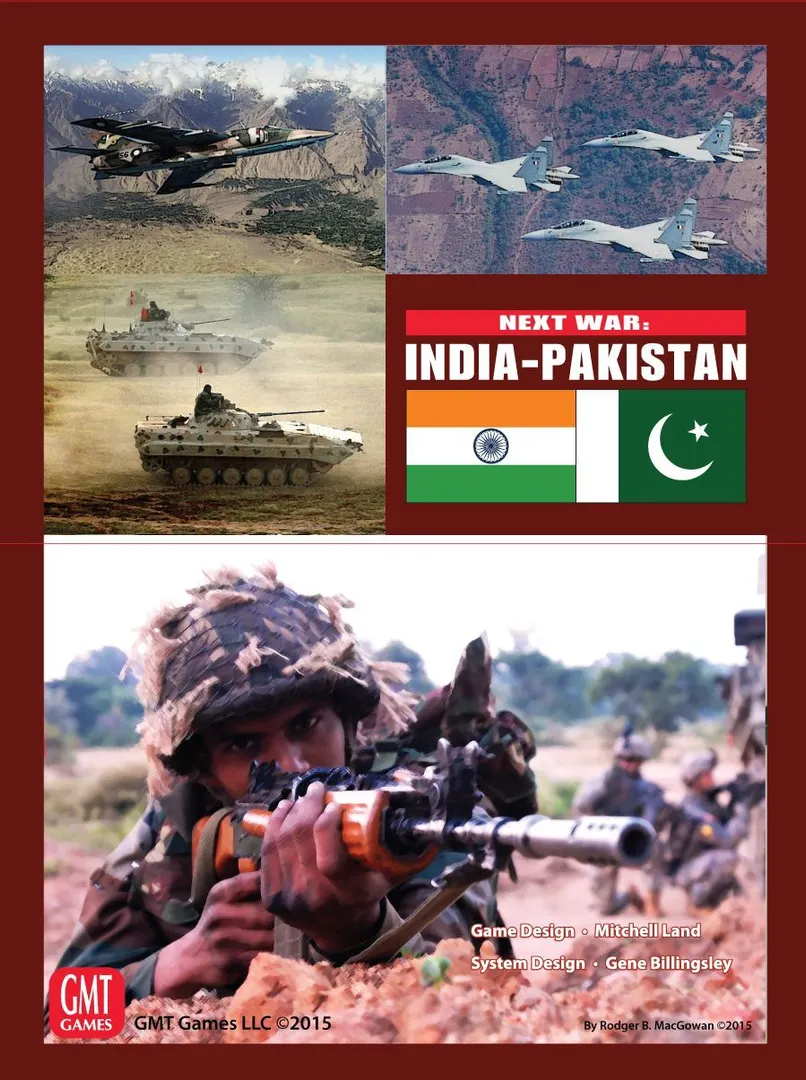
«Next War: India-Pakistan» — настольная игра 2015 года: для 2 игроков, 240–480 минут на партию и возраст от 12 лет. Авторы игры — Gene Billingsley и Mitchell Land; основные механики — Dice Rolling, Grid Movement и Hexagon Grid.




На английском
The ink was hardly dry on the documents following the partition of British India in 1947 before war broke out between India and Pakistan. Since the partition, four major wars and numerous smaller conflicts have been waged over much of the same ground. In 1947, 1965, 1971, and 1999 India and Pakistan fought in the mountains of Kashmir and on the plains of the Punjab region to the south. Today, both sides are armed with thousands of armored vehicles, hundreds of advanced aircraft, and dozens of nuclear weapons. With tensions high and both sides heavily armed, another conflict may be just a matter of time. Next War: India-Pakistan, the next volume in GMT's series of Next War games and a follow-on to Next War: Korea, allows players to fight a near future war between India and Pakistan. Due to the nature of a potential conflict, only a portion of the Indo-Pakistani border is featured so that the fighting centers around what it always has: the fate of the Indian state of Jammu & Kashmir. Special rules govern such things as the expanded role bridges play in the region play as well as the fact that both sides in the conflict are nuclear-armed nations. The People's Republic of China and the United States can make an appearance, but they might withdraw in the event of a nuclear exchange. The question is: will this war settle once and for all who will control northwest India? Note: the Next War series is not an introductory wargame. Rather, we have intended herein to create a system (and a series) that will allow detailed study of modern warfare in various venues as well as engaging gameplay. That said, the Standard Game rules encompass a fairly straightforward rule set that will, we think, be considered "easy to learn" by experienced wargamers. So, players who choose to play Standard Game scenarios can have a relatively quick game when that's what suits them. The real flavor of a war in the theatre, however, comes through in the Advanced Game, where you get much more control over airpower and can more clearly see each side's strengths and weaknesses. For players who want a "mini-monster game" experience, playing the Advanced Game Campaign Scenarios with some or all of the optional rules will definitely "deliver." Ownership of Next War: Korea will NOT be required to play. Units Ground units in Next War: India-Pakistan represent the brigades, support units, and divisions of the armies of the India, Pakistan, China, and the United States. All ground units are rated for their attack and defense strengths, movement capabilities, and unit efficiency. Air units represent fighter, bomber, and attack squadrons of the major combatants and are rated for All-Weather Capabilities as well as their range, average pilot skill, and their abilities in Air-to-Air Combat, Close Air Support, and Strike missions. Maps and Terrain The game's map represents the area in and around the Punjab district of Pakistan and the Indian state of Jammu & Kashmir at a scale of roughly 7.5 miles per hex. The map stretches from edge of The Great Indian Desert to just inside the Himalayas and encompasses portions of both sides of the border. Game System A game turn is generally composed of: Weather Determination. Bad weather can severely hamper air operations and can significantly slow ground operations. Initiative Determination and Air/Naval Phase, wherein Air Superiority levels and air availability are determined. Special Operations Phases in the Advanced Game allowing players to utilize their special operators in various recon and raid missions behind enemy lines. Strike Phases in the Advanced Game allowing players to launch air strikes, cruise missiles, artillery and tactical nuclear weapon strikes. One or more Movement and Combat Phases that allow both sides to move, react, and fight, with an advantage to the Initiative player on non-Contested turns Arrival of Reinforcements and Replacements Victory Determination Combat Combat resolution examines not only unit strengths but also unit efficiency (representing training, doctrine, and morale), as well as the terrain where the combat takes place. The CRT tends to be very bloody in nature, reflecting what we believe will be a degree of attritional warfare early due to the lethality of modern weapons. As in many games, casualties represent not only actual combat losses but also losses of unit cohesion brought about by the rapid pace with which modern armies are able to engage and exploit on the battlefield. Nukes In this installment, players will have the option, depending on game situation and a die roll to secure release authorization for and use tactical nuclear weapons in the playing area. Use of such weapons, however, could cause your international allies to leave the theater, so be careful! Scenarios There are several Standard Game scenarios. Some are small and focus on limited objectives while others are variations of a campaign game encompassing the entire map. In a break from the standard set in Next War: Korea(and its follow-on Next War: Taiwan), the scenarios in Next War: India-Pakistan posit specific at-start situations and objectives (or victory conditions). In some scenarios Pakistan is the aggressor while in others the Indian side is on the attack, in all cases there are varying levels of Chinese and United States intervention. The International Posture Matrix à la Flashpoint: Golan – The Fifth Arab-Israeli War is still present to allow players to experiment with a variety of intervention options for the US and PRC. In Next War: India-Pakistan, Jammu & Kashmir is once again aflame. Can you, as the Islamic Republic of Pakistan's commander, conquer Kashmir and hold it against the enemy? Can you, as the Republic of India's commander, attack and defeat the enemy without the conflict going nuclear? And what will happen in the international community while all this is going on? There’s only one way to find out... TIME SCALE 3.5 days per turn MAP SCALE 7.5 miles per hex UNIT SCALE Brigade / Division / Squadron NUMBER OF PLAYERS: Two (Optimal)
По данным каталога, «Next War: India-Pakistan» рассчитана на 2 игроков. Это число игроков, указанное издателем, то есть игра задумана ровно для такого количества участников. Варианты для другого состава, если они есть, описаны в правилах вашего издания; проверьте их, прежде чем готовить другую конфигурацию.
В каталоге для «Next War: India-Pakistan» указано время партии 240–480 минут — это оценка издателя для полной партии. Фактическая длительность зависит от состава, числа игроков и знакомства с правилами: первые партии обычно идут дольше, опытные компании заканчивают быстрее. Подготовка и объяснение правил в эту оценку не входят.
В каталоге для «Next War: India-Pakistan» указан возраст от 12 лет. Это рекомендация издателя: она учитывает необходимость чтения, сложность правил и мелкие компоненты, а не только тему. Младшие игроки часто могут участвовать с помощью взрослого; проверьте возрастную рекомендацию на своём издании и учтите опыт вашей компании в настольных играх.
Сложность «Next War: India-Pakistan» — 4,1 из 5 по оценкам игроков BoardGameGeek, это сложная игра. Оценка отражает, сколько знания правил, планирования и решений требует типичная партия. Сложные игры дольше объяснять в первый раз, поэтому перед игровым вечером пригодится руководство по подготовке.
Категории игры «Next War: India-Pakistan»: Wargame и Modern Warfare. Основные механики: Dice Rolling, Grid Movement и Hexagon Grid. Категории описывают тему и сеттинг игры, а механики — то, что игроки на самом деле делают в свой ход. Каждая механика ведёт в раздел каталога с похожими играми, и так проще найти что-то подобное для следующей партии.
В каталоге авторами «Next War: India-Pakistan» указаны: Gene Billingsley и Mitchell Land. Эти данные взяты из опубликованной информации об игре и называют людей, ответственных за её дизайн, а не иллюстраторов или издателей. Страницы авторов на MeepleRules собирают другие игры тех же авторов — это удобно, когда игра понравилась и хочется найти похожие.
В каталоге «Next War: India-Pakistan» отмечена как самостоятельная игра. В неё можно играть отдельно, используя компоненты из коробки, и никакая другая игра для этого не нужна. Дополнения, если они существуют, добавляют новый контент или правила и указаны в каталоге отдельно со ссылкой на эту базовую игру.