

- Место в рейтинге BGG
- BGG #3 216
- Оценка BGG
- 7,7
The Great Battles of Alexander: Deluxe Edition
- 1–4 игрока
- 240 мин
- Сложность 3,6/5
- 1995
Помощник по правилам Salamis
Понятные объяснения ходов, эффектов карт и спорных ситуаций со ссылками на официальные источники и сохранённой историей вопросов.
Что хотите уточнить?
Отвечаю по официальным правилам и показываю страницу для проверки.
«Salamis» — дополнение к игре «War Galley: Naval Warfare in the Ancient World», выпущенное в 1999 году: для 2 игроков, 360 минут на партию и возраст от 12 лет. Авторы игры — Richard H. Berg и Mark Herman; основные механики — Hexagon Grid.









На английском
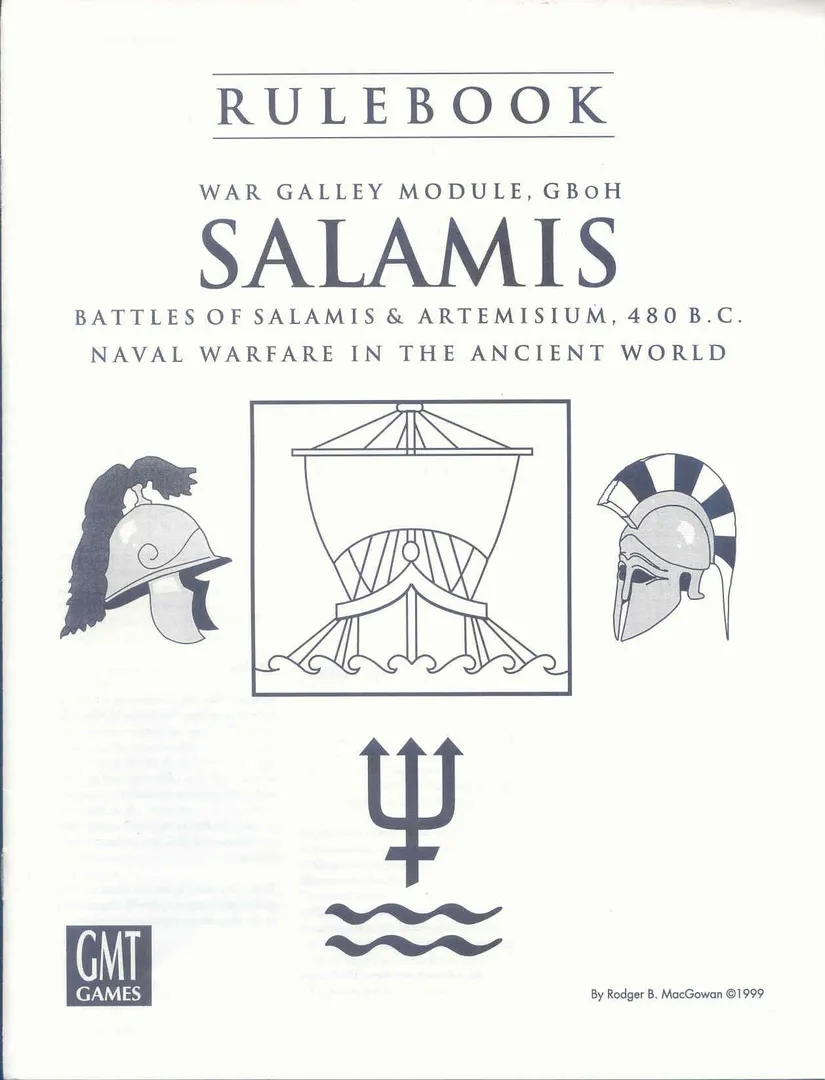
Add-on module for War Galley: Naval Warfare in the Ancient World. Salamis, one of the most famous naval battles in history, was a direct result of the Persian need to keep their large, invading army supplied by controlling the sea lanes. With Xerxes' army temporarily delayed at Thermopylae, the Greek fleet, based at Artemisium, some 50 miles or so directly east of Thermopylae, took the opportunity to attempt to stop the Persians from extending this Line of Communications. In a battle that appears to have extended over two or three days, the Greeks managed to eke out a slim tactical win. However, when Thermopylae fell, Themistocles' position became untenable, and the Greek fleet retreated to anchorage in the narrow channel of the Bay of Eleusis, west of Athens, at Salamis. With her naval flanks secured, the Persians rolled into lower Greece, capturing Athens and razing the town. However, to complete his subjugation of Greece, Xerxes had to destroy their fleet. To that end, the Persians sailed to a position south of Salamis. At Artemisium the Greeks had learned that, while their crews and marines were superior, the huge disparity in numbers could be telling. Unless they could neutralize this Persian strength. To that end, Themistocles lured the huge Persian fleet to attack the Greeks in the Bay of Eleusis, whose entrances were so restrictive as to negate any numerical superiority. There were two entrances to the bay. To plug up the western escape hatch, Xerxes dispatched his crack Egyptian squadron. Upon hearing this, Adeimantus and his Corinthians peeled off from the main fleet and sailed to the western mouth to block any Egyptian attempt to gain entrance. This "action" appears to have been a stand off, with both sides "blockading" and not fighting. At the eastern entrance, the Greeks deployed in three lines, along a narrow front of about 1800 yards, thus negating Persian numerical superiority. The Persians entered the bay in three long lines astern, which they then turned into nine lines abreast. The result was a boarding battle, and this was where the Greeks shone. Despite having half the manpower per ship of the Persians, their weaponry, armor and land-based tactics were superior to that of the Persians. And that superiority resulted in a smashing Greek victory. Xerxes retired to Thessaly, to try again the next year. The result was a great Greek victory, on land, at Plataea, followed by the Greek victory that completely cut Persian Lines of Communication, at Mycale. (from GMT website)
По данным каталога, «Salamis» рассчитана на 2 игроков. Это число игроков, указанное издателем, то есть игра задумана ровно для такого количества участников. Варианты для другого состава, если они есть, описаны в правилах вашего издания; проверьте их, прежде чем готовить другую конфигурацию.
В каталоге для «Salamis» указано время партии 360 минут — это оценка издателя для полной партии. Фактическая длительность зависит от состава, числа игроков и знакомства с правилами: первые партии обычно идут дольше, опытные компании заканчивают быстрее. Подготовка и объяснение правил в эту оценку не входят.
В каталоге для «Salamis» указан возраст от 12 лет. Это рекомендация издателя: она учитывает необходимость чтения, сложность правил и мелкие компоненты, а не только тему. Младшие игроки часто могут участвовать с помощью взрослого; проверьте возрастную рекомендацию на своём издании и учтите опыт вашей компании в настольных играх.
Сложность «Salamis» — 3,1 из 5 по оценкам игроков BoardGameGeek, это игра средней сложности. Оценка отражает, сколько знания правил, планирования и решений требует типичная партия. Сложные игры дольше объяснять в первый раз, поэтому перед игровым вечером пригодится руководство по подготовке.
Категории игры «Salamis»: Wargame, Nautical и Ancient. Основные механики: Hexagon Grid. Категории описывают тему и сеттинг игры, а механики — то, что игроки на самом деле делают в свой ход. Каждая механика ведёт в раздел каталога с похожими играми, и так проще найти что-то подобное для следующей партии.
В каталоге авторами «Salamis» указаны: Richard H. Berg и Mark Herman. Эти данные взяты из опубликованной информации об игре и называют людей, ответственных за её дизайн, а не иллюстраторов или издателей. Страницы авторов на MeepleRules собирают другие игры тех же авторов — это удобно, когда игра понравилась и хочется найти похожие.
В каталоге «Salamis» отмечено как дополнение к игре «War Galley: Naval Warfare in the Ancient World». Дополнения добавляют новый контент, правила или сценарии к базовой игре и обычно не играются сами по себе, поэтому для него нужна «War Galley: Naval Warfare in the Ancient World». Проверьте, что ваше издание «War Galley: Naval Warfare in the Ancient World» совместимо: некоторые дополнения перерабатывались между изданиями.