
- BGG-Rang
- BGG #6.992
- BGG-Bewertung
- 7,4
The Dark Sands: War in North Africa, 1940-42
- 1–2 Spieler
- 90–1500 Min.
- Komplexität 2,9/5
- 2018
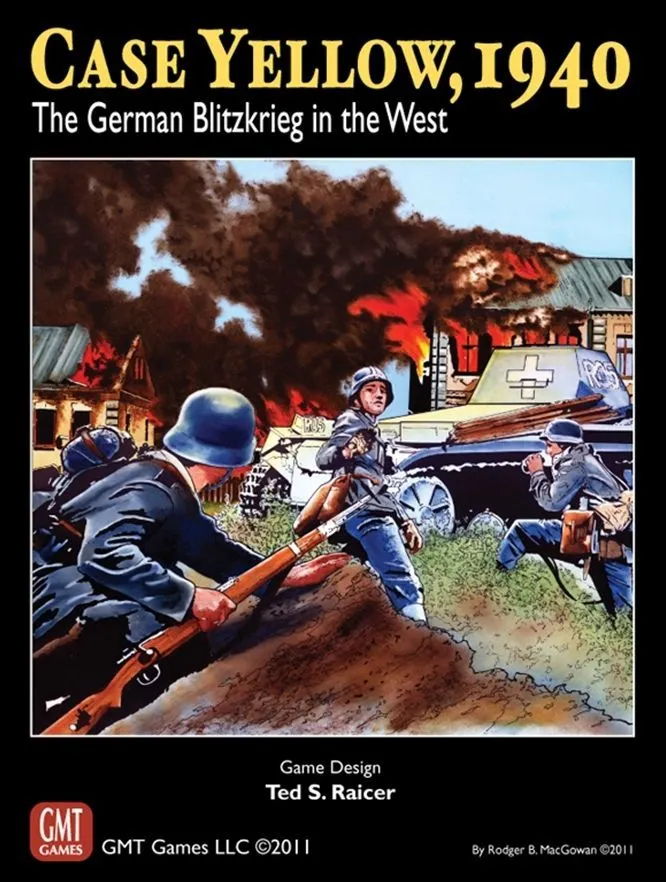
2011
Regelhilfe für Case Yellow, 1940: The German Blitzkrieg in the West
Verständliche Erklärungen zu Spielzügen, Karteneffekten und strittigen Situationen mit Verweisen auf offizielle Quellen und gespeichertem Fragenverlauf.
Für 2 Personen
Was möchtest du wissen?
Antworten stammen aus dem offiziellen Regelheft, mit Seitenangabe zum Nachprüfen.
Case Yellow, 1940: The German Blitzkrieg in the West ist ein Brettspiel aus dem Jahr 2011 für 2 Personen und mit 180 Minuten pro Partie. Entwickelt wurde es von Ted Raicer; die wichtigsten Mechaniken sind Dice Rolling, Grid Movement und Hexagon Grid.





Auf Englisch
September 1st, 1939: Germany invades Poland, setting off the Second World War. Except for minor attacks, France and Great Britain, the victors of World War One, do nothing. The Allies view the short Polish campaign of 1939 as a case of a newer, larger army winning out over an older, smaller army. Certainly the massed panzers are impressive, and need to be emulated, but the winter months see little positive activity on the Allied side. Missing the more vital lessons of the Polish campaign, the Allies are content to wait. Not only do their armies outnumber the Germans in terms of manpower, tanks and artillery, they have the advantage of operating on the defensive. Meanwhile the Germans feverishly apply the lessons they learned in Poland, and hone their operational techniques. The surprise German conquest of Norway jolts the Allies out of their lethargy. They do not have long to wait for the next blow. May 10th, 1940: Germany unleashes its Blitzkrieg upon the western Allies. Six weeks later, the war ends in a smashing German victory. Four Allied national armies have vanished. The tiny Dutch and Belgian armies, pulverized in battle, have surrendered. Great Britain rescues most of the soldiers in the BEF, but their heavy weapons and vehicles remain on the beaches of Dunkirk. The island nation begins to re-arm, but for now is out of the fight. The proud French Army, with many regiments tracing an unbroken lineage back to the 1600s, suffers the most catastrophic defeat of modern times before France surrenders. How did this happen? The Germans, realizing they could not win a repeat of World War One, set about reinventing the offense. Their formula included massed tank formations, an air force dedicated to close tactical support, and most importantly, a command and control system based on the use of radios. Allied tanks and soldiers were often equal or superior to their German counterparts – when given the opportunity to properly deploy and prepare. Unfortunately, such opportunities were few and far between. The Germans had securely positioned themselves inside an Allied decision making process that often took days to execute, rapidly concentrating, overwhelming defenders and then exploiting success. Certainly there were answers to every German innovation, but in six short weeks the Allies did not have the time to find them. Case Yellow is a simple, but accurate, simulation recreating this monumental campaign. Each game turn is divided into eight action segments. Each player has four action chits. The initiative player selects the first action chit to play. The remaining seven chits are placed in an opaque cup and drawn randomly. In most cases the Germans have the initiative and go first by playing one of their four action chits. Each German chit is marked for movement or combat, and the German player chooses what his army will do (though the German player during the course of a turn must use two chits for movement and two chits for combat). At the end of movement, any panzer or motorized formation adjacent to Allied units has the option to attack. If combat is chosen, all German units adjacent to Allied units may attack if allowed by terrain. Two Allied chits are marked two for movement and two for combat – not both. The creaky Allied command structure will bedevil the Allied player throughout the game. Need to move? Sorry – you just drew a combat chit. Set up to attack? You drew a move chit, and only the number of motorized formations equaling the roll of a six-sided die can attack. Zones of control reflect that the infantry of both sides still fight by the rules of World War One. Infantry units must stop when entering an enemy zone of control. Mount a one hex infantry attack against a defender hex, and you attack only the units in the defender hex. Mount a two hex (or greater) infantry attack against a defender hex, and all adjacent enemy hexes must also be attacked (large-scale infantry attacks take time to set up, and the defender has the time to integrate adjacent units into the defense plan). Motorized units play by different rules, though the Germans with their better-trained, veteran formations do it much better than the Allies. Simply stated, any motorized unit with a Troop Quality (TQ) higher than any adjacent unit may disregard those adjacent units’ zones of control for purposes of movement, combat and retreat. Only a solid line is proof against motorized unit exploitation and envelopment, and only so long as combat does not create gaps. Additionally, motorized units only may attack a defender hex from two hexes without engaging any other adjacent defender units – the speed of motorized concentration allows the attack to go in before a traditional defensive response can be established. The Luftwaffe is present in overwhelming strength, allowing the German player to negate the toughest defensive positions if necessary. Each Luftwaffe asset marker provides a one column shift on the combat table. Each Allied air asset marker provides the same shift, but there are far fewer Allied markers – not that the Allies had far fewer planes (they had almost as many), but the Allied air-ground coordination was so cumbersome that planes usually did not arrive in time to influence the battles being fought.
Laut Katalog unterstützt Case Yellow, 1940: The German Blitzkrieg in the West 2 Personen. Das ist die vom Verlag angegebene Spielerzahl, das Spiel ist also genau für diese Anzahl von Mitspielenden ausgelegt. Varianten für andere Gruppengrößen sind, sofern vorhanden, in der Anleitung deiner Ausgabe beschrieben; prüfe sie, bevor du eine andere Konfiguration aufbaust.
Die angegebene Spieldauer für Case Yellow, 1940: The German Blitzkrieg in the West beträgt 180 Minuten. Das ist die Schätzung des Verlags für eine vollständige Partie. Die tatsächliche Dauer hängt von der Gruppe, der Personenzahl und der Regelkenntnis ab: Erste Partien dauern meist länger, erfahrene Gruppen sind oft schneller fertig. Aufbau und Regelerklärung sind in dieser Schätzung nicht enthalten.
Case Yellow, 1940: The German Blitzkrieg in the West hat bei BoardGameGeek eine Komplexitätswertung von 3,2 von 5 und gilt damit als mittelschweres Spiel. Die Wertung zeigt, wie viel Regelwissen, Planung und Entscheidungen eine typische Partie verlangt. Schwerere Spiele brauchen bei der ersten Erklärung mehr Zeit, daher hilft vor dem Spieleabend eine Vorbereitungsanleitung.
Case Yellow, 1940: The German Blitzkrieg in the West gehört zu diesen Kategorien: Wargame und World War II. Die wichtigsten Mechaniken sind Dice Rolling, Grid Movement und Hexagon Grid. Kategorien beschreiben Thema und Setting eines Spiels, Mechaniken dagegen, was die Spielenden in ihrem Zug tatsächlich tun. Jede Mechanik führt zu einer Katalogseite mit ähnlichen Spielen, falls du etwas Vergleichbares suchst.
Als Autoren von Case Yellow, 1940: The German Blitzkrieg in the West sind angegeben: Ted Raicer. Diese Angaben stammen aus den veröffentlichten Spieldaten und nennen die für das Spieldesign verantwortlichen Personen, nicht die Illustratoren oder Verlage. Die Autorenseiten auf MeepleRules sammeln weitere Titel derselben Autoren – praktisch, wenn dir ein Spiel gefällt und du ähnliche Spiele suchst.
Im Katalog ist Case Yellow, 1940: The German Blitzkrieg in the West als Grundspiel aufgeführt. Es lässt sich eigenständig mit dem Material aus der Schachtel spielen und benötigt keinen weiteren Titel. Erweiterungen, sofern es welche gibt, ergänzen neues Material oder neue Regeln und sind im Katalog separat mit einem Verweis auf dieses Grundspiel aufgeführt.