
- BGG-Rang
- BGG #1.286
- BGG-Bewertung
- 7,9
Chronicles of Crime: 1900
- 1–4 Spieler
- 60–90 Min.
- Komplexität 1,9/5
- 2021
2021
Regelhilfe für Chronicles of Crime: 2400
Verständliche Erklärungen zu Spielzügen, Karteneffekten und strittigen Situationen mit Verweisen auf offizielle Quellen und gespeichertem Fragenverlauf.
Für 1 Person
Was möchtest du wissen?
Antworten stammen aus dem offiziellen Regelheft, mit Seitenangabe zum Nachprüfen.
Chronicles of Crime: 2400 ist ein Brettspiel aus dem Jahr 2021 für 1–4 Personen, mit 60–90 Minuten pro Partie und ab 12 Jahren. Entwickelt wurde es von David Cicurel und Wojciech Grajkowski; die wichtigsten Mechaniken sind Variable Player Powers, Deduction und Storytelling.




Auf Englisch
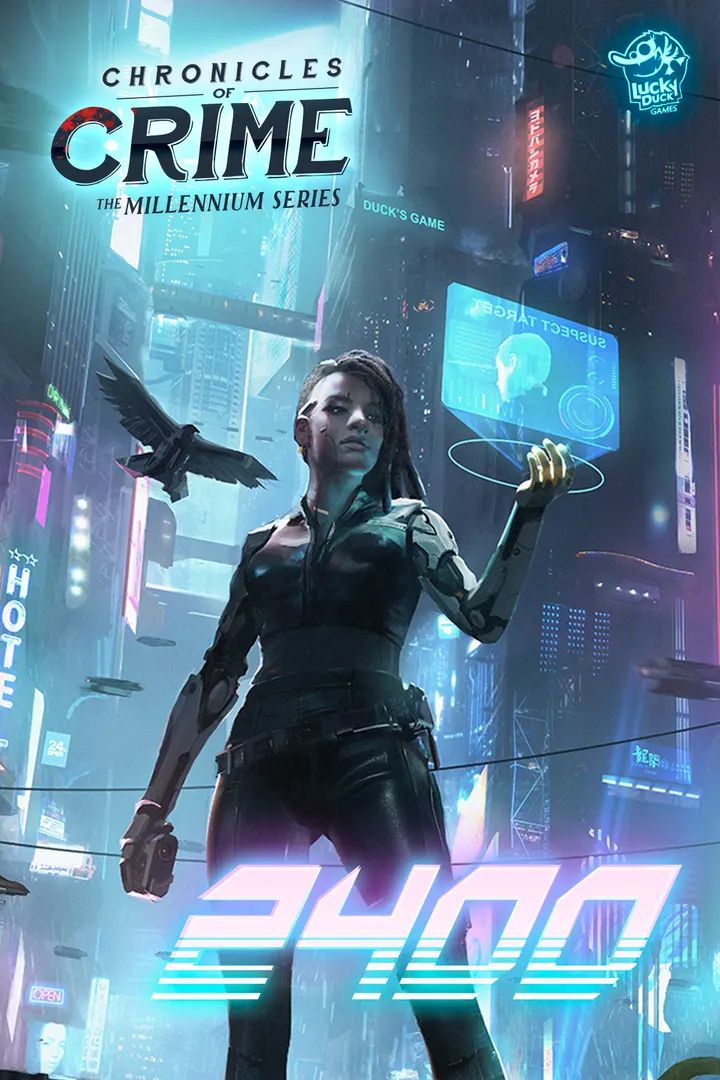
“You are Kalia Lavel. You’ve always wanted to fight crime like your famous ancestors, so you joined the elite BelCor forces. They turned you into a highly trained cyber-agent, but it didn’t take you long to figure out that your bosses cared much more about their profit than about justice for ordinary people. You turned in your badge and now you live in a tiny apartment in a bad neighborhood, stripped of most of your cybernetic implants. It doesn’t matter though, as you can finally do what a Lavel is meant to do: solve crimes and help those who can’t count on anyone else in this merciless world.” In the standalone game Chronicles of Crime: 2400, you can use all the latest technology to solve crimes. Your pet Cyber-Raven can analyze evidence and search the web to find information on suspects. During the course of a scenario, you may also obtain cybernetic implants that would increase your abilities. Super-senses that help you find evidence on the crime scene? A tomograph to quickly check the person you’re talking to for cyber enhancements? Or maybe a zapper to quickly neutralize any electronic device? The future is full of useful stuff! Be careful though, as the technology is not always on your side! Is the character you’re talking to a human or an android? Who’s hiding behind the avatars you meet in the virtual cyberspace locations? The struggle between criminals and detectives is millennia old, but at the beginning of the 25th century, it’s been taken to a whole new level. Welcome to Paris in the year 2400! Technology has taken a giant leap forward: androids, indistinguishable from humans, walk the streets, and having cybernetic implants has slowly become the norm. Artificial intelligence plays a major role in everyone’s daily life and, for many, Cyberspace has become a world as important as the real one. The landscape of Paris is now dominated by a gargantuan translucent Dome covering half a district. Under it, there’s a private city on its own, created and ruled by BelCor. Only the rich and privileged can live there and enjoy comfortable houses, unlimited access to water, clean air and controlled temperature. Uneven access to new technologies, and a host of other inequalities, fuel social unrest which often turns into open violence. Paris has become a popular destination for people from regions that suffered catastrophic droughts, epidemics, and wars. It isn’t, however, a promised land, but a merciless world where the constant fight for influence takes place on every level, from big international corporations, through political extremist groups to ordinary street gangs. Part of Chronicles of Crime - The Millennium Series Chronicles of Crime is back with a range of games called "The Millennium Series". Three brand new standalone Chronicles of Crime games, working with the same great system but providing interesting gameplay twists and refreshing universes that span an entire millennium from 1400 to 1900 and finally 2400. All three games are standalone but will offer connecting narrative threads for players to discover. -description from publisher
Laut Katalog unterstützt Chronicles of Crime: 2400 1–4 Personen. Diese Spanne entspricht der vom Verlag angegebenen Spielerzahl, das Spiel lässt sich also für jede Gruppengröße innerhalb dieser Spanne aufbauen. Aufbau, einzelne Regeln und Wertungsdetails können je nach Personenzahl trotzdem abweichen; prüfe daher die genaue Konfiguration in der Anleitung deiner Ausgabe.
Die angegebene Spieldauer für Chronicles of Crime: 2400 beträgt 60–90 Minuten. Das ist die Schätzung des Verlags für eine vollständige Partie. Die tatsächliche Dauer hängt von der Gruppe, der Personenzahl und der Regelkenntnis ab: Erste Partien dauern meist länger, erfahrene Gruppen sind oft schneller fertig. Aufbau und Regelerklärung sind in dieser Schätzung nicht enthalten.
Im Katalog wird Chronicles of Crime: 2400 ab 12 Jahren empfohlen. Das ist die Empfehlung des Verlags und berücksichtigt Leseanforderungen, Regelkomplexität und Kleinteile, nicht nur das Thema. Jüngere Kinder können oft mit Hilfe eines Erwachsenen mitspielen; beachte die Altersangabe deiner Ausgabe und die Brettspielerfahrung deiner Gruppe.
Chronicles of Crime: 2400 hat bei BoardGameGeek eine Komplexitätswertung von 2,2 von 5 und gilt damit als eher leichtes Spiel. Die Wertung zeigt, wie viel Regelwissen, Planung und Entscheidungen eine typische Partie verlangt. Schwerere Spiele brauchen bei der ersten Erklärung mehr Zeit, daher hilft vor dem Spieleabend eine Vorbereitungsanleitung.
Chronicles of Crime: 2400 gehört zu diesen Kategorien: Deduction, Murder / Mystery und Adventure. Die wichtigsten Mechaniken sind Variable Player Powers, Deduction und Storytelling. Kategorien beschreiben Thema und Setting eines Spiels, Mechaniken dagegen, was die Spielenden in ihrem Zug tatsächlich tun. Jede Mechanik führt zu einer Katalogseite mit ähnlichen Spielen, falls du etwas Vergleichbares suchst.
Als Autoren von Chronicles of Crime: 2400 sind angegeben: David Cicurel und Wojciech Grajkowski. Diese Angaben stammen aus den veröffentlichten Spieldaten und nennen die für das Spieldesign verantwortlichen Personen, nicht die Illustratoren oder Verlage. Die Autorenseiten auf MeepleRules sammeln weitere Titel derselben Autoren – praktisch, wenn dir ein Spiel gefällt und du ähnliche Spiele suchst.
Im Katalog ist Chronicles of Crime: 2400 als Grundspiel aufgeführt. Es lässt sich eigenständig mit dem Material aus der Schachtel spielen und benötigt keinen weiteren Titel. Erweiterungen, sofern es welche gibt, ergänzen neues Material oder neue Regeln und sind im Katalog separat mit einem Verweis auf dieses Grundspiel aufgeführt.