

- BGG-Rang
- BGG #8.197
- BGG-Bewertung
- 7,0
The Great War in Europe: Deluxe Edition
- 2–4 Spieler
- 600 Min.
- Komplexität 3,6/5
- 2007
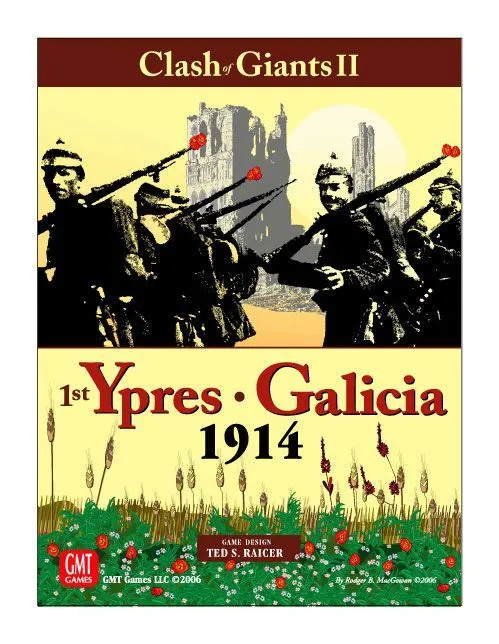
2006
Regelhilfe für Clash of Giants II: 1st Ypres & Galicia 1914
Verständliche Erklärungen zu Spielzügen, Karteneffekten und strittigen Situationen mit Verweisen auf offizielle Quellen und gespeichertem Fragenverlauf.
Für 1 Person
Was möchtest du wissen?
Antworten stammen aus dem offiziellen Regelheft, mit Seitenangabe zum Nachprüfen.
Clash of Giants II: 1st Ypres & Galicia 1914 ist ein Brettspiel aus dem Jahr 2006 für 1–2 Personen und mit 300 Minuten pro Partie. Entwickelt wurde es von Ted Raicer; die wichtigsten Mechaniken sind Hexagon Grid und Chit-Pull System.




Auf Englisch
Clash of Giants II: The Campaigns of Galicia and First Ypres, 1914 is the sequel to Ted Raicer's acclaimed Clash of Giants: Campaigns of Tannenberg and the Marne, 1914. As with the original design, CoG II contains two separate games (both using the same basic system) covering two of the most interesting (and least-gamed) campaigns of the First World War, Galicia and First Ypres . Galicia 1914 pitted the armies of Tsarist Russia and Habsburg Austria-Hungary in a ferocious struggle along a 200 mile front. The Austrian commander, General Conrad, refused to wait for the arrival of his 2nd Army, which had been initially deployed to the Serbian front, before going onto the offensive. The Austrian attack began on 19 August, with Conrad's 1st and 4th Armies on the Austrian left flank striking the Russian 4th and 5th Armies on the Tsarist right. The Austrians outnumbered the Russians on this flank, and initially drove them back, and Conrad began to dream of pocketing the entire Russian army group. But the absence of the Austrian 2nd Army gave the Russians an even greater numerical advantage on the opposite flank, as two Russian armies (the 3rd and 8th) struck the Austrian 3rd east of Lemberg (Lvov). Soon it was Conrad's armies that were in danger of being cut off and destroyed. The campaign was a catastrophe for Austria-Hungary, but in the end the result was a fatally incomplete victory for the Russians. The First Ypres game is the first game to cover the climax of the "Race to the Sea" on the Western Front that followed the inconclusive Allied victory at the Marne. By 8 October the continued outflanking attempts by both sides had nearly reached the English Channel. A massive meeting engagement developed, with the Germans first attempting to launch a massive cavalry raid around the Allied northern flank in the direction of Abbeville. When this fizzled (due to the timely arrival of a French infantry corps), the French and British began their own offensive aimed at driving all the way to the German border. But the Allied attack quickly ran into German troops of the 6th Army, hurried north from Alsace-Lorraine. Falkenhayn, the German commander, now planned to play his trump card, striking the BEF with four newly-raised reserve corps of hurriedly-trained but enthusiastic volunteers. In a month of brutal struggle in which the British lost 60,000 men, the Germans lost well over 100,000. Not realizing that the BEF had been bled white and was on the point of breaking, Falkenhayn called off his attacks in mid-November. The attempts to end the war by Christmas were over. Clash of Giants II uses a slightly modified version of the original system to model these dynamic and closely balanced contests. As in Clash of Giants, the game emphasizes the difficulty of commanding groups of armies, with a system where movement allowance for each army is separately determined by a command roll. But CoGII adds an interactive random chit-pull activation sequence, so that neither player knows which of his commands will move next. Each player has only one combat phase per turn, which he may declare at the end of any one of his command activations, but which covers the entire map. This leads to many difficult game decisions: "Do I declare combat now, with only part of my forces in position to attack, or wait hoping to get more units into the line, but risking the enemy either pulling back or striking first?" Once combat is declared, CoGII uses the unique combat system so popular in Tannenberg and Marne, in which a unit's training, equipment, and morale are factored into a Tactical Effiency Rating that often counts more than mere numbers. Galicia 1914 includes a corps/division OB and a map scaled at 9 miles to the hex that covers the entire front from Krakow to the Romanian border. The victory conditions force the Austrian player to attack initially in order to gain enough VPs to survive the strong Russian offensive certain to follow. Galicia features special rules for the great Austrian fortress of Przemysl, Russian cavalry replacements, rail supply, Offensive Support Markers (representing heavy artillery and the logistical and command preparations of a major assault), and the arrival of the Austrian 2nd Army. The OB for First Ypres is at division level (with the odd brigade). The map scale is 3.3 miles to the hex, from Lens in the south to the English Channel. Special rules include Offensive Support Markers, the Belgian retreat onto the map from Antwerp, flooding the Yser River line, French and German cavalry replacements, unknown Tactical Efficiency Ratings for the German New Reserve Corps, and British tenacity (represented by remnant counters). Victory goes to the player who controls 5 of the 9 victory hexes at the end of the game, and the game is sometimes decided on the final combat roll by a last-ditch attack or defense of a single key hex. Components One 22" x 34" backprinted game map Two 8.5 x 11 Player Aid Cards Two 5/8" Countersheets Two Six-sided Dice (from GMT Games website)
Laut Katalog unterstützt Clash of Giants II: 1st Ypres & Galicia 1914 1–2 Personen. Diese Spanne entspricht der vom Verlag angegebenen Spielerzahl, das Spiel lässt sich also für jede Gruppengröße innerhalb dieser Spanne aufbauen. Aufbau, einzelne Regeln und Wertungsdetails können je nach Personenzahl trotzdem abweichen; prüfe daher die genaue Konfiguration in der Anleitung deiner Ausgabe.
Die angegebene Spieldauer für Clash of Giants II: 1st Ypres & Galicia 1914 beträgt 300 Minuten. Das ist die Schätzung des Verlags für eine vollständige Partie. Die tatsächliche Dauer hängt von der Gruppe, der Personenzahl und der Regelkenntnis ab: Erste Partien dauern meist länger, erfahrene Gruppen sind oft schneller fertig. Aufbau und Regelerklärung sind in dieser Schätzung nicht enthalten.
Clash of Giants II: 1st Ypres & Galicia 1914 hat bei BoardGameGeek eine Komplexitätswertung von 2,4 von 5 und gilt damit als eher leichtes Spiel. Die Wertung zeigt, wie viel Regelwissen, Planung und Entscheidungen eine typische Partie verlangt. Schwerere Spiele brauchen bei der ersten Erklärung mehr Zeit, daher hilft vor dem Spieleabend eine Vorbereitungsanleitung.
Clash of Giants II: 1st Ypres & Galicia 1914 gehört zu diesen Kategorien: Wargame und World War I. Die wichtigsten Mechaniken sind Hexagon Grid und Chit-Pull System. Kategorien beschreiben Thema und Setting eines Spiels, Mechaniken dagegen, was die Spielenden in ihrem Zug tatsächlich tun. Jede Mechanik führt zu einer Katalogseite mit ähnlichen Spielen, falls du etwas Vergleichbares suchst.
Als Autoren von Clash of Giants II: 1st Ypres & Galicia 1914 sind angegeben: Ted Raicer. Diese Angaben stammen aus den veröffentlichten Spieldaten und nennen die für das Spieldesign verantwortlichen Personen, nicht die Illustratoren oder Verlage. Die Autorenseiten auf MeepleRules sammeln weitere Titel derselben Autoren – praktisch, wenn dir ein Spiel gefällt und du ähnliche Spiele suchst.
Im Katalog ist Clash of Giants II: 1st Ypres & Galicia 1914 als Grundspiel aufgeführt. Es lässt sich eigenständig mit dem Material aus der Schachtel spielen und benötigt keinen weiteren Titel. Erweiterungen, sofern es welche gibt, ergänzen neues Material oder neue Regeln und sind im Katalog separat mit einem Verweis auf dieses Grundspiel aufgeführt.