
- BGG-Rang
- BGG #3.704
- BGG-Bewertung
- 7,5
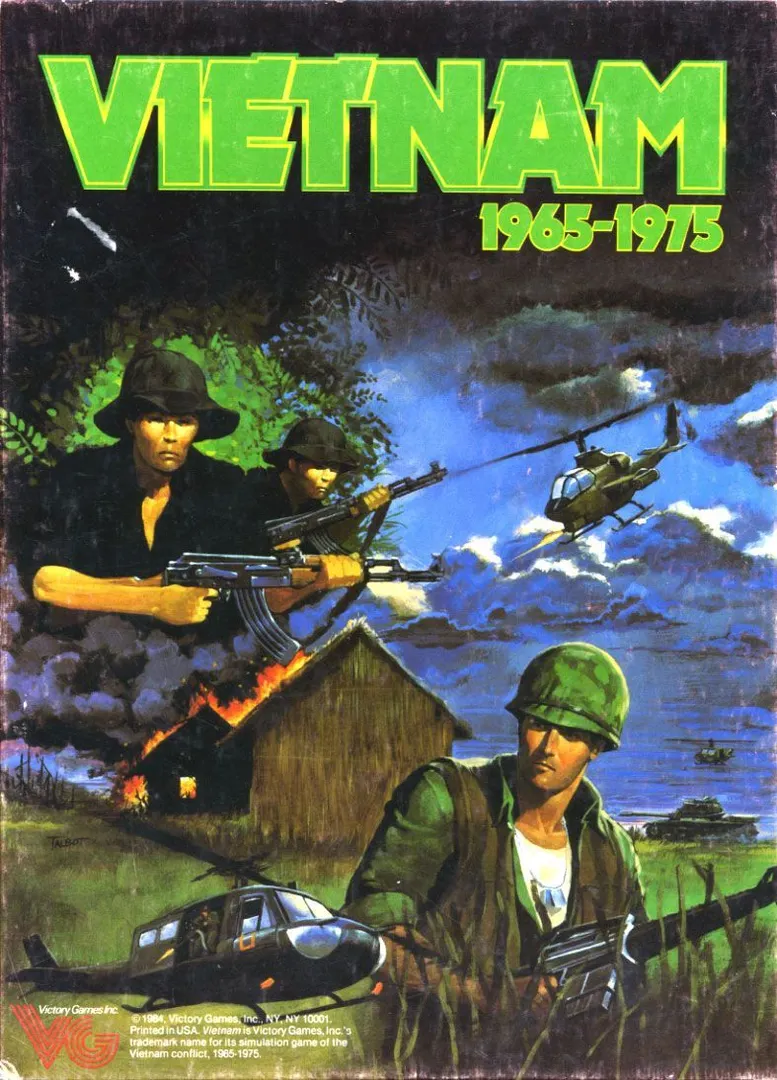
Vietnam 1965-1975
- 2 Spieler
- 360–6000 Min.
- Komplexität 4,3/5
- 1984
2014
Regelhilfe für Dien Bien Phu: The Final Gamble
Verständliche Erklärungen zu Spielzügen, Karteneffekten und strittigen Situationen mit Verweisen auf offizielle Quellen und gespeichertem Fragenverlauf.
Für 1 Person
Was möchtest du wissen?
Antworten stammen aus dem offiziellen Regelheft, mit Seitenangabe zum Nachprüfen.
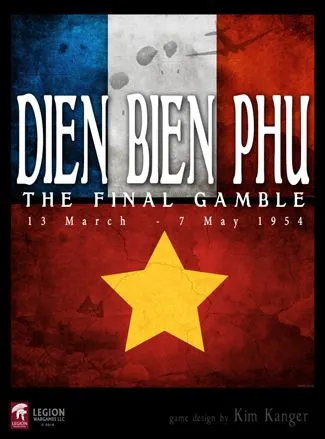
Dien Bien Phu: The Final Gamble ist ein Brettspiel aus dem Jahr 2014 für 1–2 Personen und mit 360–1440 Minuten pro Partie. Entwickelt wurde es von Kim Kanger; die wichtigsten Mechaniken sind Dice Rolling und Hexagon Grid.






Auf Englisch
"Dien Bien Phu - The Final Gamble" is a two-player wargame about the decisive battle of Dien Bien Phu in 1954 that not only ended the French Indochina War but also had political repercussions far outside the region itself. One player represents France and her colonial troops. The other player represents the armed force of Viet Minh, the communist/nationalist independence movement of Vietnam. This is a cage fight. There are no victory points, there is no marginal victory and there is no draw. Viet Minh wins by forcing the French troops to surrender. France wins by not surrendering. Map and scale: The map covers the former village of Dien Bien Phu and surrounding areas. There is a small submap of the French strongpoint "Isabelle" further south in the valley. There are several groups of French strongpoints scattered around the map, each one with a female name (all named after the commander - de Castries' - mistresses, according to lore). The map is divided into three divisional sectors (plus a fourth one facing the submap "Isabelle"). Each sector has several zones that represent Viet Minh trenches winding from the map edge towards the center of the map. Each hex represents 150 meters and each game turn covers three days. There are 21 turns in the game, but historically, it ended after 19 game turns with a Viet Minh victory. The scale allows stacking of three French units (usually infantry companies) in a hex, but there are no stacking limits for Viet Minh battalions, which creates a chess feel. Three Viet Minh battalions form a regiment and three regiments become a division and there were almost four full divisions in the valley, as well as a full artillery division off map. There was also an equivalent of another three divisions in a replacement pool outside the valley. The French troops were a colorful array of colonial paras, Vietnamese troops, units from French Algeria and Morocco, and, of course, the French Foreign Legion. Some units are of average quality, some are outright terrible, but some are the very best that could be mustered ... anywhere. A French battalion consisted of four companies and there were 12 battalions together with 11 auxiliary light companies at the start of the siege, as well as 16 artillery and mortar batteries, and three tank platoons. Waiting in Hanoi were another five para battalions together with an expected replacement pool of about 14 companies. In neighboring Laos, there were four battalions ready to march and perhaps save the day at the very end. French supply: This battle took place far out in the wilderness of Vietnam and both sides had to adjust to the limited flow of supplies that could be brought forward, though the air to the French, and through vast forests to the Viet Minh. Supplies, as historically was the case, tend to be a lot less than wished for. There are several supply tracks on the map showing how much ammo, food & bullets, fuel & spares, medicine as well as the amount of truck transport available for the French. Each game turn air transports will bring in a mix of supplies together with replacements and reinforcements. This is done on a chart with a grid where a mix of supply markers are placed together with eventual reinforcements and replacements. Weather will then decide what will arrive and what will abort back to Hanoi. The French player will never know for sure what and how much will arrive and has to take that into account. Viet Minh supply and morale: Viet Minh will receive a more steady flow of ammunition, but not enough to barrage whenever wished. There is a large pool of replacements to use, but although it is large, it is not infinite. If Viet Minh losses are too heavy, then the fact that you can only replace one step per regiment per game turn will be a painful experience. If loses are too heavy for too long, then the pool will dry out. Viet Minh's main concern is troop morale. The battle force starts with excellent morale, but each division's morale will decrease when taking replacements thus diluting the experienced veterans with newly drafted peasants with no combat experience. Morale will rise slightly when resting (not assaulting). But then again, time flies and there is a battle to win. Morale is a very important part of the game and if it falls too low, the troops will be rendered useless. Artillery: Artillery is another important aspect of the battle. There is bombardment from both sides before assaults commence. You wish to achieve two things with barrage: Losses and to make the target shaken. Targets that are shaken lose abilities to react and support combat, and they become easier to assault. Defending units bring in barrage to make it harder for the attacker to succeed. Viet Minh artillery is off-board and safe from French artillery fire (mainly that they were dug deep into the mountainsides). French artillery and mortar units, on the other hand, exist as units on the board and may fall prey to Viet Minh bombardment. French artillery units that are reduced and/or shaken are not as efficient, and those that are eliminated are obviously out of play. Both sides have a limited amount of ammunition and therefore have to spend it wisely. Combat: The main effort in the game is, of course, the assaults. Each player will conduct two die-rolls during the course of an assault to determine the outcome. The defender first conducts defensive fire in the hopes of inflicting losses, but also to possibly force the attacker abort the assault. The defender’s first die roll is compared to their strength and will show how well they defend. The defender’s second die-roll (modified from the result of the first die roll), is compared to the assaulting unit's morale and will determine the result of the defensive fire. Providing the assaulting units do not abort, the attacker (who has suffered the effects of the defensive fire) conducts two die rolls. The first one to see how well the assault is conducted, and the second one to see the outcome of the assault. Modifications, such as trenches, terrain, support from other units, etc., adjust the strength of a unit to make it stronger or weaker. You will never know for sure what that result will be due to the two die-rolls on each side. Dien Bien Phu – The Final Gamble, will be as tense and brutal a simulation as was the historical battle that determined the fate of this war as well as shaping the events of things to come. Kim Kanger
Laut Katalog unterstützt Dien Bien Phu: The Final Gamble 1–2 Personen. Diese Spanne entspricht der vom Verlag angegebenen Spielerzahl, das Spiel lässt sich also für jede Gruppengröße innerhalb dieser Spanne aufbauen. Aufbau, einzelne Regeln und Wertungsdetails können je nach Personenzahl trotzdem abweichen; prüfe daher die genaue Konfiguration in der Anleitung deiner Ausgabe.
Die angegebene Spieldauer für Dien Bien Phu: The Final Gamble beträgt 360–1440 Minuten. Das ist die Schätzung des Verlags für eine vollständige Partie. Die tatsächliche Dauer hängt von der Gruppe, der Personenzahl und der Regelkenntnis ab: Erste Partien dauern meist länger, erfahrene Gruppen sind oft schneller fertig. Aufbau und Regelerklärung sind in dieser Schätzung nicht enthalten.
Dien Bien Phu: The Final Gamble hat bei BoardGameGeek eine Komplexitätswertung von 3,0 von 5 und gilt damit als mittelschweres Spiel. Die Wertung zeigt, wie viel Regelwissen, Planung und Entscheidungen eine typische Partie verlangt. Schwerere Spiele brauchen bei der ersten Erklärung mehr Zeit, daher hilft vor dem Spieleabend eine Vorbereitungsanleitung.
Dien Bien Phu: The Final Gamble gehört zu diesen Kategorien: Wargame, Modern Warfare und Vietnam War. Die wichtigsten Mechaniken sind Dice Rolling und Hexagon Grid. Kategorien beschreiben Thema und Setting eines Spiels, Mechaniken dagegen, was die Spielenden in ihrem Zug tatsächlich tun. Jede Mechanik führt zu einer Katalogseite mit ähnlichen Spielen, falls du etwas Vergleichbares suchst.
Als Autoren von Dien Bien Phu: The Final Gamble sind angegeben: Kim Kanger. Diese Angaben stammen aus den veröffentlichten Spieldaten und nennen die für das Spieldesign verantwortlichen Personen, nicht die Illustratoren oder Verlage. Die Autorenseiten auf MeepleRules sammeln weitere Titel derselben Autoren – praktisch, wenn dir ein Spiel gefällt und du ähnliche Spiele suchst.
Im Katalog ist Dien Bien Phu: The Final Gamble als Grundspiel aufgeführt. Es lässt sich eigenständig mit dem Material aus der Schachtel spielen und benötigt keinen weiteren Titel. Erweiterungen, sofern es welche gibt, ergänzen neues Material oder neue Regeln und sind im Katalog separat mit einem Verweis auf dieses Grundspiel aufgeführt.