
- BGG-Rang
- BGG #4.538
- BGG-Bewertung
- 7,2
Caesar: Epic Battle of Alesia
- 2–4 Spieler
- 360 Min.
- Komplexität 3,0/5
- 1976
2006
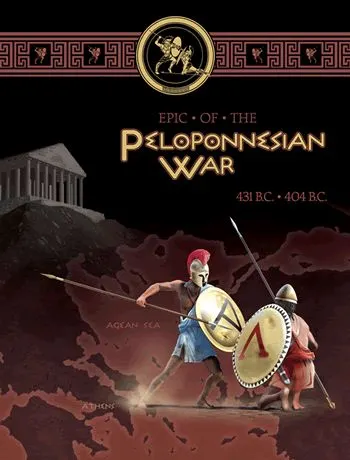
Regelhilfe für Epic of the Peloponnesian War: 431 B.C. - 404 B.C.
Verständliche Erklärungen zu Spielzügen, Karteneffekten und strittigen Situationen mit Verweisen auf offizielle Quellen und gespeichertem Fragenverlauf.
Für 2 Personen
Was möchtest du wissen?
Antworten stammen aus dem offiziellen Regelheft, mit Seitenangabe zum Nachprüfen.
Epic of the Peloponnesian War: 431 B.C. - 404 B.C. ist ein Brettspiel aus dem Jahr 2006 für 2–4 Personen, mit 300 Minuten pro Partie und ab 12 Jahren. Entwickelt wurde es von Kurt Kuhlmann und Jonathan Iwamasa; die wichtigsten Mechaniken sind Area Movement, Hexagon Grid und Simulation.

Auf Englisch
In the year 431BC, the Greek world was dominated by the Athenian Empire, due to their naval supremacy of the Aegean. Only the Spartans dared to challenge their might through the strength of their unsurpassed Hoplite troops. The result was a 30-year conflict that ended in the destruction of Greek dominance in the ancient world. Two to four players use military force and political influence in their struggle to control the city-states of ancient Greece. Playing time ranges from 4-10 hours for short scenarios, to 20+ hours for the full campaign game, as players mobilize forces four times a year, and deploy them three times each season. As the leader of the Athenian Empire, can you save Athens' glory from the Spartan onslaught? As the leader of the Peloponnesian League, can you free Greece from Athenian tyranny without destroying it in the process? Players have a full range of strategic options, including sieges, constructing and destroying fortifications, razing enemy cities, foraging and raiding. Event Cards provide both random events (such as storms at sea, bad omens, the crippling plague at Athens, etc.) and strategic targets (city betrayals, rebellion of Athenian regions, Persian support, the Sicilian Expedition, among others). Fleet units represent 25 triremes, the light war galleys of the ancient Mediterranean, plus associated transport vessels. Hoplite units represent 1,000 heavily-armored Greek infantrymen. Each cavalry unit represents about 400 men and horses. Light infantry includes all types of lightly armored foot soldiers, including missile troops and barbarians, with each unit representing between 1,000 and 5,000 men. The rules allow for historically accurate periods of peace, where both sides caught their breath while preparing for a renewed struggle. The Epic of the Peloponnesian War is a complete simulation of this conflict. Scenarios include the introductory Argive League scenario, played on only a portion of the map; three scenarios each covering only a portion of the war; and the full Campaign Game for 2-4 players (adding Thebes and Corinth to the Peloponnesian side as the third and fourth players).
Laut Katalog unterstützt Epic of the Peloponnesian War: 431 B.C. - 404 B.C. 2–4 Personen. Diese Spanne entspricht der vom Verlag angegebenen Spielerzahl, das Spiel lässt sich also für jede Gruppengröße innerhalb dieser Spanne aufbauen. Aufbau, einzelne Regeln und Wertungsdetails können je nach Personenzahl trotzdem abweichen; prüfe daher die genaue Konfiguration in der Anleitung deiner Ausgabe.
Die angegebene Spieldauer für Epic of the Peloponnesian War: 431 B.C. - 404 B.C. beträgt 300 Minuten. Das ist die Schätzung des Verlags für eine vollständige Partie. Die tatsächliche Dauer hängt von der Gruppe, der Personenzahl und der Regelkenntnis ab: Erste Partien dauern meist länger, erfahrene Gruppen sind oft schneller fertig. Aufbau und Regelerklärung sind in dieser Schätzung nicht enthalten.
Im Katalog wird Epic of the Peloponnesian War: 431 B.C. - 404 B.C. ab 12 Jahren empfohlen. Das ist die Empfehlung des Verlags und berücksichtigt Leseanforderungen, Regelkomplexität und Kleinteile, nicht nur das Thema. Jüngere Kinder können oft mit Hilfe eines Erwachsenen mitspielen; beachte die Altersangabe deiner Ausgabe und die Brettspielerfahrung deiner Gruppe.
Epic of the Peloponnesian War: 431 B.C. - 404 B.C. hat bei BoardGameGeek eine Komplexitätswertung von 4,0 von 5 und gilt damit als schweres Spiel. Die Wertung zeigt, wie viel Regelwissen, Planung und Entscheidungen eine typische Partie verlangt. Schwerere Spiele brauchen bei der ersten Erklärung mehr Zeit, daher hilft vor dem Spieleabend eine Vorbereitungsanleitung.
Epic of the Peloponnesian War: 431 B.C. - 404 B.C. gehört zu diesen Kategorien: Wargame und Ancient. Die wichtigsten Mechaniken sind Area Movement, Hexagon Grid und Simulation. Kategorien beschreiben Thema und Setting eines Spiels, Mechaniken dagegen, was die Spielenden in ihrem Zug tatsächlich tun. Jede Mechanik führt zu einer Katalogseite mit ähnlichen Spielen, falls du etwas Vergleichbares suchst.
Als Autoren von Epic of the Peloponnesian War: 431 B.C. - 404 B.C. sind angegeben: Kurt Kuhlmann und Jonathan Iwamasa. Diese Angaben stammen aus den veröffentlichten Spieldaten und nennen die für das Spieldesign verantwortlichen Personen, nicht die Illustratoren oder Verlage. Die Autorenseiten auf MeepleRules sammeln weitere Titel derselben Autoren – praktisch, wenn dir ein Spiel gefällt und du ähnliche Spiele suchst.
Im Katalog ist Epic of the Peloponnesian War: 431 B.C. - 404 B.C. als Grundspiel aufgeführt. Es lässt sich eigenständig mit dem Material aus der Schachtel spielen und benötigt keinen weiteren Titel. Erweiterungen, sofern es welche gibt, ergänzen neues Material oder neue Regeln und sind im Katalog separat mit einem Verweis auf dieses Grundspiel aufgeführt.