- BGG-Rang
- BGG #2.274
- BGG-Bewertung
- 6,9
Burg Appenzell
- 2–4 Spieler
- 30 Min.
- Komplexität 1,6/5
- 2007
2017
Regelhilfe für Five Little Fish
Verständliche Erklärungen zu Spielzügen, Karteneffekten und strittigen Situationen mit Verweisen auf offizielle Quellen und gespeichertem Fragenverlauf.
Was möchtest du wissen?
Antworten stammen aus dem offiziellen Regelheft, mit Seitenangabe zum Nachprüfen.
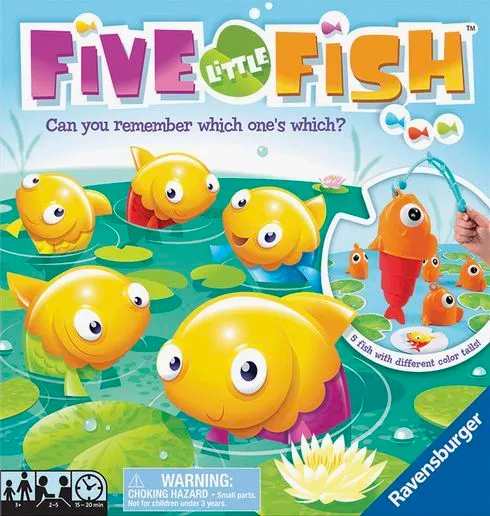
Five Little Fish ist ein Brettspiel aus dem Jahr 2017 für 2–4 Personen und ab 3 Jahren. Die wichtigsten Mechaniken sind Memory.




Auf Englisch
Fish or Frog, what’s hiding under the Lily Pads? It’s a classic game of matching with a clever twist that will keep parents and children guessing. Flip a Lily Pad Card to see which fish you need to catch. Use a Fishing Rod to hook the fish you think will match. Reel it in to reveal its telescoping colored tail. If it’s a match, you keep the catch! Pay close attention! If you flip over Grumpy Frog’s Lily Pad, you throw a fish back. Can you remember which one’s which? Catch the most fish to win! Place all the Little Fish in the center of the table so the heads face up, and the telescoping tails are tucked inside. Shuffle the Little Fish so no one knows which one’s which and put the Fishing Rods to the side. Shuffle the Lily Pad cards and lay them face down around the Little Fish. The youngest player goes first! Start by turning over a Lily Pad Card of your choice. If the Lily Pad shows a… Fish – Take a Fishing Rod, choose any one of the Little Fish on the table and hook it with the Fishing Rod. Lift the Little Fish so that everyone can see which colored body falls out from underneath the head. If it matches the fish shown on the Lily Pad Card, place it down on the table in front of you, making sure to collapse the body back inside its head. If there is no match, then the Little Fish you chose remains in its current position. Rainbow Fish – Choose ANY one of the Little Fish and drag it in front of you. Do NOT lift it up and reveal the color of the body. If there are no Little Fish in the middle of the table, then you may take one Little Fish sitting in front of another player, careful to not reveal the body of the Little Fish. Grumpy Frog – Bad Luck! Push one of your Little Fish from in front of you back in the middle of the table. Do NOT lift it up and reveal the colored body inside. If you don’t have a Little Fish in front of you then nothing happens and your turn is over. If you turn over a Lily Pad card that reveals a Little Fish that you think is already in front of you, then you can use a Fishing Rod to lift it up and show the match. If you’re correct, you may turn over another Lily Pad Card and have another turn. If you do not reveal the matching Little Fish, your turn is over. The game ends when all the Lily Pad Cards have been discarded. The player with the most fish in front of them wins! If it’s a tie, players will check the tail tips of their Little Fish – the player with the highest number on their Little Fish wins the game!
Laut Katalog unterstützt Five Little Fish 2–4 Personen. Diese Spanne entspricht der vom Verlag angegebenen Spielerzahl, das Spiel lässt sich also für jede Gruppengröße innerhalb dieser Spanne aufbauen. Aufbau, einzelne Regeln und Wertungsdetails können je nach Personenzahl trotzdem abweichen; prüfe daher die genaue Konfiguration in der Anleitung deiner Ausgabe.
Im Katalog wird Five Little Fish ab 3 Jahren empfohlen. Das ist die Empfehlung des Verlags und berücksichtigt Leseanforderungen, Regelkomplexität und Kleinteile, nicht nur das Thema. Jüngere Kinder können oft mit Hilfe eines Erwachsenen mitspielen; beachte die Altersangabe deiner Ausgabe und die Brettspielerfahrung deiner Gruppe.
Five Little Fish hat bei BoardGameGeek eine Komplexitätswertung von 1,0 von 5 und gilt damit als leichtes Spiel. Die Wertung zeigt, wie viel Regelwissen, Planung und Entscheidungen eine typische Partie verlangt. Schwerere Spiele brauchen bei der ersten Erklärung mehr Zeit, daher hilft vor dem Spieleabend eine Vorbereitungsanleitung.
Five Little Fish gehört zu diesen Kategorien: Animals, Children's Game und Memory. Die wichtigsten Mechaniken sind Memory. Kategorien beschreiben Thema und Setting eines Spiels, Mechaniken dagegen, was die Spielenden in ihrem Zug tatsächlich tun. Jede Mechanik führt zu einer Katalogseite mit ähnlichen Spielen, falls du etwas Vergleichbares suchst.
Im Katalog ist Five Little Fish als Grundspiel aufgeführt. Es lässt sich eigenständig mit dem Material aus der Schachtel spielen und benötigt keinen weiteren Titel. Erweiterungen, sofern es welche gibt, ergänzen neues Material oder neue Regeln und sind im Katalog separat mit einem Verweis auf dieses Grundspiel aufgeführt.


