

- BGG-Rang
- BGG #8.367
- BGG-Bewertung
- 8,1
The Killing Ground: Campaign for Normandy, July-August 1944
- 2–4 Spieler
- 300–2880 Min.
- Komplexität 4,0/5
- 2002
2020
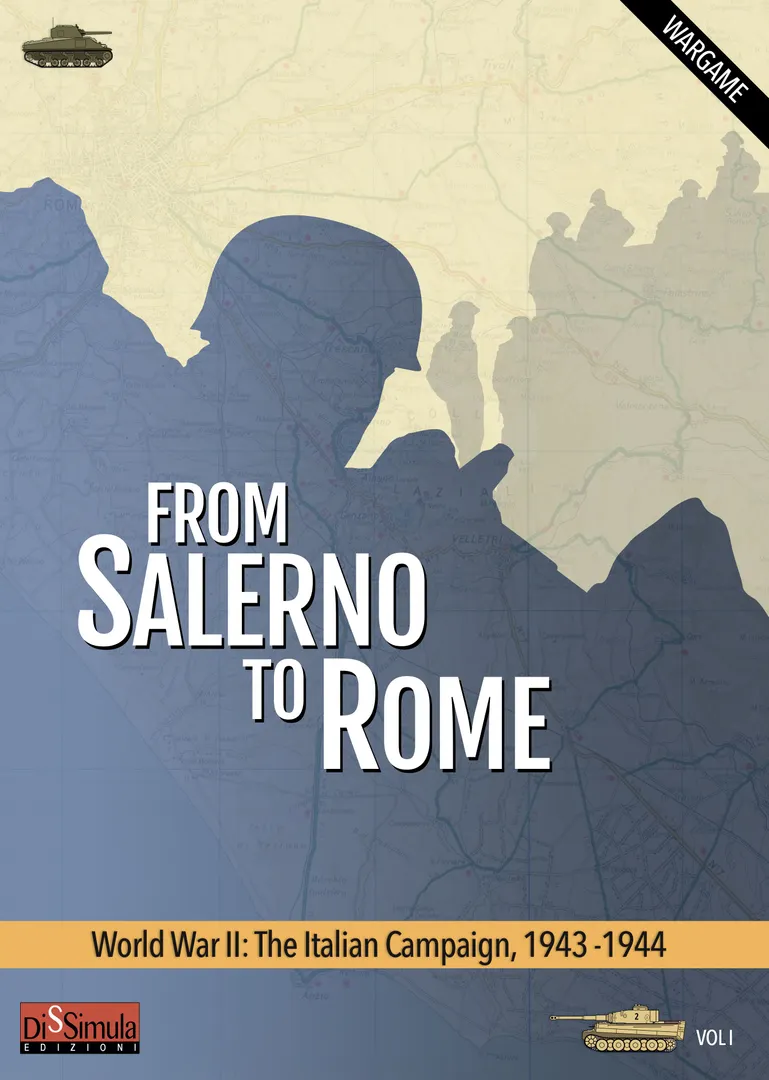
Regelhilfe für From Salerno to Rome: World War II – The Italian Campaign, 1943-1944
Verständliche Erklärungen zu Spielzügen, Karteneffekten und strittigen Situationen mit Verweisen auf offizielle Quellen und gespeichertem Fragenverlauf.
Für 2 Personen
Was möchtest du wissen?
Antworten stammen aus dem offiziellen Regelheft, mit Seitenangabe zum Nachprüfen.
From Salerno to Rome: World War II – The Italian Campaign, 1943-1944 ist ein Brettspiel aus dem Jahr 2020 für 2 Personen, mit 120–720 Minuten pro Partie und ab 14 Jahren. Entwickelt wurde es von Sergio Schiavi; die wichtigsten Mechaniken sind Dice Rolling, Variable Set-up und Hexagon Grid.










Auf Englisch
From Salerno to Rome allows you to simulate the first ten months of the military campaign in Italy during WW2, from the landing in Salerno (September ’43) to the liberation of Rome (June ’44). The game starts with the American 5th army that has just landed in Salerno and the British 8th army advancing in Apulia, while the Axis powers gather their forces to hit with a powerful counter-offensive one of the two allied armies… The game enables you to fight the battles that took place in Italy from September ’43 to May ’44: Salerno, Cassino, Anzio, Ortona… WHAT’S IN THE BOX? Two maps (56,2 x 86,2 cm / 22x34 inch), depicting the Italian peninsula from Salerno to Rome 576 counters (3 countersheets - 192 counters per sheet) Rulebook (24 pages - A4 size) with example of play 7 charts & tables Tanks and Aircraft booklet (8 pages - A5 size) SCENARIOS Ortona - The shortest scenario of all; the 8th Army crosses the Sangro river and engages a fight at Ortona, defended by the Green Devils of the German 1st parachute division. 1 Map - 1 turn Salerno - The landing of the 5th Army. 1 Map - 2 turns Anzio - The Shingle Operation and the bloody battles of Cassino. 1 Map - 2 turns Diadem - The breakthrough of the Gustav line and the entry into Rome. 1 Map - 2 turns The Kesselring’s Option: Foggia Counterattack - A hypothetical scenario, yet absolutely plausible: The 2nd SS Panzerkorps counterattacks in an attempt to reconquer Foggia and its precious airports. 1 Map - 2 turns The Campaign Game - The whole campaign, from the landing in Salerno to the conquest of Rome. The longest game! 2 Maps - 10 turns GAME SCALE Time Scale: 1 turn = 1 month, turns subdivided in impulses. Unit scale: Brigade (Commonwealth infantry), regiments (German, US & French infantry), battalions (German PanzerGrenadier), groups of 15-30 tank Map Scale: 1 hex = 5 Km Number of Players: Two Playing Time: 2 hours for the shortest scenario, Ortona. 6-12 hours for the entire campaign Complexity: 3 out of 5 Solitaire Suitability: 2,5 out 5 -------------------- HOW TO PLAY The game lasts 10 turns, each representing one month. Each turn is divided in a varying number of impulses, during which both players always have the opportunity to react to their opponent’s moves, alternating within an extremely flexible game structure. When a turn starts, each player gets a certain amount of activation points he can use to put under command his forces during impulses. These formations, single divisions or whole army corps, once activated, can move and fight, move strategically in a different sector, can be put in reserve and so on. Activation points can also be used for other operations: air cover, landings, strengthening defensive lines, recon, ULTRA, etc. Artillery has a very important role in the game; it can perform various missions: bombardment, interdiction, tactical support. Aircraft perform the same kind of missions too, but with a much longer range. The activation point system creates great uncertainty in the game, so every game plays out differently: players must carefully plan their strategy and constantly make fundamental decisions. It is a game of great tension and depth, where desperate counter-attacks alternate with strategic surprises; the attention of players must always be constant. Other detailed rules cover: combat, breakthroughs, artillery, reserves, reinforcements, replacements, naval support, supply in mountainous terrain and flat land and, of course, victory conditions. HOW TO WIN The German player has obviously a chance to win the game right away if he manages to repel the US 5th Army in Salerno. If the German player does not win, the game goes on, and the Allies must conquer Rome, trying to eliminate the armies of the Axis powers, in order to win. The Axis wins if the Allies do not reach their victory conditions or if, in any moment, the losses for the Allies go over a certain level. 'The Kesserling’s Option' variant changes the game completely, giving back the initiative to the Axis player and changing the victory conditions again. (description from the publisher and BGG user)
Laut Katalog unterstützt From Salerno to Rome: World War II – The Italian Campaign, 1943-1944 2 Personen. Das ist die vom Verlag angegebene Spielerzahl, das Spiel ist also genau für diese Anzahl von Mitspielenden ausgelegt. Varianten für andere Gruppengrößen sind, sofern vorhanden, in der Anleitung deiner Ausgabe beschrieben; prüfe sie, bevor du eine andere Konfiguration aufbaust.
Die angegebene Spieldauer für From Salerno to Rome: World War II – The Italian Campaign, 1943-1944 beträgt 120–720 Minuten. Das ist die Schätzung des Verlags für eine vollständige Partie. Die tatsächliche Dauer hängt von der Gruppe, der Personenzahl und der Regelkenntnis ab: Erste Partien dauern meist länger, erfahrene Gruppen sind oft schneller fertig. Aufbau und Regelerklärung sind in dieser Schätzung nicht enthalten.
Im Katalog wird From Salerno to Rome: World War II – The Italian Campaign, 1943-1944 ab 14 Jahren empfohlen. Das ist die Empfehlung des Verlags und berücksichtigt Leseanforderungen, Regelkomplexität und Kleinteile, nicht nur das Thema. Jüngere Kinder können oft mit Hilfe eines Erwachsenen mitspielen; beachte die Altersangabe deiner Ausgabe und die Brettspielerfahrung deiner Gruppe.
From Salerno to Rome: World War II – The Italian Campaign, 1943-1944 hat bei BoardGameGeek eine Komplexitätswertung von 4,2 von 5 und gilt damit als schweres Spiel. Die Wertung zeigt, wie viel Regelwissen, Planung und Entscheidungen eine typische Partie verlangt. Schwerere Spiele brauchen bei der ersten Erklärung mehr Zeit, daher hilft vor dem Spieleabend eine Vorbereitungsanleitung.
From Salerno to Rome: World War II – The Italian Campaign, 1943-1944 gehört zu diesen Kategorien: Wargame und World War II. Die wichtigsten Mechaniken sind Dice Rolling, Variable Set-up und Hexagon Grid. Kategorien beschreiben Thema und Setting eines Spiels, Mechaniken dagegen, was die Spielenden in ihrem Zug tatsächlich tun. Jede Mechanik führt zu einer Katalogseite mit ähnlichen Spielen, falls du etwas Vergleichbares suchst.
Als Autoren von From Salerno to Rome: World War II – The Italian Campaign, 1943-1944 sind angegeben: Sergio Schiavi. Diese Angaben stammen aus den veröffentlichten Spieldaten und nennen die für das Spieldesign verantwortlichen Personen, nicht die Illustratoren oder Verlage. Die Autorenseiten auf MeepleRules sammeln weitere Titel derselben Autoren – praktisch, wenn dir ein Spiel gefällt und du ähnliche Spiele suchst.
Im Katalog ist From Salerno to Rome: World War II – The Italian Campaign, 1943-1944 als Grundspiel aufgeführt. Es lässt sich eigenständig mit dem Material aus der Schachtel spielen und benötigt keinen weiteren Titel. Erweiterungen, sofern es welche gibt, ergänzen neues Material oder neue Regeln und sind im Katalog separat mit einem Verweis auf dieses Grundspiel aufgeführt.