
- BGG-Rang
- BGG #31.482
- BGG-Bewertung
- 3,0
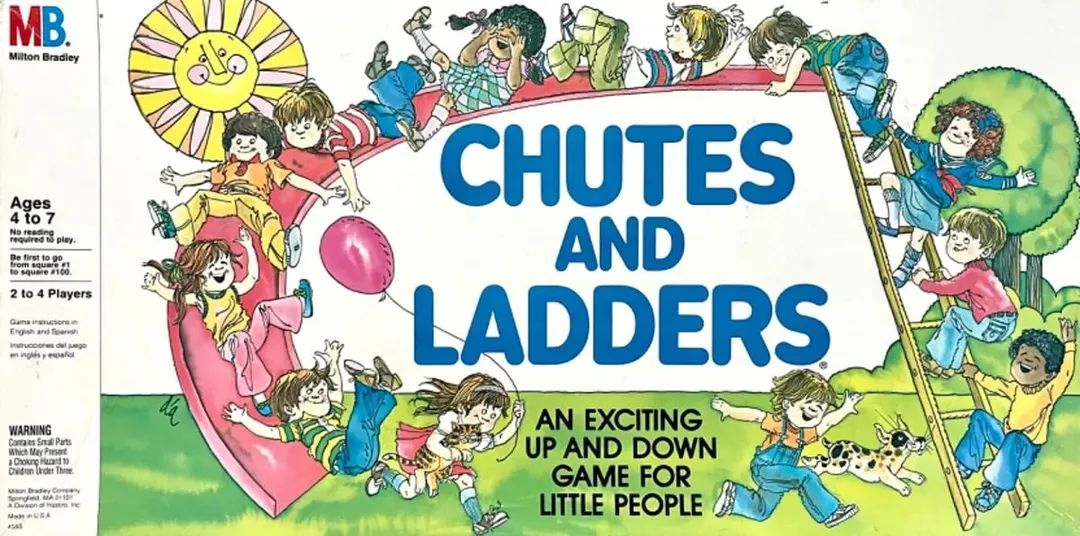
Chutes and Ladders
- 2–6 Spieler
- 30 Min.
- Komplexität 1,1/5
- -200

1587
Regelhilfe für Game of Goose
Verständliche Erklärungen zu Spielzügen, Karteneffekten und strittigen Situationen mit Verweisen auf offizielle Quellen und gespeichertem Fragenverlauf.
Was möchtest du wissen?
Antworten stammen aus dem offiziellen Regelheft, mit Seitenangabe zum Nachprüfen.
Game of Goose ist ein Brettspiel aus dem Jahr 1587 für 2–6 Personen, mit 20 Minuten pro Partie und ab 5 Jahren. Die wichtigsten Mechaniken sind Race, Roll / Spin and Move und Lose a Turn.



Auf Englisch
The Game of Goose is an ancient children's classic, possibly tracing its roots all the way to the Ancient Egyptian game of Mehen which was played in early Old Kingdom times. Francesco de Medici in Italy sent a copy of this game to King Felipe II of Spain during the 16th century. It became one of the most popular games in Europe during that time. Circa 1600, Benoît Rigaud's heirs printed in Lyon "Le Jeu de l'oye, renouvellé des Grecs, jeu de grand plaisir, comme aujourd'huy princes & grands seigneur" [sic] "le pratiquent" - Le jeu de l'oie, renewed from the Greeks, game of great pleasure, as today princes and great lord [sic] play it -, the oldest French copy known. Father Claude-François Menestrier describes the game in his "Bibliothèque curieuse et instructive" (1704) : 'There's another type of game, that seems easier to learn, and easier to play; it's the game of goose so common and it is said to come from the Greeks, though nothing can be found about it in their authors. This game is much easier than cards game, because it's always wholly displayed to the players, and, being in the form of a snail or spirally folded snake, it's appropriate to print the things that one wants to learn...'. The game became an instant hit in France in the 1600s, and engendered a lot of variants (educational, commemorative, ...) up to the present day. It turned up later in England about 1750, according to Whitehouse, under the title "Royall & most pleasant game of the goose - Invented at the Consistory in Rome and are printed and sold by H. OVERTON at Ye White Horse without Newgate where all sorts of Fine Prints and maps are Sold and Framed at Reasonable Rate". By 1851 it had been copied by the American publisher J.P. Beach of New York who entitled it The Jolly Game of Goose. An 1855 edition was called simply The Game of Goose. It is a simple game of racing, using a spiral track with lovely illustrations. The main principle is one shared with Snakes and Ladders as well as the later Game of Life: virtue is rewarded and vice is punished. Schmidt Spiele rates their Gänsespiel for ages 5 and up. Bibliography Whitehouse, F. R. B. (1971) [1951]. Table games of Georgian and Victorian days. Birmingham: Priory Press Ltd. 'Jeux de princes, jeux de vilains', edited by Eve Netchine, Bibliothèque nationale de France / Seuil (2009). --gameplay description from Wikipedia: The board consists of a track with consecutively numbered spaces (usually 63), and is often arranged in a spiral with the starting point at the outside. Each player's piece is moved according to throws of one or two dice. Scattered throughout the board are a number of spaces on which a goose is depicted; landing on a goose allows the player to move again by the same distance. Additional shortcuts, such as spaces marked with a bridge, move the player to some other specified position. There are also a few penalty spaces which force the player to move backwards or lose one or more turns, the most recognizable being the one marked with a skull and symbolizing death; landing on this space results in the player being sent back to start. On Spanish boards the reverse is usually a Pachisi board. Many themed versions of the game have been created, depicting topics as diverse as ice skating, Richard Nixon, and sewage pumps. These can be valued for their historical or artistic merits even by those who have no interest in the game itself, with some editions having been sold for thousands of dollars at auction or displayed in museums.
Laut Katalog unterstützt Game of Goose 2–6 Personen. Diese Spanne entspricht der vom Verlag angegebenen Spielerzahl, das Spiel lässt sich also für jede Gruppengröße innerhalb dieser Spanne aufbauen. Aufbau, einzelne Regeln und Wertungsdetails können je nach Personenzahl trotzdem abweichen; prüfe daher die genaue Konfiguration in der Anleitung deiner Ausgabe.
Die angegebene Spieldauer für Game of Goose beträgt 20 Minuten. Das ist die Schätzung des Verlags für eine vollständige Partie. Die tatsächliche Dauer hängt von der Gruppe, der Personenzahl und der Regelkenntnis ab: Erste Partien dauern meist länger, erfahrene Gruppen sind oft schneller fertig. Aufbau und Regelerklärung sind in dieser Schätzung nicht enthalten.
Im Katalog wird Game of Goose ab 5 Jahren empfohlen. Das ist die Empfehlung des Verlags und berücksichtigt Leseanforderungen, Regelkomplexität und Kleinteile, nicht nur das Thema. Jüngere Kinder können oft mit Hilfe eines Erwachsenen mitspielen; beachte die Altersangabe deiner Ausgabe und die Brettspielerfahrung deiner Gruppe.
Game of Goose hat bei BoardGameGeek eine Komplexitätswertung von 1,1 von 5 und gilt damit als leichtes Spiel. Die Wertung zeigt, wie viel Regelwissen, Planung und Entscheidungen eine typische Partie verlangt. Schwerere Spiele brauchen bei der ersten Erklärung mehr Zeit, daher hilft vor dem Spieleabend eine Vorbereitungsanleitung.
Game of Goose gehört zu diesen Kategorien: Animals, Children's Game und Racing. Die wichtigsten Mechaniken sind Race, Roll / Spin and Move und Lose a Turn. Kategorien beschreiben Thema und Setting eines Spiels, Mechaniken dagegen, was die Spielenden in ihrem Zug tatsächlich tun. Jede Mechanik führt zu einer Katalogseite mit ähnlichen Spielen, falls du etwas Vergleichbares suchst.
Im Katalog ist Game of Goose als Grundspiel aufgeführt. Es lässt sich eigenständig mit dem Material aus der Schachtel spielen und benötigt keinen weiteren Titel. Erweiterungen, sofern es welche gibt, ergänzen neues Material oder neue Regeln und sind im Katalog separat mit einem Verweis auf dieses Grundspiel aufgeführt.