
- BGG-Rang
- BGG #22.276
- BGG-Bewertung
- 6,2
Duel in the Desert: Rommel's Campaign in North Africa
- 2 Spieler
- 90 Min.
- Komplexität 2,5/5
- 1986
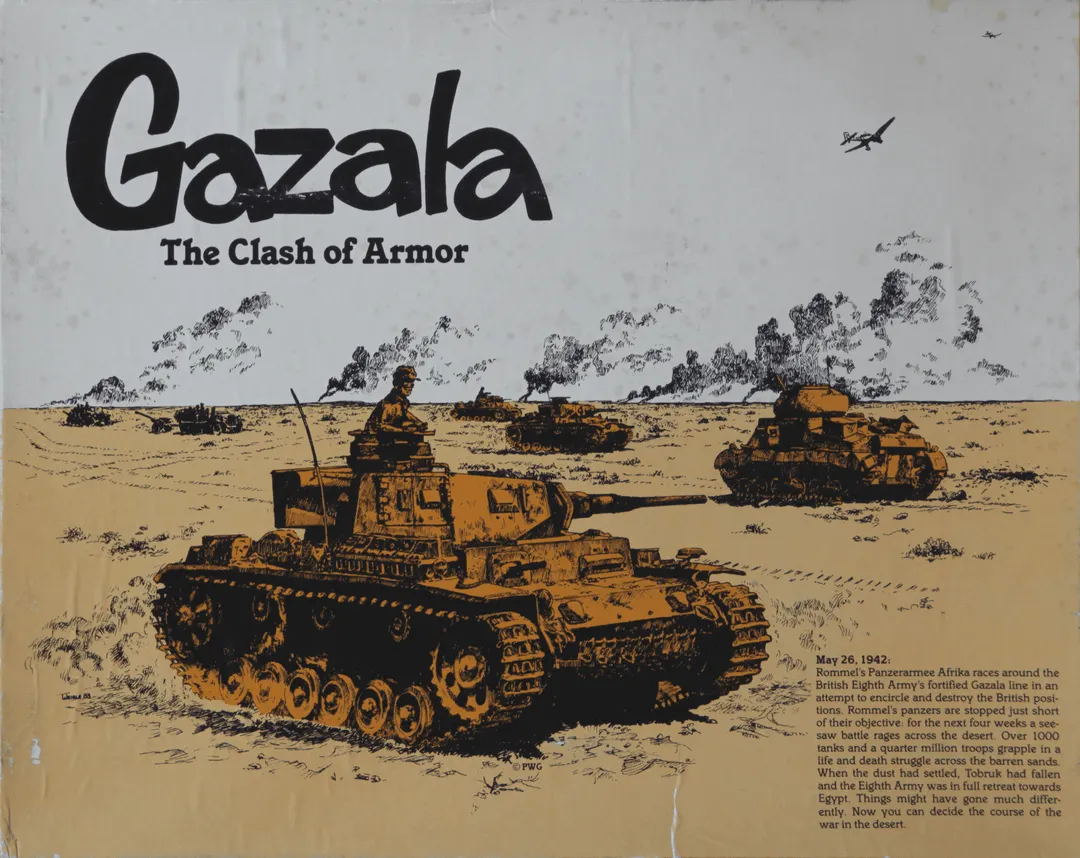
1983
Regelhilfe für Gazala: The Clash of Armor
Verständliche Erklärungen zu Spielzügen, Karteneffekten und strittigen Situationen mit Verweisen auf offizielle Quellen und gespeichertem Fragenverlauf.
Für 2 Personen
Was möchtest du wissen?
Antworten stammen aus dem offiziellen Regelheft, mit Seitenangabe zum Nachprüfen.
Gazala: The Clash of Armor ist ein Brettspiel aus dem Jahr 1983 für 2 Personen, mit 180 Minuten pro Partie und ab 12 Jahren. Entwickelt wurde es von David Bolt; die wichtigsten Mechaniken sind Dice Rolling, Variable Set-up und Grid Movement.
Auf Englisch
The History Late May 1942 saw the massing of unprecedented strength on both sides of the desert war. For several months the front had lain static and quiet while the opposing armies absorbed hundreds of new tanks and guns. The front erupted in a massive armored battle on May 27, which continued for four long weeks. In battle after battle Rommel, the desert fox, seemed to be surrounded and defeated, only to slip away and strike again. The British superiority in armor was hurled repeatedly against the deadly German 88 mm flak guns, leaving the desert covered with tank wrecks. Bravery was common among all the nationalities present: German, British, Free French, Italian, Indian, and South African troops all fought fiercely among the desert sands for the citadel of Tobruk. The Game The game GAZALA 1942 has daily turns that are composed of morning, afternoon, and evening phases. Each phase has a movement, combat, and exploitation segment. Players alternate moving formations (regiments, divisions, and corps) in a uniquely integrated movement system. The player with the initiative attempts to move one formation of his choice, and if successful in activating the formation, he may move all the units that belong to it. The opposing player than has the opportunity to move one of his formations in response, if he can activate it. This system captures the feeling of desert warfare in which neither side knew for certain who was going to move what where. Combined with the unlimited possibilities of movement is a hidden unit rule that has units on the map inverted, only a dust-cloud is shown to the opponent. Players must conduct reconnaissance in order to determine if a single inverted unit on the map represents an infantry battalion, or an entire panzer regiment. Units are composed of strength points: each strength point represents 100 infantry, or 3 tanks, or 3–6 guns. Movement points, which are expended at different rates by moving units that have different mobility abilities, are also spent to prepare for combat, perform reconnaissance, and cross minefields. Both players participate in the same combat phase with everything from anti-tank fire (differentiated for range), direct fire and assaults (which occur between opposing units that occupy the same hex), barrages, and airstrikes (plotted in advance, and liable to come down on your troops if you aren’t careful). The rules cover the full range of features that were characteristic of desert warfare. There are five scenarios including an introductory scenario, and a campaign game. With full examples of play, extensive players’ notes, and an Order of Battle compiled by Gary Helmer, Frank Prieskop, and David Bolt, GAZALA 1942 offers players a detailed and comprehensive insight into one of the most mobile and fluid periods of warfare ever known. 5 scenarios (campaign game 27 May - 2 June) Scale 1,5 miles per hex 1 battalion per counter 1 day per turn Components 32 pages rulebook 1 map (86 x 55.7 cm) 600 counters 6 standard size pages of charts (from the back box and BGG user)
Laut Katalog unterstützt Gazala: The Clash of Armor 2 Personen. Das ist die vom Verlag angegebene Spielerzahl, das Spiel ist also genau für diese Anzahl von Mitspielenden ausgelegt. Varianten für andere Gruppengrößen sind, sofern vorhanden, in der Anleitung deiner Ausgabe beschrieben; prüfe sie, bevor du eine andere Konfiguration aufbaust.
Die angegebene Spieldauer für Gazala: The Clash of Armor beträgt 180 Minuten. Das ist die Schätzung des Verlags für eine vollständige Partie. Die tatsächliche Dauer hängt von der Gruppe, der Personenzahl und der Regelkenntnis ab: Erste Partien dauern meist länger, erfahrene Gruppen sind oft schneller fertig. Aufbau und Regelerklärung sind in dieser Schätzung nicht enthalten.
Im Katalog wird Gazala: The Clash of Armor ab 12 Jahren empfohlen. Das ist die Empfehlung des Verlags und berücksichtigt Leseanforderungen, Regelkomplexität und Kleinteile, nicht nur das Thema. Jüngere Kinder können oft mit Hilfe eines Erwachsenen mitspielen; beachte die Altersangabe deiner Ausgabe und die Brettspielerfahrung deiner Gruppe.
Gazala: The Clash of Armor hat bei BoardGameGeek eine Komplexitätswertung von 4,2 von 5 und gilt damit als schweres Spiel. Die Wertung zeigt, wie viel Regelwissen, Planung und Entscheidungen eine typische Partie verlangt. Schwerere Spiele brauchen bei der ersten Erklärung mehr Zeit, daher hilft vor dem Spieleabend eine Vorbereitungsanleitung.
Gazala: The Clash of Armor gehört zu diesen Kategorien: Wargame und World War II. Die wichtigsten Mechaniken sind Dice Rolling, Variable Set-up und Grid Movement. Kategorien beschreiben Thema und Setting eines Spiels, Mechaniken dagegen, was die Spielenden in ihrem Zug tatsächlich tun. Jede Mechanik führt zu einer Katalogseite mit ähnlichen Spielen, falls du etwas Vergleichbares suchst.
Als Autoren von Gazala: The Clash of Armor sind angegeben: David Bolt. Diese Angaben stammen aus den veröffentlichten Spieldaten und nennen die für das Spieldesign verantwortlichen Personen, nicht die Illustratoren oder Verlage. Die Autorenseiten auf MeepleRules sammeln weitere Titel derselben Autoren – praktisch, wenn dir ein Spiel gefällt und du ähnliche Spiele suchst.
Im Katalog ist Gazala: The Clash of Armor als Grundspiel aufgeführt. Es lässt sich eigenständig mit dem Material aus der Schachtel spielen und benötigt keinen weiteren Titel. Erweiterungen, sofern es welche gibt, ergänzen neues Material oder neue Regeln und sind im Katalog separat mit einem Verweis auf dieses Grundspiel aufgeführt.