
- BGG-Rang
- BGG #617
- BGG-Bewertung
- 7,0
Alhambra
- 2–6 Spieler
- 45–60 Min.
- Komplexität 2,1/5
- 2003
2009
Regelhilfe für Granada
Verständliche Erklärungen zu Spielzügen, Karteneffekten und strittigen Situationen mit Verweisen auf offizielle Quellen und gespeichertem Fragenverlauf.
Für 2 Personen
Was möchtest du wissen?
Antworten stammen aus dem offiziellen Regelheft, mit Seitenangabe zum Nachprüfen.
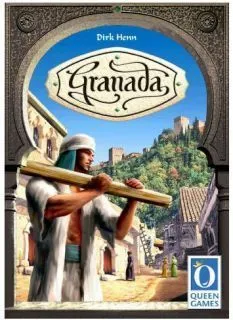
Granada ist ein Brettspiel aus dem Jahr 2009 für 2–6 Personen, mit 45–60 Minuten pro Partie und ab 8 Jahren. Entwickelt wurde es von Dirk Henn; die wichtigsten Mechaniken sind Set Collection, Tile Placement und Commodity Speculation.


Auf Englisch
Granada – many artisans, traders and entire families have settled at the foot of the Sierra Nevada because the Palace of Alhambra promises all people work, contracts and above all prosperity. (From the publisher's blurb.) Granada is new member of the Game: Alhambra family with a more challenging character: in this standalone game the players develop the city of Granada next to Sierra Nevada, where the famous Alhambra stands, by buying building tiles to construct the city which will earn the most victory points. Building tiles now have two sides and there are new building types for which the value is set during the game. Link to Trailer http://www.queen-games.de/index.php?id=2537----2 Play Differences from Alhambra Alhambra advanced. Play is the same: buy a building tile, take money or remodel. If you buy a tile for the exact amount, you can take another action, same as in Alhambra. The differences: new building types, building values are dynamic, two-sided tiles, and moats instead of walls. There are 9 building types in Granada. Unlike Alhambra, the buildings do not have a set value. Instead, building value is determined by the count of that type of building in all players' cities times a multiplier. As in Alhambra, there are 3 scoring rounds during which each building type is examined and points awarded for the player with the majority of that type of building. In the first scoring round, A, only the player with the most tiles of a particular building type scores for that building type (1 times the total count). In the second scoring round, B, the top 2 players score (2 times the total count and 1 times the total count respectively), and in the final round, the top 3 score (3x, 2x, and 1x the total count of that building type). Scoring for a "Beginners Game" is a little different. There are no ties in Granada: points are never divided like in Alhambra. In the case of two players having the same number of tiles of a particular type in their cities, the player with the highest valued tile of that type wins, and the other player takes next place. So, in Granada, it pays to buy the more expensive buildings. For example: When the A round-scoring card is turned up, Cindy has 2 Schools, Diana has 2, Tim has 1, Tina and Bailey each have 0, for a total of 5 Schools currently in cities. Cindy's highest School is a 10, Diana's is a 7. So, in round A, Cindy would score 1 x 5 = 5 points. When the B round-scoring card is turned up, the count for Schools is: Cindy 2, Diana 3, Tim 1, Tina and Bailey 0 each for a total of 6 Schools. So, Diana scores 2 x 6 = 12 points and Cindy scores 1 x 6 = 6 points. In the final round, the School count is Cindy 2, Diana 3, Tim 1, Tina 2, Bailey 0 for a total of 8 Schools in cities. Cindy's highest School is a 10, Tina's is a 4. So, Diana scores 3 x 8 = 24 points, Cindy score 2 x 8 = 16 points and Tina score 1 x 8 = 8 points. Another difference in Granada is that the tiles are two-sided: on one side an even-numbered building of some type, on the other a different, odd-numbered building valued exactly one higher. The configuration of the buildings on both sides is identical in terms of moat placement or lack thereof on each side. When purchasing a building, a player can immediately place the building, as is, into her city or may flip it to the other side and place it in her supply for later placement during a remodel action. The Building Market is initially filled with tiles even-side up. The next time the market is filled, the odd side will be placed up, then even, then odd, etc. A handy toggle feature is provided on the board near the Building Market to facilitate this. The last difference between Alhambra and Granada, moats instead of walls, is really just a difference in artwork. As in Alhambra, during each scoring round, each player scores points for her longest continuous moat, instead of wall, surrounding her city. The rules are the same regarding tile placement: must be able to trace an unbroken path back to the city's center, moat can touch moat, etc. In games I've played, players have often commented that it seems to be harder to build with the moat tiles of Granada than with the wall tiles of Alhambra. Just one more way to make Granada an advanced version of Alhambra? Re-implements: Alhambra
Laut Katalog unterstützt Granada 2–6 Personen. Diese Spanne entspricht der vom Verlag angegebenen Spielerzahl, das Spiel lässt sich also für jede Gruppengröße innerhalb dieser Spanne aufbauen. Aufbau, einzelne Regeln und Wertungsdetails können je nach Personenzahl trotzdem abweichen; prüfe daher die genaue Konfiguration in der Anleitung deiner Ausgabe.
Die angegebene Spieldauer für Granada beträgt 45–60 Minuten. Das ist die Schätzung des Verlags für eine vollständige Partie. Die tatsächliche Dauer hängt von der Gruppe, der Personenzahl und der Regelkenntnis ab: Erste Partien dauern meist länger, erfahrene Gruppen sind oft schneller fertig. Aufbau und Regelerklärung sind in dieser Schätzung nicht enthalten.
Im Katalog wird Granada ab 8 Jahren empfohlen. Das ist die Empfehlung des Verlags und berücksichtigt Leseanforderungen, Regelkomplexität und Kleinteile, nicht nur das Thema. Jüngere Kinder können oft mit Hilfe eines Erwachsenen mitspielen; beachte die Altersangabe deiner Ausgabe und die Brettspielerfahrung deiner Gruppe.
Granada hat bei BoardGameGeek eine Komplexitätswertung von 2,2 von 5 und gilt damit als eher leichtes Spiel. Die Wertung zeigt, wie viel Regelwissen, Planung und Entscheidungen eine typische Partie verlangt. Schwerere Spiele brauchen bei der ersten Erklärung mehr Zeit, daher hilft vor dem Spieleabend eine Vorbereitungsanleitung.
Granada gehört zu diesen Kategorien: City Building und Renaissance. Die wichtigsten Mechaniken sind Set Collection, Tile Placement und Commodity Speculation. Kategorien beschreiben Thema und Setting eines Spiels, Mechaniken dagegen, was die Spielenden in ihrem Zug tatsächlich tun. Jede Mechanik führt zu einer Katalogseite mit ähnlichen Spielen, falls du etwas Vergleichbares suchst.
Als Autoren von Granada sind angegeben: Dirk Henn. Diese Angaben stammen aus den veröffentlichten Spieldaten und nennen die für das Spieldesign verantwortlichen Personen, nicht die Illustratoren oder Verlage. Die Autorenseiten auf MeepleRules sammeln weitere Titel derselben Autoren – praktisch, wenn dir ein Spiel gefällt und du ähnliche Spiele suchst.
Im Katalog ist Granada als Grundspiel aufgeführt. Es lässt sich eigenständig mit dem Material aus der Schachtel spielen und benötigt keinen weiteren Titel. Erweiterungen, sofern es welche gibt, ergänzen neues Material oder neue Regeln und sind im Katalog separat mit einem Verweis auf dieses Grundspiel aufgeführt.