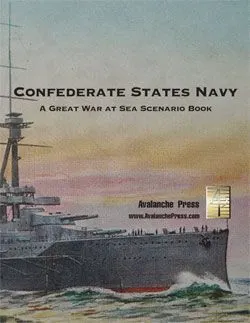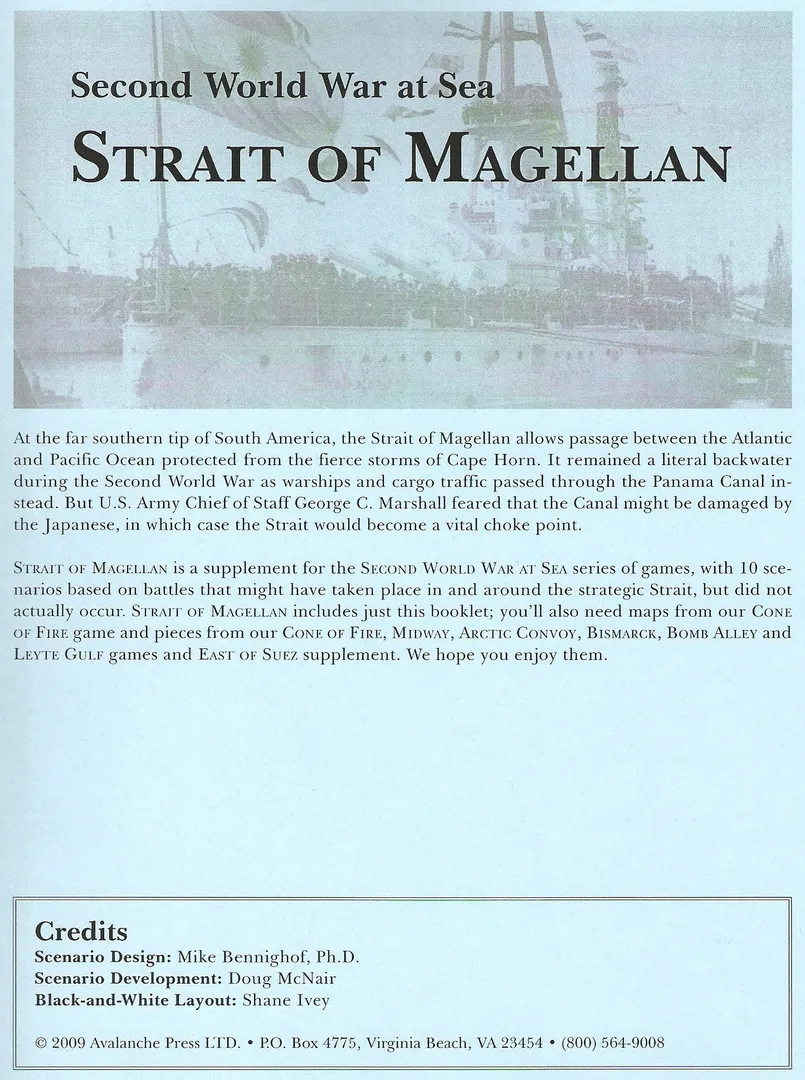
- BGG-Bewertung
- 6,4
Second World War at Sea: Strait of Magellan
- 2 Spieler
- 60 Min.
- Komplexität 3,0/5
- 2009
2008
Regelhilfe für Great War at Sea / Second World War at Sea: Cone of Fire
Verständliche Erklärungen zu Spielzügen, Karteneffekten und strittigen Situationen mit Verweisen auf offizielle Quellen und gespeichertem Fragenverlauf.
Für 2 Personen
Was möchtest du wissen?
Antworten stammen aus dem offiziellen Regelheft, mit Seitenangabe zum Nachprüfen.
Great War at Sea / Second World War at Sea: Cone of Fire ist ein Brettspiel aus dem Jahr 2008 für 2–4 Personen und ab 12 Jahren. Entwickelt wurde es von Michael Bennighof und Doug McNair; die wichtigsten Mechaniken sind Dice Rolling, Secret Unit Deployment und Hexagon Grid.




Auf Englisch
From the Avalanche Press website: At the turn of the last century, South America seemed poised to make the same economic leap as the northern half of the hemisphere. Fueled by booming exports of grain, cattle, coffee and rubber, Brazil and Argentina saw their economies grow rapidly and at one time both stood among the world's ten wealthiest nations. All that cash led their leaders to seek the prestige symbols of the day: dreadnought battleships. Argentina, Brazil and Chile all built dreadnoughts just like the Great Powers, but none of them ever fired a shot at a foreign enemy. Cone of Fire is a boxed game for both the Second World War at Sea and Great War at Sea series. The fleets of Argentina, Brazil and Chile plus those of Peru and Uruguay are added to both series, along with ships from Germany, France and Britain. Most of the scenarios, or game situations, are based on hypothetical situations arising from the actual war scares between the South American nations and sometimes European interlopers, and the war plans with which they addressed them. There are also scenarios based on the actual conflicts which took place in South American waters: the hunt for Admiral Maximilian Graf von Spee's German cruiser squadron in 1914, and the hunt for the cruiser that bore his name 25 years later. Alongside the ships actually operated by the South American naval powers, there are also ships they ordered and did not receive, or contemplated but did not order. The Brazilians have several projected classes of battleships that they never completed, as well as the modern warships they sought from the U.S. Navy during World War II. Argentina and Chile have their projected battleships, carriers and cruisers as well. And there are the actual jet aircraft flown by Argentina and Brazil. There are six maps, three at Second World War at Sea scale, and three at Great War at Sea scale. These cover the region from south of Tierra del Fuego, the southernmost tip of the Americas, to well north of Rio de Janeiro. There are huge stretches of ocean as well as the narrow, winding channels of the Chilean coast.
Laut Katalog unterstützt Great War at Sea / Second World War at Sea: Cone of Fire 2–4 Personen. Diese Spanne entspricht der vom Verlag angegebenen Spielerzahl, das Spiel lässt sich also für jede Gruppengröße innerhalb dieser Spanne aufbauen. Aufbau, einzelne Regeln und Wertungsdetails können je nach Personenzahl trotzdem abweichen; prüfe daher die genaue Konfiguration in der Anleitung deiner Ausgabe.
Im Katalog wird Great War at Sea / Second World War at Sea: Cone of Fire ab 12 Jahren empfohlen. Das ist die Empfehlung des Verlags und berücksichtigt Leseanforderungen, Regelkomplexität und Kleinteile, nicht nur das Thema. Jüngere Kinder können oft mit Hilfe eines Erwachsenen mitspielen; beachte die Altersangabe deiner Ausgabe und die Brettspielerfahrung deiner Gruppe.
Great War at Sea / Second World War at Sea: Cone of Fire hat bei BoardGameGeek eine Komplexitätswertung von 2,9 von 5 und gilt damit als eher leichtes Spiel. Die Wertung zeigt, wie viel Regelwissen, Planung und Entscheidungen eine typische Partie verlangt. Schwerere Spiele brauchen bei der ersten Erklärung mehr Zeit, daher hilft vor dem Spieleabend eine Vorbereitungsanleitung.
Great War at Sea / Second World War at Sea: Cone of Fire gehört zu diesen Kategorien: Wargame, Nautical und World War II. Die wichtigsten Mechaniken sind Dice Rolling, Secret Unit Deployment und Hexagon Grid. Kategorien beschreiben Thema und Setting eines Spiels, Mechaniken dagegen, was die Spielenden in ihrem Zug tatsächlich tun. Jede Mechanik führt zu einer Katalogseite mit ähnlichen Spielen, falls du etwas Vergleichbares suchst.
Als Autoren von Great War at Sea / Second World War at Sea: Cone of Fire sind angegeben: Michael Bennighof und Doug McNair. Diese Angaben stammen aus den veröffentlichten Spieldaten und nennen die für das Spieldesign verantwortlichen Personen, nicht die Illustratoren oder Verlage. Die Autorenseiten auf MeepleRules sammeln weitere Titel derselben Autoren – praktisch, wenn dir ein Spiel gefällt und du ähnliche Spiele suchst.
Im Katalog ist Great War at Sea / Second World War at Sea: Cone of Fire als Grundspiel aufgeführt. Es lässt sich eigenständig mit dem Material aus der Schachtel spielen und benötigt keinen weiteren Titel. Erweiterungen, sofern es welche gibt, ergänzen neues Material oder neue Regeln und sind im Katalog separat mit einem Verweis auf dieses Grundspiel aufgeführt.