

- BGG-Rang
- BGG #3.965
- BGG-Bewertung
- 6,9
A Brief History of the World
- 3–6 Spieler
- 90–180 Min.
- Komplexität 2,9/5
- 2009
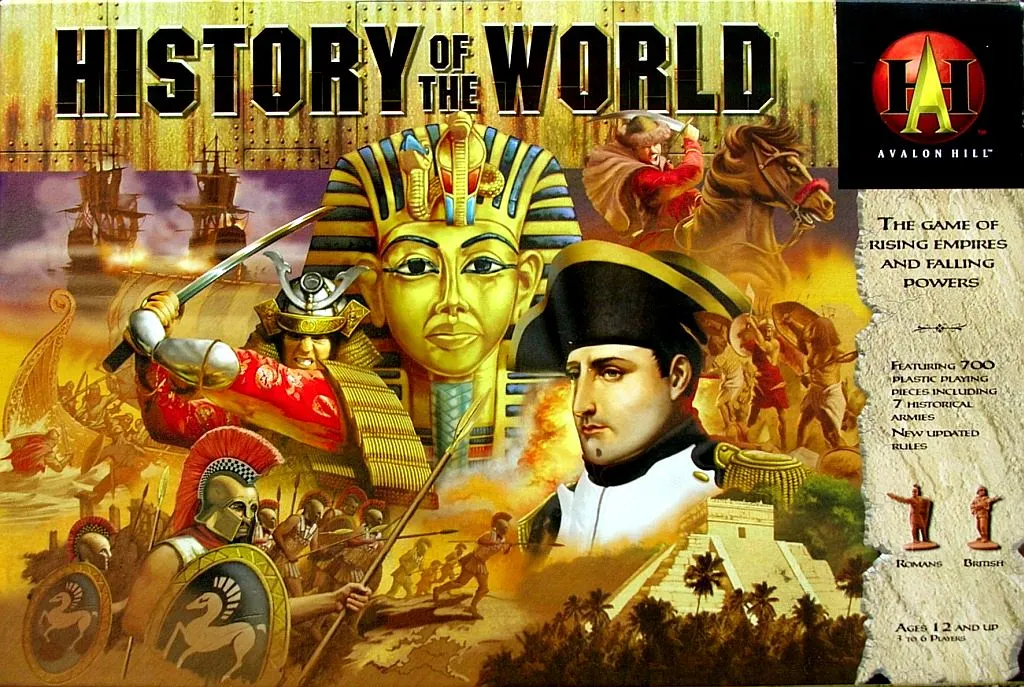
1991
Regelhilfe für History of the World
Verständliche Erklärungen zu Spielzügen, Karteneffekten und strittigen Situationen mit Verweisen auf offizielle Quellen und gespeichertem Fragenverlauf.
Für 3 Personen
Was möchtest du wissen?
Antworten stammen aus dem offiziellen Regelheft, mit Seitenangabe zum Nachprüfen.
History of the World ist ein Brettspiel aus dem Jahr 1991 für 3–6 Personen, mit 135–270 Minuten pro Partie und ab 12 Jahren. Entwickelt wurde es von Gary Dicken, Steve Kendall und Phil Kendall; die wichtigsten Mechaniken sind Hand Management, Dice Rolling und Area Majority / Influence.
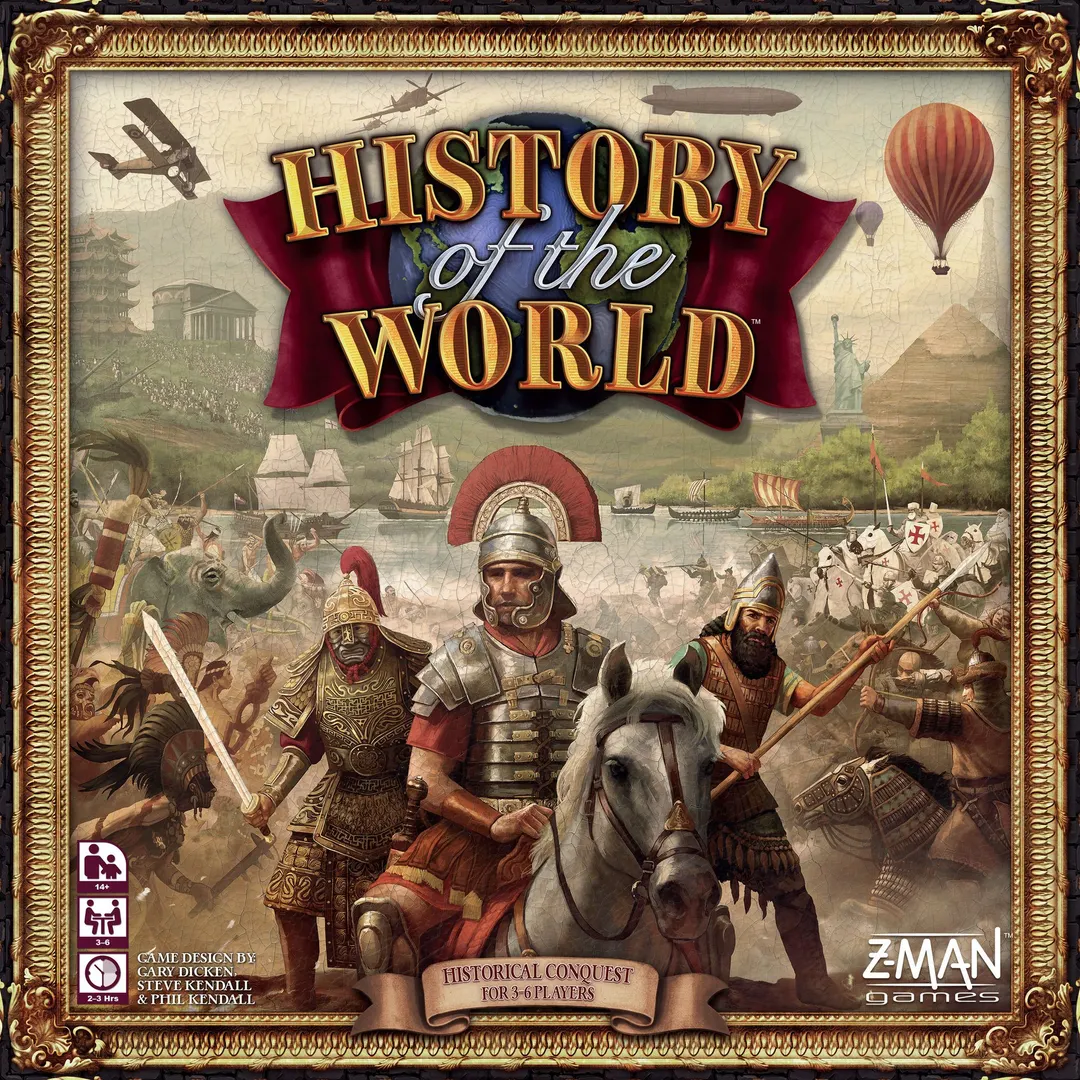

Auf Englisch
History of the World works under the assumptions that all empires eventually fade and that the only things differentiating great empires from lesser ones is how much territory they conquer and how long it takes for their civilizations to disappear. The game is played out over 7 epochs or rounds, from the ancient 3000 B.C. Sumerians to the pre-WW1 Germany, with every player controlling a new rising empire from history. Some empires are stronger than others (like the Romans), but the game's clever mechanisms can help balance that out. At the end of each epoch, players score points for all units of their color (from both the current and any previous empires) remaining on the board. Before the start of their turn a player may play up to two Event cards from their hand. The Events played are resolved before the player starts his Empire's actions. If the player's active Empire has navigation a ship token is placed in each sea or ocean listed (if an ocean is listed all adjacent seas to the ocean have ship markers put into them). A Reallocation Greater Event allows an Empire with Navigation to exchange Fleets in seas and oceans for Coins that can be used to buy back defeated troops (1 coin per troop). If the active Empire has a capitol it is taken and placed in the Empire's starting land with one unit of the Empire's available troops. Since each land space may only contain one troop the player begins expanding from their starting land by placing troops in any adjacent land space that they wish to occupy or conquer. To conquer a land the attacker moves one unit into the land space either from adjacent land or through a sea with a ship in it. Then dice are rolled, the attacker gets 2 dice and the defender only one, unless the attacker traveled across a strait or the defender's land has either a forest, the great wall of China, or mountains on the border of the land that the attacker came from. In this case the defender receives 2 dice as well. If the attack comes from the sea the defender gets 3 dice for defense. Highest score wins with ties killing off both the defender and attacker. In this case the attacker can merely place the next troop, if he has any left, in the now-empty land space. At any time the active Empire player may exchange an unplaced troop for a fort. On later turns, a fort gives the player a +1 to defensive rolls in that land. Also, if the defender in a fort loses or ties with an attacker only the fort is removed and the battle continues. Whenever an army conquers a land with a capitol the capitol mini is flipped reducing it to a city (if it was a city to begin with it is removed from board when conquered). After the active player's Empire is finished with it's actions check to see if it conquered to land spaces with resource symbols, if so it can build a monument. Then scoring takes place. Each area (Middle-East, Northern Europe, Eurasia, etc...) has a tile with 3 values for the current Epoch. One value is for having a presence in the area (at least one land). Another value is for having Dominance in the area (at least 2 lands and more than any other player in area). The last value is for having Control of an area (at least 3 lands and no other player has any in area). These values vary from Epoch to Epoch and Area to Area (Middle-East is more valuable in early Epochs and fades in later Epochs, for example). Total the scores from each area for all pieces of the player's color from all Empires controlled that remain on board. Then add 2 points for each capitol controlled, 1 point per city and one point for each monument controlled. After all areas are scored the next Empire called takes its turn. After all players have taken their turns and scored, for the first Epoch, the player with the highest score gets to take a pre-eminence marker and places it in front of him. These are secret bonus points (worth somewhere from 3 to 6) for the end of the game and may not be examined till then. This bonus to leader helps balance the Empire-draw mechanic and makes it valuable to score maximal points even early in the game, rather than tanking to get a better draw later. Then drawing begins for the next Epoch with the player having the lowest score drawing first on up to the person with the highest score drawing last (and likely being given a less than optimal Empire by another player). After the last player has scored for Epoch 7 and the leader has drawn a pre-eminence marker, all players reveal their pre-eminence markers and add them to their scores. The player with the highest score wins.
Laut Katalog unterstützt History of the World 3–6 Personen. Diese Spanne entspricht der vom Verlag angegebenen Spielerzahl, das Spiel lässt sich also für jede Gruppengröße innerhalb dieser Spanne aufbauen. Aufbau, einzelne Regeln und Wertungsdetails können je nach Personenzahl trotzdem abweichen; prüfe daher die genaue Konfiguration in der Anleitung deiner Ausgabe.
Die angegebene Spieldauer für History of the World beträgt 135–270 Minuten. Das ist die Schätzung des Verlags für eine vollständige Partie. Die tatsächliche Dauer hängt von der Gruppe, der Personenzahl und der Regelkenntnis ab: Erste Partien dauern meist länger, erfahrene Gruppen sind oft schneller fertig. Aufbau und Regelerklärung sind in dieser Schätzung nicht enthalten.
Im Katalog wird History of the World ab 12 Jahren empfohlen. Das ist die Empfehlung des Verlags und berücksichtigt Leseanforderungen, Regelkomplexität und Kleinteile, nicht nur das Thema. Jüngere Kinder können oft mit Hilfe eines Erwachsenen mitspielen; beachte die Altersangabe deiner Ausgabe und die Brettspielerfahrung deiner Gruppe.
History of the World hat bei BoardGameGeek eine Komplexitätswertung von 2,8 von 5 und gilt damit als eher leichtes Spiel. Die Wertung zeigt, wie viel Regelwissen, Planung und Entscheidungen eine typische Partie verlangt. Schwerere Spiele brauchen bei der ersten Erklärung mehr Zeit, daher hilft vor dem Spieleabend eine Vorbereitungsanleitung.
History of the World gehört zu diesen Kategorien: Wargame, Napoleonic und Medieval. Die wichtigsten Mechaniken sind Hand Management, Dice Rolling und Area Majority / Influence. Kategorien beschreiben Thema und Setting eines Spiels, Mechaniken dagegen, was die Spielenden in ihrem Zug tatsächlich tun. Jede Mechanik führt zu einer Katalogseite mit ähnlichen Spielen, falls du etwas Vergleichbares suchst.
Als Autoren von History of the World sind angegeben: Gary Dicken, Steve Kendall und Phil Kendall. Diese Angaben stammen aus den veröffentlichten Spieldaten und nennen die für das Spieldesign verantwortlichen Personen, nicht die Illustratoren oder Verlage. Die Autorenseiten auf MeepleRules sammeln weitere Titel derselben Autoren – praktisch, wenn dir ein Spiel gefällt und du ähnliche Spiele suchst.
Im Katalog ist History of the World als Grundspiel aufgeführt. Es lässt sich eigenständig mit dem Material aus der Schachtel spielen und benötigt keinen weiteren Titel. Erweiterungen, sofern es welche gibt, ergänzen neues Material oder neue Regeln und sind im Katalog separat mit einem Verweis auf dieses Grundspiel aufgeführt.