

- BGG-Rang
- BGG #5.412
- BGG-Bewertung
- 6,6
Déjà Vu
- 2–6 Spieler
- 15 Min.
- Komplexität 1,1/5
- 2017
2003
Regelhilfe für Igloo Pop
Verständliche Erklärungen zu Spielzügen, Karteneffekten und strittigen Situationen mit Verweisen auf offizielle Quellen und gespeichertem Fragenverlauf.
Für 2 Personen
Was möchtest du wissen?
Antworten stammen aus dem offiziellen Regelheft, mit Seitenangabe zum Nachprüfen.
Igloo Pop ist ein Brettspiel aus dem Jahr 2003 für 2–6 Personen, mit 15–20 Minuten pro Partie und ab 7 Jahren. Entwickelt wurde es von Klaus Zoch und Heinz Meister; die wichtigsten Mechaniken sind Simultaneous Action Selection und Betting and Bluffing.
Auf Englisch
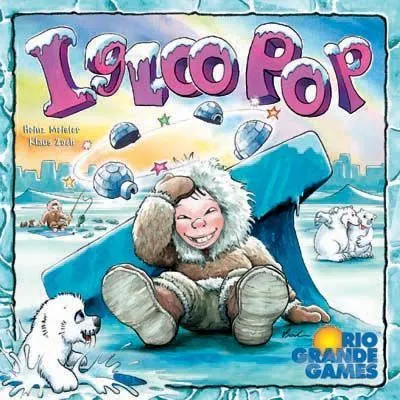
A children's game where players shake plastic igloos in an attempt to identify how many beads (between 2 and 13) they hold. Nine cards are dealt face-up in a circle around the igloos, with each card showing a different number (or range of numbers). Players then start shaking the igloos to find one that matches the number of beads shown on a card. When a match is found, the player marks that igloo with a colored chip and places it on the card with the same number. If the guess is correct, that player receives the card (worth points) as a reward. If the guess is incorrect, that player loses the chip used to mark the igloo. The game is finished when one player has no chips left, or when all of the cards have been claimed! Although the appearance of Igloo Pop is quite silly, it takes a steady hand and well-trained ear to be able to determine how many beads are inside an igloo. The sound and vibration when shaking each igloo is slightly different, allowing skilled players to judge the contents quickly and accurately. Also, a risk/reward system is introduced in the cards: cards with several numbers are easier to guess, but are worth less points; cards with a single number are often difficult to guess exactly, but are worth more points. Background story, from the back of the box: The young ice giant has a big problem: he wants to buy fish sticks, but he cannot remember how many and he has nine shopping lists in his basket. So he goes from igloo to igloo and shakes each. In each he listens to the delicious fish sticks bouncing off the igloo walls. When he thinks that the igloo in his hand has the same number of fish sticks as one of his shopping lists, he takes it home. When he gets home, there are no fish sticks in the igloo. Instead, wild and laughing Inuit children tumble out of the igloo. Excitedly they shout, "Shake us again!" "That was great fun!" "This is super", thinks the young ice giant. "Now, I have found some new friends to play with!" And, he promptly forgets all about his shopping lists.
Laut Katalog unterstützt Igloo Pop 2–6 Personen. Diese Spanne entspricht der vom Verlag angegebenen Spielerzahl, das Spiel lässt sich also für jede Gruppengröße innerhalb dieser Spanne aufbauen. Aufbau, einzelne Regeln und Wertungsdetails können je nach Personenzahl trotzdem abweichen; prüfe daher die genaue Konfiguration in der Anleitung deiner Ausgabe.
Die angegebene Spieldauer für Igloo Pop beträgt 15–20 Minuten. Das ist die Schätzung des Verlags für eine vollständige Partie. Die tatsächliche Dauer hängt von der Gruppe, der Personenzahl und der Regelkenntnis ab: Erste Partien dauern meist länger, erfahrene Gruppen sind oft schneller fertig. Aufbau und Regelerklärung sind in dieser Schätzung nicht enthalten.
Im Katalog wird Igloo Pop ab 7 Jahren empfohlen. Das ist die Empfehlung des Verlags und berücksichtigt Leseanforderungen, Regelkomplexität und Kleinteile, nicht nur das Thema. Jüngere Kinder können oft mit Hilfe eines Erwachsenen mitspielen; beachte die Altersangabe deiner Ausgabe und die Brettspielerfahrung deiner Gruppe.
Igloo Pop hat bei BoardGameGeek eine Komplexitätswertung von 1,1 von 5 und gilt damit als leichtes Spiel. Die Wertung zeigt, wie viel Regelwissen, Planung und Entscheidungen eine typische Partie verlangt. Schwerere Spiele brauchen bei der ersten Erklärung mehr Zeit, daher hilft vor dem Spieleabend eine Vorbereitungsanleitung.
Igloo Pop gehört zu diesen Kategorien: Children's Game und Action / Dexterity. Die wichtigsten Mechaniken sind Simultaneous Action Selection und Betting and Bluffing. Kategorien beschreiben Thema und Setting eines Spiels, Mechaniken dagegen, was die Spielenden in ihrem Zug tatsächlich tun. Jede Mechanik führt zu einer Katalogseite mit ähnlichen Spielen, falls du etwas Vergleichbares suchst.
Als Autoren von Igloo Pop sind angegeben: Klaus Zoch und Heinz Meister. Diese Angaben stammen aus den veröffentlichten Spieldaten und nennen die für das Spieldesign verantwortlichen Personen, nicht die Illustratoren oder Verlage. Die Autorenseiten auf MeepleRules sammeln weitere Titel derselben Autoren – praktisch, wenn dir ein Spiel gefällt und du ähnliche Spiele suchst.
Im Katalog ist Igloo Pop als Grundspiel aufgeführt. Es lässt sich eigenständig mit dem Material aus der Schachtel spielen und benötigt keinen weiteren Titel. Erweiterungen, sofern es welche gibt, ergänzen neues Material oder neue Regeln und sind im Katalog separat mit einem Verweis auf dieses Grundspiel aufgeführt.