

- BGG-Rang
- BGG #15.226
- BGG-Bewertung
- 7,2
Desert Fox Deluxe
- 2 Spieler
- 180–2880 Min.
- Komplexität 3,1/5
- 2016
2013
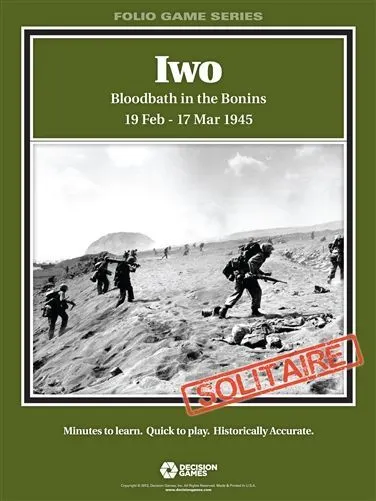
Regelhilfe für Iwo: Bloodbath in the Bonins 19 Feb – 17 Mar 1945
Verständliche Erklärungen zu Spielzügen, Karteneffekten und strittigen Situationen mit Verweisen auf offizielle Quellen und gespeichertem Fragenverlauf.
Für 1 Person
Was möchtest du wissen?
Antworten stammen aus dem offiziellen Regelheft, mit Seitenangabe zum Nachprüfen.
Iwo: Bloodbath in the Bonins 19 Feb – 17 Mar 1945 ist ein Brettspiel aus dem Jahr 2013 für 1–2 Personen, mit 60–120 Minuten pro Partie und ab 12 Jahren. Entwickelt wurde es von Chris Perello; die wichtigsten Mechaniken sind Dice Rolling, Hexagon Grid und Simulation.




Auf Englisch
Iwo, Bloodbath in the Bonins 19 Feb – 17 Mar 1945, is a solitaire board-wargame using a modification of the Series: Fire & Movement combat system (Decision Games). Developed to portray the mechanized battlefields of a later generation, F&M stresses the use of fire support to generate breakthroughs, followed by a rapid penetration by mobile reserves. Iwo Jima was a critical point on the flight path of US bombers from their Saipan bases to their Japanese targets. The island would be a refuge for malfunctioning or damaged bombers coming or going. An obvious target for a US amphibious assault, the Japanese had reinforced the garrison and dug miles of tunnels the length and breadth of the island. Their goal was to inflict maximum casualties on the Americans to force them to reconsider the seemingly inevitable invasion of Japan. The resulting battle was brutal, even by the standards of the Pacific War. On Iwo, the Japanese fought from within an extensive tunnel network, neutralizing the usual fire support effects and limiting maneuver to the US approach to each fortified position. The Japanese units are hidden, their strength revealed only at the instant of combat, so the US player must mass against a position to play it safe, using fire support to suppress the defenders and so reduce attacker casualties (a key victory condition]. On the other hand, the US player must clear the island to win, and time is not on his side. Sooner or later he must take risks to push the battle forward. Taking some terrain, like Mount Suribachi, is critical to weakening the island's defense. The Japanese defense is handled by a short, simple set of priorities when conducting Japanese bombardments, punctuated with an occasional Banzai charge. A weak attack against a bunker may only displace the defenders to another position, where they will have to be attacked again. The rules include an option for a two-player game, with a second player handling the Japanese forces. Note: This is a SOLITAIRE game with two-player rules included. Game Scale: Game Turn: 2 days Hex: 350 yards / 300 meters Units: Company to Battalion Game Inventory: One 17 x 22" full color map One dual-side printed countersheet (100 1/2" counters) One 4-page Iwo rulebook One 8-page Fire & Movement Folio Standard rulebook Solitaire Playability: Very High Complexity Level: Low Players: 1 (Solitaire game, but 2 or more can play) Playing Time: 1-2 hours Players will need to include one 6-sided die for play.
Laut Katalog unterstützt Iwo: Bloodbath in the Bonins 19 Feb – 17 Mar 1945 1–2 Personen. Diese Spanne entspricht der vom Verlag angegebenen Spielerzahl, das Spiel lässt sich also für jede Gruppengröße innerhalb dieser Spanne aufbauen. Aufbau, einzelne Regeln und Wertungsdetails können je nach Personenzahl trotzdem abweichen; prüfe daher die genaue Konfiguration in der Anleitung deiner Ausgabe.
Die angegebene Spieldauer für Iwo: Bloodbath in the Bonins 19 Feb – 17 Mar 1945 beträgt 60–120 Minuten. Das ist die Schätzung des Verlags für eine vollständige Partie. Die tatsächliche Dauer hängt von der Gruppe, der Personenzahl und der Regelkenntnis ab: Erste Partien dauern meist länger, erfahrene Gruppen sind oft schneller fertig. Aufbau und Regelerklärung sind in dieser Schätzung nicht enthalten.
Im Katalog wird Iwo: Bloodbath in the Bonins 19 Feb – 17 Mar 1945 ab 12 Jahren empfohlen. Das ist die Empfehlung des Verlags und berücksichtigt Leseanforderungen, Regelkomplexität und Kleinteile, nicht nur das Thema. Jüngere Kinder können oft mit Hilfe eines Erwachsenen mitspielen; beachte die Altersangabe deiner Ausgabe und die Brettspielerfahrung deiner Gruppe.
Iwo: Bloodbath in the Bonins 19 Feb – 17 Mar 1945 hat bei BoardGameGeek eine Komplexitätswertung von 2,5 von 5 und gilt damit als eher leichtes Spiel. Die Wertung zeigt, wie viel Regelwissen, Planung und Entscheidungen eine typische Partie verlangt. Schwerere Spiele brauchen bei der ersten Erklärung mehr Zeit, daher hilft vor dem Spieleabend eine Vorbereitungsanleitung.
Iwo: Bloodbath in the Bonins 19 Feb – 17 Mar 1945 gehört zu diesen Kategorien: Wargame und World War II. Die wichtigsten Mechaniken sind Dice Rolling, Hexagon Grid und Simulation. Kategorien beschreiben Thema und Setting eines Spiels, Mechaniken dagegen, was die Spielenden in ihrem Zug tatsächlich tun. Jede Mechanik führt zu einer Katalogseite mit ähnlichen Spielen, falls du etwas Vergleichbares suchst.
Als Autoren von Iwo: Bloodbath in the Bonins 19 Feb – 17 Mar 1945 sind angegeben: Chris Perello. Diese Angaben stammen aus den veröffentlichten Spieldaten und nennen die für das Spieldesign verantwortlichen Personen, nicht die Illustratoren oder Verlage. Die Autorenseiten auf MeepleRules sammeln weitere Titel derselben Autoren – praktisch, wenn dir ein Spiel gefällt und du ähnliche Spiele suchst.
Im Katalog ist Iwo: Bloodbath in the Bonins 19 Feb – 17 Mar 1945 als Grundspiel aufgeführt. Es lässt sich eigenständig mit dem Material aus der Schachtel spielen und benötigt keinen weiteren Titel. Erweiterungen, sofern es welche gibt, ergänzen neues Material oder neue Regeln und sind im Katalog separat mit einem Verweis auf dieses Grundspiel aufgeführt.