
- BGG-Rang
- BGG #14.917
- BGG-Bewertung
- 7,1
Taĉmento
- 1–2 Spieler
- 5–10 Min.
- Komplexität 1,5/5
- 2023
2025
Regelhilfe für Iwo Jima: Hell On Earth
Verständliche Erklärungen zu Spielzügen, Karteneffekten und strittigen Situationen mit Verweisen auf offizielle Quellen und gespeichertem Fragenverlauf.
Für 1 Person
Was möchtest du wissen?
Antworten stammen aus dem offiziellen Regelheft, mit Seitenangabe zum Nachprüfen.
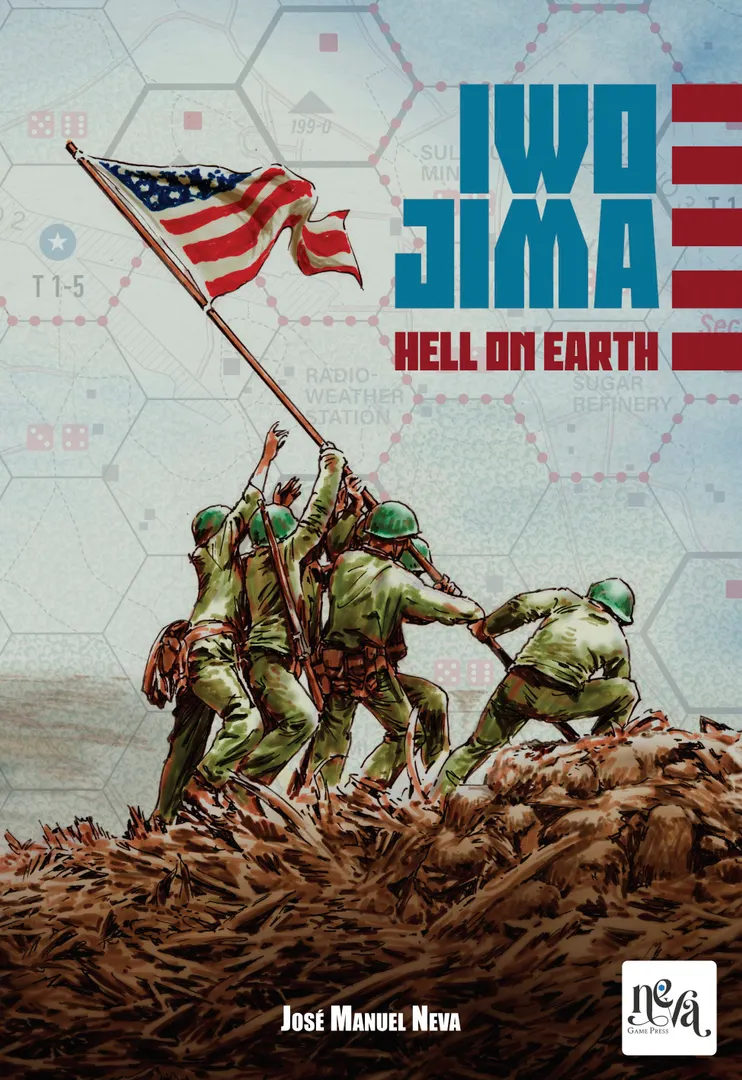
Iwo Jima: Hell On Earth ist ein Brettspiel aus dem Jahr 2025 für 1 Person, mit 90–120 Minuten pro Partie und ab 14 Jahren. Entwickelt wurde es von José Manuel Neva; die wichtigsten Mechaniken sind Dice Rolling, Variable Set-up und Hexagon Grid.


Auf Englisch
THE HISTORICAL CONTEXT The Battle of Iwo Jima, a pivotal momentin the Pacific Theater of World War II, stands as a testament to the indomitable spirit of the human will and the immense cost of victory. This brutal conflict, fought between the United States Marine Corps and the Imperial Japanese Army, unfolded on the small volcanic island of Iwo Jima, a mere 660 miles south of Tokyo. From February 19 to March 26, 1945, American forces waged a relentless assault against a well-fortified enemy, determined to seize control of the island’s strategic airfields. Iwo Jima was crucial to the Allied war effort, serving as a vital base for fighter planes escorting long-range bombers on missions to the Japanese mainland. The battle was marked by fierce resistance from the Japanese defenders, who had meticulously constructed a network of underground tunnels and fortifications.The Marines faced relentless attacks, as they fought their way across the island’s rugged terrain. The iconic image of Marines raising the American flag atop Mount Suribachi became a symbol of American determination and sacrifice. The Battle of Iwo Jima was one of the bloodiest battles in Marine Corps history, with thousands of American and Japanese soldiers losing their lives. The island’s volcanic ash and the intense fighting conditions made it a grueling ordeal for both sides. Despite the heavy casualties, the Marines ultimately achieved their objective, securing Iwo Jima and bringing the United States one step closer to victory in the Pacific War. GAMEPLAY AT A GLANCE In “Iwo Jima: Hell on Earth,” your mission as the commander of US forces is to conquer the island of Iwo Jima to secure its three airfields and the iconic Mount Suribachi. The game simulates the 36-day battle in nine turns, with each turn representing approximately four days. Objective and how to win: Victory is determined at the end of Turn 9 by calculating your Victory Points (VPs). You earn VPs by: Eliminating Japanese units, Capturing key objectives on time, Japanese surrender. You can lose VPs if: You play too many Special Orders and/or You suffer too many US casualties. Your final VP score will give you an assessment of your performance, ranging from a “pen-pushing job” (1 or less to 5 VP) to an “incredible victory” (19-20 VP) Sequence of play: The game is played over nine turns, and each turn follows the sequence below: 1. Weather Phase: A die is rolled to determine the weather conditions for the turn, which can affect bombardment points and unit movement. Turn 1 always has “Good Weather”. 2. Bombardment Phase: Both US and Japanese forces bombard enemy units. First, each side’s bombardment points (BP) are determined, which can be modified by weather or airfield control. Then bombardments are resolved, US first, then Japanese, by selecting targets and rolling dice to determine hits. 3. First Movement Phase: US units can attempt to recover from retreat markers (rally) and then move across the map, choosing between normal or strategic movement. 4. First Attack Phase: US units that have not performed a previous action can conduct a Reconnaissance-in-Force (Recon) or an Assault against adjacent Japanese units. They can also provide Combat Support to an assault. During assaults, hidden Japanese units will reveal their response, which may include a Banzai Attack or a Redeployment. The combat ratio is calculated, and results are applied. 5. Raid Phase (Japanese): Japanese forces react with limited attacks, carrying out raids against nearby US units. 6. Second Movement Phase: This phase is a repeat of the First Movement Phase for US units. 7. Second Attack Phase: Similar to the First Attack Phase, US units can perform Reconnaissance or Assaults. At the end of this phase, all situation markers are removed. 8. Command Phase (Skipped on Turn 9): US units attempt to rally again with a +1 modifier. Command Points (CPs) are gained by rolling a die, which can be spent on reinforcements, unit deployment, or to obtain special command markers. The Japanese side also resolves a limited command step, where their single-step units can attempt to gain a step or perform a Banzai attack. 9. Organization Phase: The turn marker is advanced. US units on the turn track can move to the Reserve Area or recover steps. Reaction markers are put into the red bag, and Command markers can be drawn if the turn space is highlighted. At the end of Turn 9, the player’s performance is assessed based on criteria such as Japanese units eliminated, capture of key objectives, special order markers played, and US casualties. Key decision/challenges: US units have a dual role, acting as both direct assault regiments and providing various combat support types (Flamethrowers, Tank, Artillery). This requires careful planning to combine their direct combat strength with support for optimal attacks. Assaults against hidden Japanese units are resolved using a chit-pull system: Intelligence markers are drawn to determine Japanese defense, support, and unpredictable “Banzai” attacks or “Redeployments” via tunnels. This random element ensures high replayability, making each game fresh. The game is designed to be very difficult to achieve a significant victory, reflecting the brutal historical battle. WHAT’S IN THE BOX? 1 Mounted Map 120 Counters 2 6-sided dice 4 Player Aid Sheets 2 Cloth bags 1 Rulebook —description from the publisher
Laut Katalog unterstützt Iwo Jima: Hell On Earth 1 Person. Das ist die vom Verlag angegebene Spielerzahl, das Spiel ist also genau für diese Anzahl von Mitspielenden ausgelegt. Varianten für andere Gruppengrößen sind, sofern vorhanden, in der Anleitung deiner Ausgabe beschrieben; prüfe sie, bevor du eine andere Konfiguration aufbaust.
Die angegebene Spieldauer für Iwo Jima: Hell On Earth beträgt 90–120 Minuten. Das ist die Schätzung des Verlags für eine vollständige Partie. Die tatsächliche Dauer hängt von der Gruppe, der Personenzahl und der Regelkenntnis ab: Erste Partien dauern meist länger, erfahrene Gruppen sind oft schneller fertig. Aufbau und Regelerklärung sind in dieser Schätzung nicht enthalten.
Im Katalog wird Iwo Jima: Hell On Earth ab 14 Jahren empfohlen. Das ist die Empfehlung des Verlags und berücksichtigt Leseanforderungen, Regelkomplexität und Kleinteile, nicht nur das Thema. Jüngere Kinder können oft mit Hilfe eines Erwachsenen mitspielen; beachte die Altersangabe deiner Ausgabe und die Brettspielerfahrung deiner Gruppe.
Iwo Jima: Hell On Earth hat bei BoardGameGeek eine Komplexitätswertung von 2,3 von 5 und gilt damit als eher leichtes Spiel. Die Wertung zeigt, wie viel Regelwissen, Planung und Entscheidungen eine typische Partie verlangt. Schwerere Spiele brauchen bei der ersten Erklärung mehr Zeit, daher hilft vor dem Spieleabend eine Vorbereitungsanleitung.
Iwo Jima: Hell On Earth gehört zu diesen Kategorien: Wargame und World War II. Die wichtigsten Mechaniken sind Dice Rolling, Variable Set-up und Hexagon Grid. Kategorien beschreiben Thema und Setting eines Spiels, Mechaniken dagegen, was die Spielenden in ihrem Zug tatsächlich tun. Jede Mechanik führt zu einer Katalogseite mit ähnlichen Spielen, falls du etwas Vergleichbares suchst.
Als Autoren von Iwo Jima: Hell On Earth sind angegeben: José Manuel Neva. Diese Angaben stammen aus den veröffentlichten Spieldaten und nennen die für das Spieldesign verantwortlichen Personen, nicht die Illustratoren oder Verlage. Die Autorenseiten auf MeepleRules sammeln weitere Titel derselben Autoren – praktisch, wenn dir ein Spiel gefällt und du ähnliche Spiele suchst.
Im Katalog ist Iwo Jima: Hell On Earth als Grundspiel aufgeführt. Es lässt sich eigenständig mit dem Material aus der Schachtel spielen und benötigt keinen weiteren Titel. Erweiterungen, sofern es welche gibt, ergänzen neues Material oder neue Regeln und sind im Katalog separat mit einem Verweis auf dieses Grundspiel aufgeführt.