
- BGG-Bewertung
- 7,9
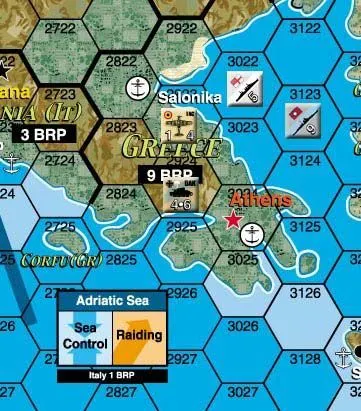
John Prados' Third Reich: Deluxe Map
- Komplexität 3,0/5
- 2004
2001
Regelhilfe für John Prados' Third Reich
Verständliche Erklärungen zu Spielzügen, Karteneffekten und strittigen Situationen mit Verweisen auf offizielle Quellen und gespeichertem Fragenverlauf.
Für 2 Personen
Was möchtest du wissen?
Antworten stammen aus dem offiziellen Regelheft, mit Seitenangabe zum Nachprüfen.
John Prados' Third Reich ist ein Brettspiel aus dem Jahr 2001 für 2–5 Personen, mit 360 Minuten pro Partie und ab 12 Jahren. Entwickelt wurde es von John Prados und Brian L. Knipple; die wichtigsten Mechaniken sind Dice Rolling, Hexagon Grid und Simulation.






Auf Englisch
(from Avalanche Press website:) Third Reich interweaves not only the land, naval and air struggles, but also the equally important economic and political battles. Players must guide their nation to victory by capturing key objectives while making sure no one else — in particular their allies — gets there first. Players take on the leadership of Britain, France, Italy, Germany, the United States or the Soviet Union. Each of these major powers, in turn, can influence smaller countires like Turkey, Greece or Romania to join the war on their side. They can offer bribes or territory, and sometimes it’s more important to decrease someone else’s influence than to build up your own. The currency of the game is the Basic Resource Point, or BRP. This represents the financial, industrial and agricultural production needed to wage war. BRP’s are used to build new units, to pay for offensives, to replace losses suffered in battle, to bribe minor countries, and for a host of other purposes. Each country’s production can be affected by conquering or losing territory, or through strategic warfare (chiefly, attacks by submarines and bombers). Once activated (usually at a cost in BRP’s), land, naval and air units can move and attack enemy units. Combat is resolved by rolling dice, with a result of 6 usually equalling a hit. There are no Combat Results Tables; every factor counts and there are no “perfect numbers” of units to commit to battle as in some wargames. When a land unit is hit, BRP’s can be used to absorb some of the damage, but too many hits and it is reduced in strength or destroyed. Naval and air units pack a greater punch, but don’t bounce back from damage as easily. Scenarios, or game situations, begin the game in 1938, 1939, 1940, 1941, 1942, 1943, 1944 or 1945. Political markers are randomly chosen to determine what events might take place outside the players’ control: Poland might capitulate to Germany in 1939, Mussolini, Churchill or Hitler might unleash some stupid scheme the Italian, British or German player will have to execute, oil could be found in Libya, the French navy could rally to the Allies or the Axis, jets can be developed, good Germans might kill Hitler — dozens of such events are possible. As one of the most popular games of all time, our edition of Third Reich has also spawned a sequel, Great Pacific War. The two games can be played together or separately. (BGG description:)Avalanche Press' re-release of the original classic. This is a significant overhaul based on the Avalon Hill Third Reich, and has nothing to do with the later Advanced Third Reich. There has been dramatic simplification and streamlining, however. Gone is the CRT, replaced by a Columbia-esque "roll lots of dice" combat resolution system. The whole front/option system has been revised with an "HQ activation marker" system: each nation buys activation markers for HQs, land, and air units, and puts them in a cup. Turn order is then determined by draws. Naval and air systems have been overhauled and simplified: sea zones now regulate movement. Tactical air support is now limited to being equal to the strength of the attacker/defender, not three times. Also includes 1938 (Spanish Civil War boils over to a general European conflict) and 1945 scenarios (Western Allies and Russia fall out after collapse of Germany).
Laut Katalog unterstützt John Prados' Third Reich 2–5 Personen. Diese Spanne entspricht der vom Verlag angegebenen Spielerzahl, das Spiel lässt sich also für jede Gruppengröße innerhalb dieser Spanne aufbauen. Aufbau, einzelne Regeln und Wertungsdetails können je nach Personenzahl trotzdem abweichen; prüfe daher die genaue Konfiguration in der Anleitung deiner Ausgabe.
Die angegebene Spieldauer für John Prados' Third Reich beträgt 360 Minuten. Das ist die Schätzung des Verlags für eine vollständige Partie. Die tatsächliche Dauer hängt von der Gruppe, der Personenzahl und der Regelkenntnis ab: Erste Partien dauern meist länger, erfahrene Gruppen sind oft schneller fertig. Aufbau und Regelerklärung sind in dieser Schätzung nicht enthalten.
Im Katalog wird John Prados' Third Reich ab 12 Jahren empfohlen. Das ist die Empfehlung des Verlags und berücksichtigt Leseanforderungen, Regelkomplexität und Kleinteile, nicht nur das Thema. Jüngere Kinder können oft mit Hilfe eines Erwachsenen mitspielen; beachte die Altersangabe deiner Ausgabe und die Brettspielerfahrung deiner Gruppe.
John Prados' Third Reich hat bei BoardGameGeek eine Komplexitätswertung von 4,0 von 5 und gilt damit als schweres Spiel. Die Wertung zeigt, wie viel Regelwissen, Planung und Entscheidungen eine typische Partie verlangt. Schwerere Spiele brauchen bei der ersten Erklärung mehr Zeit, daher hilft vor dem Spieleabend eine Vorbereitungsanleitung.
John Prados' Third Reich gehört zu diesen Kategorien: Economic, Wargame und World War II. Die wichtigsten Mechaniken sind Dice Rolling, Hexagon Grid und Simulation. Kategorien beschreiben Thema und Setting eines Spiels, Mechaniken dagegen, was die Spielenden in ihrem Zug tatsächlich tun. Jede Mechanik führt zu einer Katalogseite mit ähnlichen Spielen, falls du etwas Vergleichbares suchst.
Als Autoren von John Prados' Third Reich sind angegeben: John Prados und Brian L. Knipple. Diese Angaben stammen aus den veröffentlichten Spieldaten und nennen die für das Spieldesign verantwortlichen Personen, nicht die Illustratoren oder Verlage. Die Autorenseiten auf MeepleRules sammeln weitere Titel derselben Autoren – praktisch, wenn dir ein Spiel gefällt und du ähnliche Spiele suchst.
Im Katalog ist John Prados' Third Reich als Grundspiel aufgeführt. Es lässt sich eigenständig mit dem Material aus der Schachtel spielen und benötigt keinen weiteren Titel. Erweiterungen, sofern es welche gibt, ergänzen neues Material oder neue Regeln und sind im Katalog separat mit einem Verweis auf dieses Grundspiel aufgeführt.