
- BGG-Rang
- BGG #15.435
- BGG-Bewertung
- 7,0
Jack The Ripper
- 2 Spieler
- 120 Min.
- Komplexität 2,4/5
- 1983
1983
Regelhilfe für Mohawk
Verständliche Erklärungen zu Spielzügen, Karteneffekten und strittigen Situationen mit Verweisen auf offizielle Quellen und gespeichertem Fragenverlauf.
Für 2 Personen
Was möchtest du wissen?
Antworten stammen aus dem offiziellen Regelheft, mit Seitenangabe zum Nachprüfen.
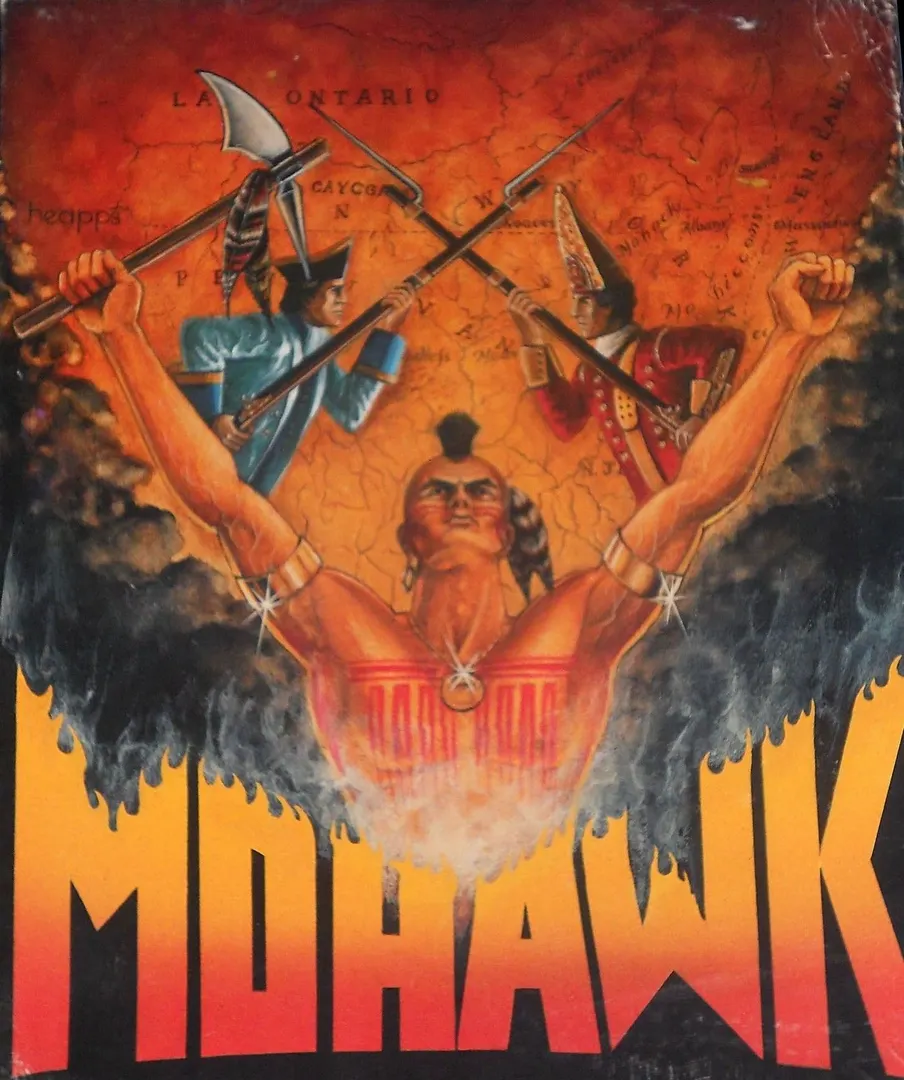
Mohawk ist ein Brettspiel aus dem Jahr 1983 für 2 Personen, mit 240 Minuten pro Partie und ab 14 Jahren. Entwickelt wurde es von Tom Loback und Rick Bowes; die wichtigsten Mechaniken sind Dice Rolling, Point to Point Movement und Variable Set-up.




Auf Englisch
"Mohawk" is a wargame of the "French and Indian War" in North America. Mounted, color mapboard measures 22" x 17". Map features significant land and water routes used in the period. Inset maps are included for high seas naval movement and tactical battle resolution. 176 two-sided mounted and die-cut counters represent regular and militia, Indians, fortresses and fleets. Reinforcements from Europe are variable depending on naval activity. Militia must be "mustered," and "go home" at the end of each campaign year. Natives are influenced by "gifts and supplies" and by battlefield victories. Road, Indian trail and Water movement all have key roles in operations. Battles occur between opposing forces occupying the same point. Engagements take place on an inset map determined by terrain and situation: "Attacking/Defending Fort," "Open Ground," "Wood" (forested) or "Landing." Modifiers apply depending on whether engaged units are Regulars, Militia, or Indians, Rangers and Couriers de Bois. Units engaging in battle line up opposite one another. A "hit" is determined by a D6 roll of "6." Die rolls are modified according to unit type and battle setting (Regulars defending a fort, for example, are "plus 2", hitting on a four or better). All units, except Iroquois, are flipped on the first hit and eliminated on the second. At the start of his/her battle turn, a player may elect to "retreat" in lieu of firing. Retreating units move to an adjacent friendly point, preferably toward their Base of Operations. At the end of a victorious battle, flipped pieces are turned back to full strength, and one victorious militia unit, if present, may be "promonted" to a Regular or Ranger (British) or a "Troop of the Marine battalion" or "Courier de Bois" (French). Fortresses can be built; Towns and Fortresses can be burned. Supply is critical at the end of a campaign year; all Regular and militia units must occupy either a town or fort, or is not connected by a red road (not trail). They must be able to trace supply by road or waterway to their Base of Operations (Montreal or Quebec for the French; Boston, New York or Philadelphia for the British). Regular or militia units which fail these conditions are eliminated unless they are in a seaport. The powerful Iroquois Nation is key to victory. Three of the six Iroquois tribes begin aligned with each side (the counters are two-sided). After each battle, the victor of that battle flips one Iroquois unit to his/her side. Any time a player begins his/her turn with all six tribes oriented to his/her side, the Iroquois have joined him/her for the duration. The other twenty tribes are activated to support the French either by the activities of the Couriers de Bois, or by French bribes ("gifts and supplies"). Except for the Iroquois, Native tribes usually "go home" after a victory (to celebrate). Victory is determined by conquest. The French must begin a turn, or end the game, holding Albany and one of New York, Boston or Philadelphia, or must deny the British their victory conditions. The British must hold a total of three French cities from the list of Louisbourg, Frontenac, Duquesne, Montreal or Quebec (at least one must be Montreal or Quebec).
Laut Katalog unterstützt Mohawk 2 Personen. Das ist die vom Verlag angegebene Spielerzahl, das Spiel ist also genau für diese Anzahl von Mitspielenden ausgelegt. Varianten für andere Gruppengrößen sind, sofern vorhanden, in der Anleitung deiner Ausgabe beschrieben; prüfe sie, bevor du eine andere Konfiguration aufbaust.
Die angegebene Spieldauer für Mohawk beträgt 240 Minuten. Das ist die Schätzung des Verlags für eine vollständige Partie. Die tatsächliche Dauer hängt von der Gruppe, der Personenzahl und der Regelkenntnis ab: Erste Partien dauern meist länger, erfahrene Gruppen sind oft schneller fertig. Aufbau und Regelerklärung sind in dieser Schätzung nicht enthalten.
Im Katalog wird Mohawk ab 14 Jahren empfohlen. Das ist die Empfehlung des Verlags und berücksichtigt Leseanforderungen, Regelkomplexität und Kleinteile, nicht nur das Thema. Jüngere Kinder können oft mit Hilfe eines Erwachsenen mitspielen; beachte die Altersangabe deiner Ausgabe und die Brettspielerfahrung deiner Gruppe.
Mohawk hat bei BoardGameGeek eine Komplexitätswertung von 2,0 von 5 und gilt damit als eher leichtes Spiel. Die Wertung zeigt, wie viel Regelwissen, Planung und Entscheidungen eine typische Partie verlangt. Schwerere Spiele brauchen bei der ersten Erklärung mehr Zeit, daher hilft vor dem Spieleabend eine Vorbereitungsanleitung.
Mohawk gehört zu diesen Kategorien: Wargame, Nautical und Age of Reason. Die wichtigsten Mechaniken sind Dice Rolling, Point to Point Movement und Variable Set-up. Kategorien beschreiben Thema und Setting eines Spiels, Mechaniken dagegen, was die Spielenden in ihrem Zug tatsächlich tun. Jede Mechanik führt zu einer Katalogseite mit ähnlichen Spielen, falls du etwas Vergleichbares suchst.
Als Autoren von Mohawk sind angegeben: Tom Loback und Rick Bowes. Diese Angaben stammen aus den veröffentlichten Spieldaten und nennen die für das Spieldesign verantwortlichen Personen, nicht die Illustratoren oder Verlage. Die Autorenseiten auf MeepleRules sammeln weitere Titel derselben Autoren – praktisch, wenn dir ein Spiel gefällt und du ähnliche Spiele suchst.
Im Katalog ist Mohawk als Grundspiel aufgeführt. Es lässt sich eigenständig mit dem Material aus der Schachtel spielen und benötigt keinen weiteren Titel. Erweiterungen, sofern es welche gibt, ergänzen neues Material oder neue Regeln und sind im Katalog separat mit einem Verweis auf dieses Grundspiel aufgeführt.