

- BGG-Rang
- BGG #226
- BGG-Bewertung
- 7,5
Memoir '44
- 2–4 Spieler
- 30–45 Min.
- Komplexität 2,3/5
- 2004
2018
Regelhilfe für Normandy: The Beginning of the End
Verständliche Erklärungen zu Spielzügen, Karteneffekten und strittigen Situationen mit Verweisen auf offizielle Quellen und gespeichertem Fragenverlauf.
Für 2 Personen
Was möchtest du wissen?
Antworten stammen aus dem offiziellen Regelheft, mit Seitenangabe zum Nachprüfen.
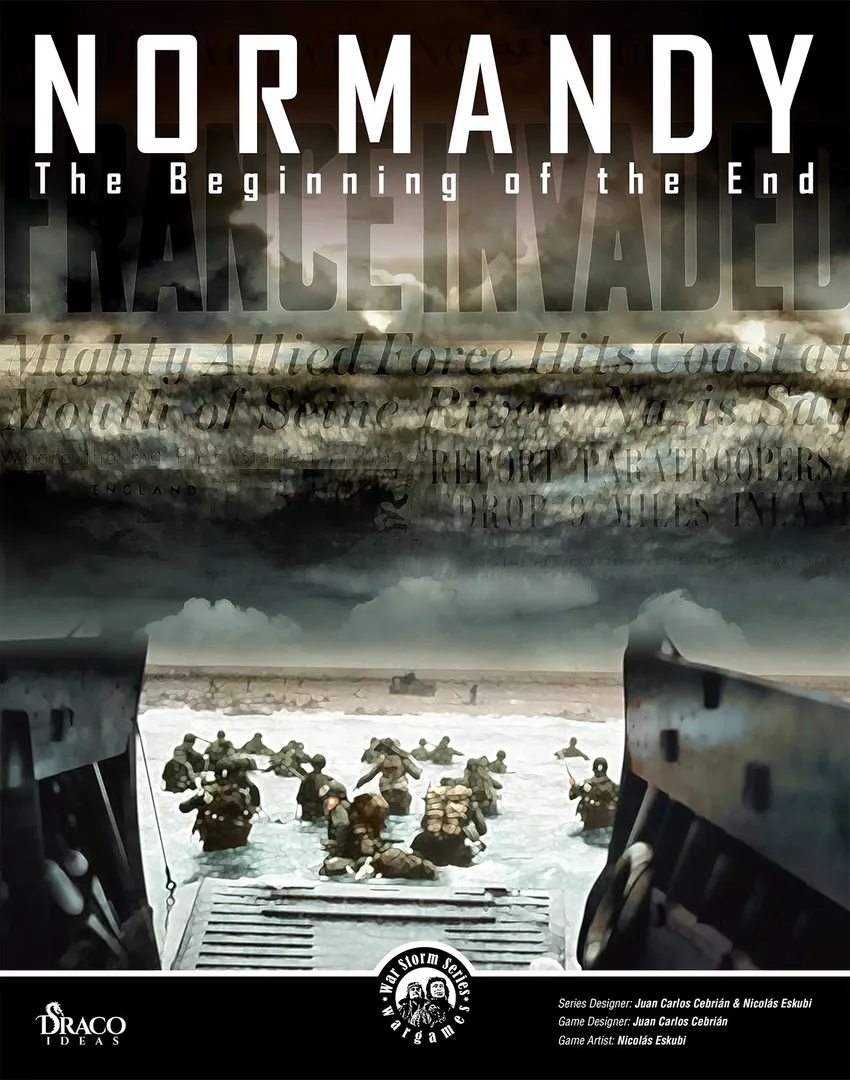
Normandy: The Beginning of the End ist ein Brettspiel aus dem Jahr 2018 für 2 Personen, mit 60–120 Minuten pro Partie und ab 12 Jahren. Entwickelt wurde es von Juan Carlos Cebrián und Nicolás Eskubi; die wichtigsten Mechaniken sind Dice Rolling, Modular Board und Hexagon Grid.






Auf Englisch
Normandy: The Beginning of the End is a standalone game in the War Storms series. Recreates the events of those days and allows the players to reproduce the most famous battles of the D-Day on the American beaches at a tactical level. Players take command of either the Allied or Axis forces (or can play solitaire) in the tactical battles of each scenario. Normandy: The Beginning of the End, while utilizing "Paths to Hell" standard rules, incorporates new and adapted rules and additions for this new front. The WSS promises many hours of fierce fighting between the infantry, tanks, artillery and aircraft belonging to the armies enveloped in this conflict. Just a few of the additions include: Landings Battalion officers Paratroopers rules Recon rules Amphibious Tanks Waffen SS Fallschirmjäger Free French troops One A4 chart with many overlays including a whole beach making a large map. Normandy: The Beginning of the End has a moderate complexity with good solitaire suitability. The system emphasizes the role of officers. Officers can activate units, coordinate with other officers and their units, call for artillery support, air support, smoke screens, influence moral checks, coordinate assaults, and much more. Rules for special actions. Based on the principle of simultaneous execution, or simply "WE GO", a hybrid system of turns and "real time". The players must activate unit officers to perform many actions (fire, assault, move, coordinate, etc). A turn ends when both players have completed all their activations. The scale is platoon level with units. Representing groups of between 30 and 40 soldiers, weapons units represents groups of 3-4 weapons and their accompanying crews (20-25 soldiers), and the AFvs-Transports representing groups of 3 to 5 vehicles and their corresponding crews. Scenarios are divided into turns representing about 12-15 minutes of action. Turns are divided into the following phases: Command Phase, Initiative Phase, Activation Phase and Marker Removal Phase The game uses isomorphic mapboards, each of which are aligned to any edge of equal length on any other mopboard. This allows for an almost unlimited number of combinations to create any terrain situation, including player designed scenarios. Each map hex represents a distance of approximately 150 to 200 metres. The following components are included in this game: • 2 3/4” countersheets with German/American and Free French vehicles (AFV and transports) and weapon units (Mortars, MG, AT, AA guns, infantry guns, artillery,…). • 2 5/8” countersheets with German/American and Free French troops and officers. • 1 5/8” countersheet with common markers. • 4 Isomorphic mapboards. • 8 Overlays. • 3 Charts & Tables cards. • 2 Battalion Battle Stress Charts • 17 scenarios. • 1 Standard rulebook. • 1 Exclusive rules booklet. • 2 Six-sided dice.
Laut Katalog unterstützt Normandy: The Beginning of the End 2 Personen. Das ist die vom Verlag angegebene Spielerzahl, das Spiel ist also genau für diese Anzahl von Mitspielenden ausgelegt. Varianten für andere Gruppengrößen sind, sofern vorhanden, in der Anleitung deiner Ausgabe beschrieben; prüfe sie, bevor du eine andere Konfiguration aufbaust.
Die angegebene Spieldauer für Normandy: The Beginning of the End beträgt 60–120 Minuten. Das ist die Schätzung des Verlags für eine vollständige Partie. Die tatsächliche Dauer hängt von der Gruppe, der Personenzahl und der Regelkenntnis ab: Erste Partien dauern meist länger, erfahrene Gruppen sind oft schneller fertig. Aufbau und Regelerklärung sind in dieser Schätzung nicht enthalten.
Im Katalog wird Normandy: The Beginning of the End ab 12 Jahren empfohlen. Das ist die Empfehlung des Verlags und berücksichtigt Leseanforderungen, Regelkomplexität und Kleinteile, nicht nur das Thema. Jüngere Kinder können oft mit Hilfe eines Erwachsenen mitspielen; beachte die Altersangabe deiner Ausgabe und die Brettspielerfahrung deiner Gruppe.
Normandy: The Beginning of the End hat bei BoardGameGeek eine Komplexitätswertung von 3,9 von 5 und gilt damit als schweres Spiel. Die Wertung zeigt, wie viel Regelwissen, Planung und Entscheidungen eine typische Partie verlangt. Schwerere Spiele brauchen bei der ersten Erklärung mehr Zeit, daher hilft vor dem Spieleabend eine Vorbereitungsanleitung.
Normandy: The Beginning of the End gehört zu diesen Kategorien: Wargame und World War II. Die wichtigsten Mechaniken sind Dice Rolling, Modular Board und Hexagon Grid. Kategorien beschreiben Thema und Setting eines Spiels, Mechaniken dagegen, was die Spielenden in ihrem Zug tatsächlich tun. Jede Mechanik führt zu einer Katalogseite mit ähnlichen Spielen, falls du etwas Vergleichbares suchst.
Als Autoren von Normandy: The Beginning of the End sind angegeben: Juan Carlos Cebrián und Nicolás Eskubi. Diese Angaben stammen aus den veröffentlichten Spieldaten und nennen die für das Spieldesign verantwortlichen Personen, nicht die Illustratoren oder Verlage. Die Autorenseiten auf MeepleRules sammeln weitere Titel derselben Autoren – praktisch, wenn dir ein Spiel gefällt und du ähnliche Spiele suchst.
Im Katalog ist Normandy: The Beginning of the End als Grundspiel aufgeführt. Es lässt sich eigenständig mit dem Material aus der Schachtel spielen und benötigt keinen weiteren Titel. Erweiterungen, sofern es welche gibt, ergänzen neues Material oder neue Regeln und sind im Katalog separat mit einem Verweis auf dieses Grundspiel aufgeführt.