
- BGG-Rang
- BGG #12.984
- BGG-Bewertung
- 6,2
Tara Wolf in Valley of the Kings
- 2 Spieler
- 30 Min.
- Komplexität 1,8/5
- 2016
2014
Regelhilfe für Opération Commando: Pegasus Bridge
Verständliche Erklärungen zu Spielzügen, Karteneffekten und strittigen Situationen mit Verweisen auf offizielle Quellen und gespeichertem Fragenverlauf.
Für 2 Personen
Was möchtest du wissen?
Antworten stammen aus dem offiziellen Regelheft, mit Seitenangabe zum Nachprüfen.
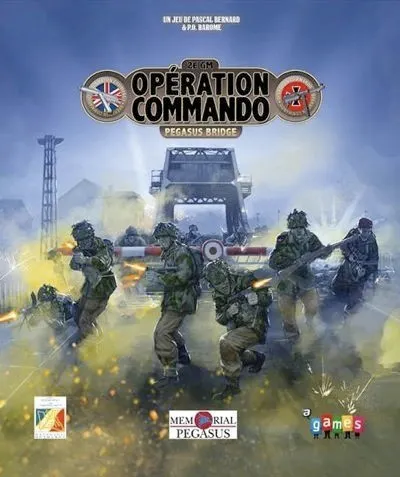
Opération Commando: Pegasus Bridge ist ein Brettspiel aus dem Jahr 2014 für 2 Personen, mit 15–60 Minuten pro Partie und ab 10 Jahren. Entwickelt wurde es von Pascal Bernard und P. O. Barome; die wichtigsten Mechaniken sind Hand Management und Campaign / Battle Card Driven.

Auf Englisch
(Version française ci-dessous.) In 1944, during the night of 5th to 6th June, paratroopers of the British 6th Airborne achieved three heroic missions that made possible the D-Day Normandy Landings on the East sector (Gold, Juno and Sword beaches). In Operation Commando - Pegasus Bridge, one player leads the English commandos, while his opponent is in charge of the defending German troops. Each turn, on a different battlefield (each ground having specific characteristics), players draw cards (each player has his own deck), can play events, and then an assault begins. The German plays a unit; the English answers with a unit, that must have a Combat value equal or higher than the German unit's, or reach it thanks to boosts. If it does, the German can boost his unit, then the English, and so on until a player stops. A unit's combat value can be raised by combat action cards and tokens (one side +1 Combat, one blank side) taken from the player's tokens reserve and flipped. If the English's unit is destroyed, he loses one of his 3 Manpower Points (MP) but moves to the next ground (the assault ends, as does the turn on this ground). If the German's unit is destroyed, he can play another one (depending on the ground's size) and the assault goes on. If the English destroys all enemy units present on the ground, he wins the assault and progresses without losing a MP. Players also have a pool of special cards, the powerful "heroic" cards, from which they secretely choose one card to add to their hand each two turns. Since heroic cards have potent effects and can't be countered, choosing them well depending on the situation of the game is strategically very important. These cards feature actual historical officers and events. The game contains three scenarios, each of which corresponding to one of the three missions that the English commandos had to fulfill this night: the taking of the bridge of Bénouville ("Pegasus Bridge") to allow the landed troops to progress deeper inside the land; the assault on the Merville Gun Battery, a fortified area threatening the Landind beaches with long distance cannons; and the bombing of the bridges on the Dives river to prevent the tanks of the 21th Panzer Division from reinforcing the German troops. Each scenario has its own pool of cards (including heroic cards) and different gameplays. To win, the English must fulfill his objective (which depends of the scenario), by winning the assault on one or more objective grounds. To win, the German has to prevent the English to reach his goal, generally by bringing his Manpower Points to zero or, in the Dives scenario, by preventing him to destroy two bridges out of four. The three scenarios can be played in campaign mode (one after the other) to recreate the historic night. Depending on his results, the English gets more or less campaign points, and when the three scenarios have been played, his total score indicates if the D-Day Landing will be possible or not. The 120 artworks illustrating the cards are realistic and faithful to historical documents (uniforms, weapons, locations...) --- En 1944, pendant la nuit du 5 au 6 juin, les parachutistes de la 6e Division Aéroportée Britannique ("6th Airborne") accomplirent trois missions héroïques qui permirent au Débarquement d'avoir lieu sur le secteur est (plages Gold, Juno et Sword). Dans **Opération Commando - Pegasus Bridge**, l'un des joueurs dirige les commandos anglais, et son adversaire les troupes allemandes. À chaque tour, sur un champ de bataille différent (chaque terrain possédant des caractéristiques spécifiques), les joueurs piochent des cartes (chacun a sa propre pioche), peuvent jouer des événements, puis un assaut commence. L'Allemand joue une unité ; l'Anglais répond par une unité, qui doit avoir une valeur de combat égale ou supérieure à celle de l'unité allemande, ou l'atteindre grâce à des bonus. Si c'est le cas, l'Allemand peut renforcer son unité, puis l'Anglais peut faire de même, et ainsi de suite jusqu'à ce qu'un joueur renonce. La valeur de combat d'une unité peut être augmentée grâce à des actions de combat et des jetons (avec une face +1 et une face sans bonus) pris dans la réserve du joueur et jetés en l'air comme un pile ou face. Si l'unité de l'Anglais est détruite, il perd l'un de ses 3 Points d'Effectifs (PE) mais avance jusqu'au prochain terrain (l'assaut se termine, de même que le tour sur ce terrain). Si c'est l'unité de l'Allemand qui est détruite, ce dernier peut en jouer une autre (selon la taille du terrain) et l'assaut se poursuit. Si l'Anglais élimine toutes les unités ennemies présentes, il remporte l'assaut et progresse sans perdre de PE. Les joueurs disposent également d'une réserve de cartes spéciales, les puissantes cartes "héroïques", réserve dans laquelle ils choisissent secrètement une carte qu'ils ajoutent à leur main tous les deux tours. Les cartes héroïques ayant des effets puissants et ne pouvant être annulées, bien les choisir en fonction du déroulement de la partie est stratégiquement très important. Ces cartes représentent des officiers ayant réellement pris part aux opérations et des événements s'étant effectivement produits. Le jeu propose trois scénarios, chacun d'eux correspondant à l'une des trois missions que les commandos anglais devaient accomplir cette nuit-là : la prise du pont de Bénouville ("Pegasus Bridge") pour permettre aux troupes débarquées de progresser à l'intérieur des terres ; l'assaut sur la batterie de Merville, une zone fortifiée menaçant les plages du Débarquement avec des canons à longue portée ; et la destruction des ponts sur la rivière Dives pour empêcher les blindés de la 21e Panzer Division de venir renforcer les troupes allemandes. Chaque scénario possède ses propres cartes (dont les cartes héroïques) et des mécaniques de jeu différentes. Pour gagner, l'Anglais doit remplir sa mission (qui dépend du scénario), en remportant l'assaut sur un ou plusieurs terrains objectifs. Pour gagner, l'Allemand doit empêcher l'Anglais d'atteindre son but, généralement en lui faisant perdre tous ses Points d'Effectifs, ou, dans le scénario de la Dives, en l'empêchant de détruire deux des quatre ponts. Les trois scénarios peuvent être joués à la suite, en mode "campagne", pour recréer cette nuit historique. En fonction de ses résultats, l'Anglais obtient plus ou moins de points de campagne, et quand les trois scénarios ont été joués, son score total indique si le Débarquement sur les plages de Gold, Juno et Sword pourra avoir lieu ou non. Les 120 illustrations de cartes sont réalistes et fidèles aux documents historiques (uniformes, armes, lieux...)
Laut Katalog unterstützt Opération Commando: Pegasus Bridge 2 Personen. Das ist die vom Verlag angegebene Spielerzahl, das Spiel ist also genau für diese Anzahl von Mitspielenden ausgelegt. Varianten für andere Gruppengrößen sind, sofern vorhanden, in der Anleitung deiner Ausgabe beschrieben; prüfe sie, bevor du eine andere Konfiguration aufbaust.
Die angegebene Spieldauer für Opération Commando: Pegasus Bridge beträgt 15–60 Minuten. Das ist die Schätzung des Verlags für eine vollständige Partie. Die tatsächliche Dauer hängt von der Gruppe, der Personenzahl und der Regelkenntnis ab: Erste Partien dauern meist länger, erfahrene Gruppen sind oft schneller fertig. Aufbau und Regelerklärung sind in dieser Schätzung nicht enthalten.
Im Katalog wird Opération Commando: Pegasus Bridge ab 10 Jahren empfohlen. Das ist die Empfehlung des Verlags und berücksichtigt Leseanforderungen, Regelkomplexität und Kleinteile, nicht nur das Thema. Jüngere Kinder können oft mit Hilfe eines Erwachsenen mitspielen; beachte die Altersangabe deiner Ausgabe und die Brettspielerfahrung deiner Gruppe.
Opération Commando: Pegasus Bridge hat bei BoardGameGeek eine Komplexitätswertung von 2,0 von 5 und gilt damit als eher leichtes Spiel. Die Wertung zeigt, wie viel Regelwissen, Planung und Entscheidungen eine typische Partie verlangt. Schwerere Spiele brauchen bei der ersten Erklärung mehr Zeit, daher hilft vor dem Spieleabend eine Vorbereitungsanleitung.
Opération Commando: Pegasus Bridge gehört zu diesen Kategorien: Card Game, Wargame und World War II. Die wichtigsten Mechaniken sind Hand Management und Campaign / Battle Card Driven. Kategorien beschreiben Thema und Setting eines Spiels, Mechaniken dagegen, was die Spielenden in ihrem Zug tatsächlich tun. Jede Mechanik führt zu einer Katalogseite mit ähnlichen Spielen, falls du etwas Vergleichbares suchst.
Als Autoren von Opération Commando: Pegasus Bridge sind angegeben: Pascal Bernard und P. O. Barome. Diese Angaben stammen aus den veröffentlichten Spieldaten und nennen die für das Spieldesign verantwortlichen Personen, nicht die Illustratoren oder Verlage. Die Autorenseiten auf MeepleRules sammeln weitere Titel derselben Autoren – praktisch, wenn dir ein Spiel gefällt und du ähnliche Spiele suchst.
Im Katalog ist Opération Commando: Pegasus Bridge als Grundspiel aufgeführt. Es lässt sich eigenständig mit dem Material aus der Schachtel spielen und benötigt keinen weiteren Titel. Erweiterungen, sofern es welche gibt, ergänzen neues Material oder neue Regeln und sind im Katalog separat mit einem Verweis auf dieses Grundspiel aufgeführt.