
- BGG-Rang
- BGG #832
- BGG-Bewertung
- 8,3
D-Day at Omaha Beach
- 1 Spieler
- 120–480 Min.
- Komplexität 3,5/5
- 2009
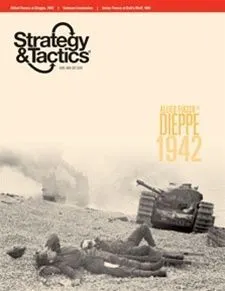
2010
Regelhilfe für Operation Jubilee: Dieppe, August 1942
Verständliche Erklärungen zu Spielzügen, Karteneffekten und strittigen Situationen mit Verweisen auf offizielle Quellen und gespeichertem Fragenverlauf.
Für 1 Person
Was möchtest du wissen?
Antworten stammen aus dem offiziellen Regelheft, mit Seitenangabe zum Nachprüfen.
Operation Jubilee: Dieppe, August 1942 ist ein Brettspiel aus dem Jahr 2010 für 1 Person und mit 180–240 Minuten pro Partie. Entwickelt wurde es von John H. Butterfield; die wichtigsten Mechaniken sind Hexagon Grid.





Auf Englisch
Portrays the disastrous Commonwealth raid against the German-held French port city of Dieppe in 1942. The game uses a simplified version of the D-Day at Omaha Beach system. (from Publisher website :)Operation Jubilee: Dieppe, August 1942 (OJ) is a purpose-designed solitaire game, by John Butterfield, simulating the disastrous Commonwealth raid against the German-held French port of Dieppe on 19 August 1942. It uses an evolution of his well-liked system from our earlier boxed game release: D-Day on Omaha Beach. Historically, a mixed force of Canadian troops and tanks and British Commandos landed on several beaches along a 16-mile stretch of coast, with a variety of objectives. While the commando raids on the flanks met with some success, the major action against Dieppe was a costly failure. It didn’t come close to achieving its objectives, and over 75 percent of that landing force were killed or captured. You control the CW forces assaulting the beaches and struggling to achieve their objectives against intense German resistance. The game system controls the German forces that oppose you. The overall 34x22” large-hex map, which is cut in half and reassembled into a 17"x42" play area, consists of three sector maps: the main map showing the French port of Dieppe and surrounding areas, and two smaller maps portraying coastal areas east and west of the main map. The main map is divided into four areas: Blue Beach, Dieppe town, Green Beach and Rear. Each hex represents 400 meters (438 yards) across; each game turn equals 20 minutes. Units of maneuver are companies and batteries; there are 176 large-size NATO-style and iconic counters in the mix. Rules cover such things as: coastal battery fire, random events, unit depth, command-control and communication, air attack, “what if” variants, amphibious warfare and much more. The game can be completed in about three to four hours. The turn sequence is as follows. I. CW Amphibious Transport Phase 1. Unit Transport 2. Landing Check II. Operations Phase III. Commonwealth Action Phase 1. Beach Landings or Evacuation. 2. CW Actions 3. Recovery IV. End of Turn Phase
Laut Katalog unterstützt Operation Jubilee: Dieppe, August 1942 1 Person. Das ist die vom Verlag angegebene Spielerzahl, das Spiel ist also genau für diese Anzahl von Mitspielenden ausgelegt. Varianten für andere Gruppengrößen sind, sofern vorhanden, in der Anleitung deiner Ausgabe beschrieben; prüfe sie, bevor du eine andere Konfiguration aufbaust.
Die angegebene Spieldauer für Operation Jubilee: Dieppe, August 1942 beträgt 180–240 Minuten. Das ist die Schätzung des Verlags für eine vollständige Partie. Die tatsächliche Dauer hängt von der Gruppe, der Personenzahl und der Regelkenntnis ab: Erste Partien dauern meist länger, erfahrene Gruppen sind oft schneller fertig. Aufbau und Regelerklärung sind in dieser Schätzung nicht enthalten.
Operation Jubilee: Dieppe, August 1942 hat bei BoardGameGeek eine Komplexitätswertung von 2,9 von 5 und gilt damit als eher leichtes Spiel. Die Wertung zeigt, wie viel Regelwissen, Planung und Entscheidungen eine typische Partie verlangt. Schwerere Spiele brauchen bei der ersten Erklärung mehr Zeit, daher hilft vor dem Spieleabend eine Vorbereitungsanleitung.
Operation Jubilee: Dieppe, August 1942 gehört zu diesen Kategorien: Wargame und World War II. Die wichtigsten Mechaniken sind Hexagon Grid. Kategorien beschreiben Thema und Setting eines Spiels, Mechaniken dagegen, was die Spielenden in ihrem Zug tatsächlich tun. Jede Mechanik führt zu einer Katalogseite mit ähnlichen Spielen, falls du etwas Vergleichbares suchst.
Als Autoren von Operation Jubilee: Dieppe, August 1942 sind angegeben: John H. Butterfield. Diese Angaben stammen aus den veröffentlichten Spieldaten und nennen die für das Spieldesign verantwortlichen Personen, nicht die Illustratoren oder Verlage. Die Autorenseiten auf MeepleRules sammeln weitere Titel derselben Autoren – praktisch, wenn dir ein Spiel gefällt und du ähnliche Spiele suchst.
Im Katalog ist Operation Jubilee: Dieppe, August 1942 als Grundspiel aufgeführt. Es lässt sich eigenständig mit dem Material aus der Schachtel spielen und benötigt keinen weiteren Titel. Erweiterungen, sofern es welche gibt, ergänzen neues Material oder neue Regeln und sind im Katalog separat mit einem Verweis auf dieses Grundspiel aufgeführt.

