
- BGG-Rang
- BGG #2.078
- BGG-Bewertung
- 7,3
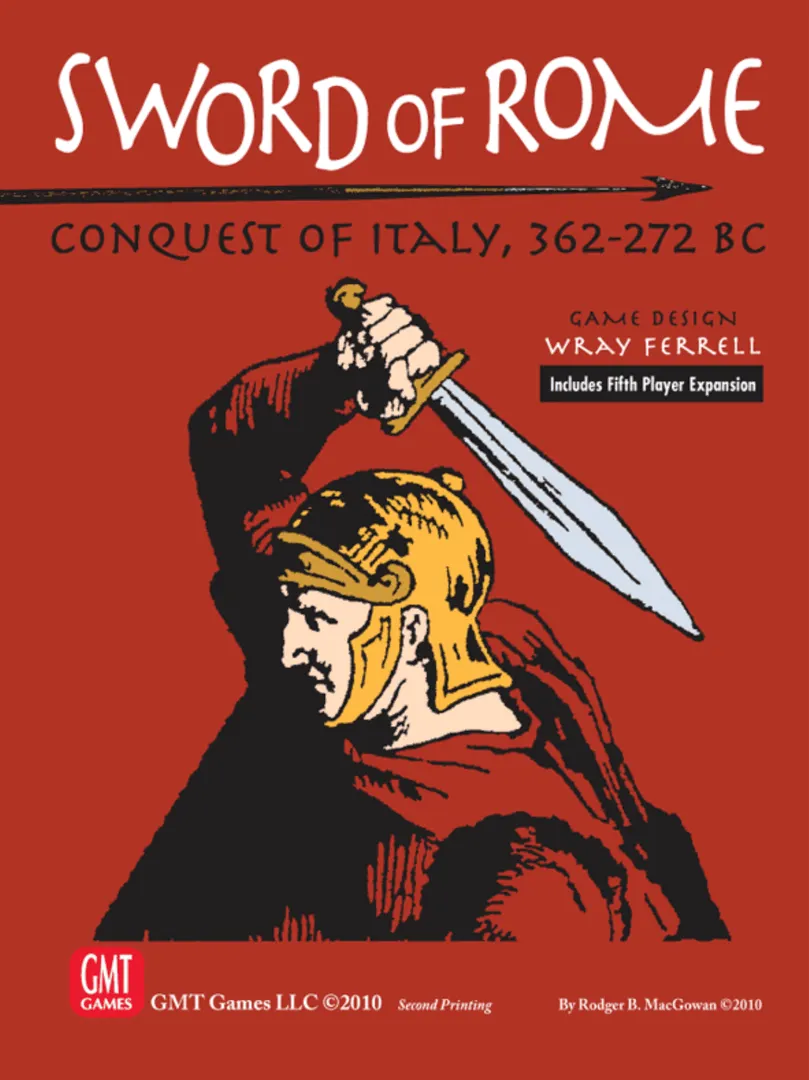
Sword of Rome: Conquest of Italy, 362-272 BC
- 2–5 Spieler
- 360 Min.
- Komplexität 3,3/5
- 2004
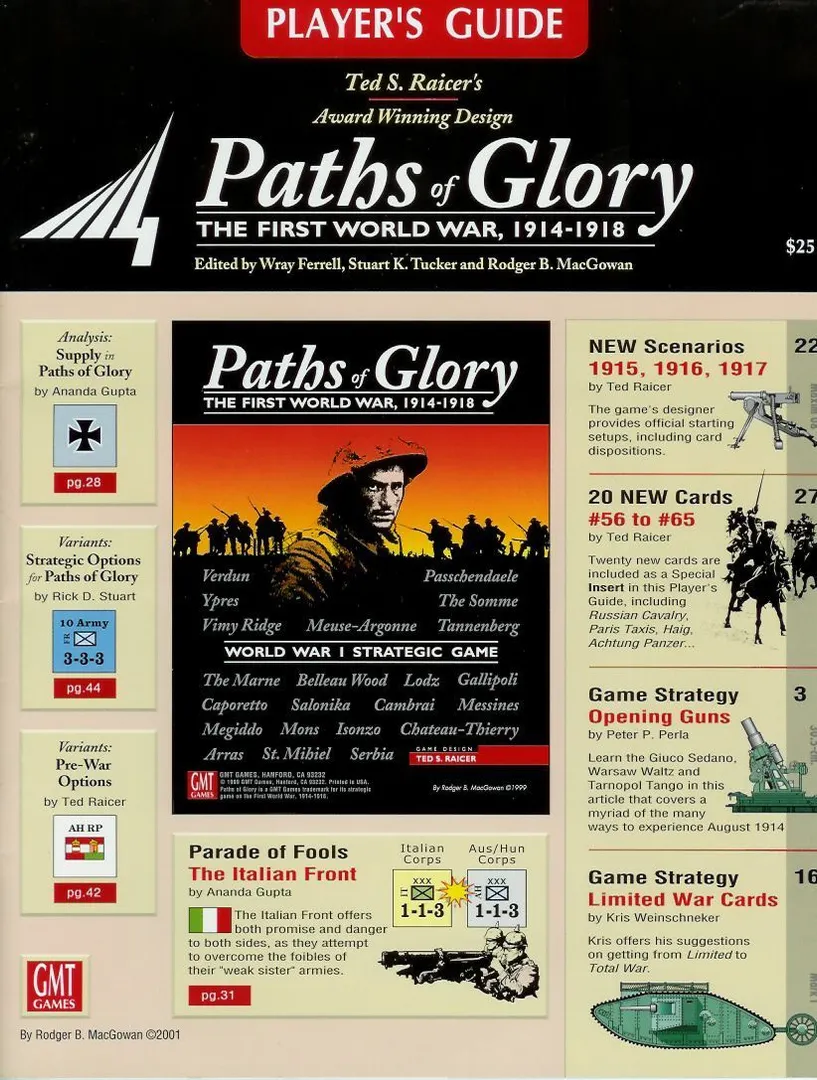
Regelhilfe für Paths of Glory: Player's Guide
Verständliche Erklärungen zu Spielzügen, Karteneffekten und strittigen Situationen mit Verweisen auf offizielle Quellen und gespeichertem Fragenverlauf.
Was möchtest du wissen?
Antworten stammen aus dem offiziellen Regelheft, mit Seitenangabe zum Nachprüfen.
Paths of Glory: Player's Guide ist eine Erweiterung für Paths of Glory aus dem Jahr 2001 für 2 Personen und ab 14 Jahren. Entwickelt wurde es von Ted Raicer, Rodger B. MacGowan, Stuart K. Tucker und Wray Ferrell; die wichtigsten Mechaniken sind Dice Rolling, Simulation und Campaign / Battle Card Driven.




Auf Englisch
The Player's Guide contains articles that describe tips, tactics, strategies, and variants available for Paths of Glory. In addition to the 48-page magazine, the Player's Guide includes 20 new cards and a 1/4 sheet of additional counters. Recent deluxe editions of the base game (6th edition 2018 and later) already contain the "optional counters first released in the POG Player’s Guide in 2002" and the "20 Optional Cards from the POG Player’s Guide". (from GMT Games's website:) Features The Paths of Glory Player's Guide is designed as an expansion kit for your enjoyment of this wonderful game, with exciting and informative articles featuring strategies for you to employ, new scenarios and variants, new playing cards, in-depth analysis of key features in the game, and so much more. Executive Editor Wray Ferrell has put together an excellent team of authors and Managing Editor Stuart K. Tucker's handsome layout design makes reading and utilizing the Player's Guide a pleasure. Contents and Authors Strategy The Opening Guns (Peter P. Perla) - Learn the Giuco Sedano, Warsaw Waltz and Tarnopol Tango in this article that covers a myriad of the many ways to experience August 1914 in Paths of Glory. Goin' Mobile (Kris Weinschneker) - Play of the Mobilization deck involves some critical choices about War Status and Reinforcements. Limited War Cards (Kris Weinschneker) - Continuing his discussion of the card decks, Kris offers his suggestions on getting from "Limited" to "Total" war quickly. Total War Cards (Kris Weinschneker) - Wrapping up his review of the cards, Kris offers some endgame card play suggestions. New Scenarios and Cards New Scenarios (Ted Raicer) - The game's designer provides the official starting setups, including card dispositions, for games begun in 1915, 1916, or 1917. Adding More Paths to Your Deck (Ted Raicer) - Twenty new cards are included as an insert to this magazine. Here are their historical bases. Analysis PoG Supply (Ananda Gupta) - The disruption of supply lines can cause the collapse of a front. Each theater has a number of key locations in the defense of those vital supply lines. Parade of Fools: The Italian Front (Ananda Gupta) - The Italian front offers both promise and danger to both sides, as they attempt to overcome the foibles of their "weak sister" armies. Optional Rules: Assessing the Balance (Ananda Gupta) - How effective are the mainstream optional rules at establishing a balanced game? Cybergaming PBEM Primer (Kris Weinschneker) - A primer on playing Paths of Glory via Play By Email. Variants Variant Cards (Tod Reiser) - More card ideas to consider adding to your deck. Pre-War Options (Ted Raicer) - For those wanting to vary the starting force setup, here are some ideas for each major nation. Strategic Options (Rick D. Stuart) - Rick provides us with more options to alter game play - some affecting the setup, some used later in the game. Historical Variants (Brad Martin) - For those seeking to experiment with history and game balance, here are more variant rule ideas.
Laut Katalog unterstützt Paths of Glory: Player's Guide 2 Personen. Das ist die vom Verlag angegebene Spielerzahl, das Spiel ist also genau für diese Anzahl von Mitspielenden ausgelegt. Varianten für andere Gruppengrößen sind, sofern vorhanden, in der Anleitung deiner Ausgabe beschrieben; prüfe sie, bevor du eine andere Konfiguration aufbaust.
Im Katalog wird Paths of Glory: Player's Guide ab 14 Jahren empfohlen. Das ist die Empfehlung des Verlags und berücksichtigt Leseanforderungen, Regelkomplexität und Kleinteile, nicht nur das Thema. Jüngere Kinder können oft mit Hilfe eines Erwachsenen mitspielen; beachte die Altersangabe deiner Ausgabe und die Brettspielerfahrung deiner Gruppe.
Paths of Glory: Player's Guide hat bei BoardGameGeek eine Komplexitätswertung von 2,9 von 5 und gilt damit als eher leichtes Spiel. Die Wertung zeigt, wie viel Regelwissen, Planung und Entscheidungen eine typische Partie verlangt. Schwerere Spiele brauchen bei der ersten Erklärung mehr Zeit, daher hilft vor dem Spieleabend eine Vorbereitungsanleitung.
Paths of Glory: Player's Guide gehört zu diesen Kategorien: Card Game, Wargame und Expansion for Base-game. Die wichtigsten Mechaniken sind Dice Rolling, Simulation und Campaign / Battle Card Driven. Kategorien beschreiben Thema und Setting eines Spiels, Mechaniken dagegen, was die Spielenden in ihrem Zug tatsächlich tun. Jede Mechanik führt zu einer Katalogseite mit ähnlichen Spielen, falls du etwas Vergleichbares suchst.
Als Autoren von Paths of Glory: Player's Guide sind angegeben: Ted Raicer, Rodger B. MacGowan, Stuart K. Tucker und Wray Ferrell. Diese Angaben stammen aus den veröffentlichten Spieldaten und nennen die für das Spieldesign verantwortlichen Personen, nicht die Illustratoren oder Verlage. Die Autorenseiten auf MeepleRules sammeln weitere Titel derselben Autoren – praktisch, wenn dir ein Spiel gefällt und du ähnliche Spiele suchst.
Im Katalog ist Paths of Glory: Player's Guide als Erweiterung zu Paths of Glory aufgeführt. Erweiterungen ergänzen das Grundspiel um neues Material, neue Regeln oder Szenarien und sind meist nicht eigenständig spielbar; du brauchst also Paths of Glory, um sie zu nutzen. Prüfe, ob deine Ausgabe von Paths of Glory kompatibel ist, da manche Erweiterungen zwischen den Auflagen überarbeitet wurden.