
- BGG-Rang
- BGG #10.475
- BGG-Bewertung
- 7,2
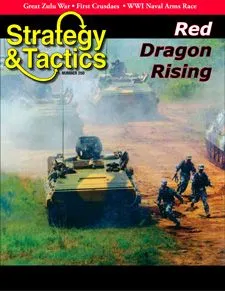
Red Dragon Rising: The Coming War With China
- 1–2 Spieler
- 180 Min.
- Komplexität 2,9/5
- 2008
2012
Regelhilfe für Red Dragon / Green Crescent
Verständliche Erklärungen zu Spielzügen, Karteneffekten und strittigen Situationen mit Verweisen auf offizielle Quellen und gespeichertem Fragenverlauf.
Was möchtest du wissen?
Antworten stammen aus dem offiziellen Regelheft, mit Seitenangabe zum Nachprüfen.
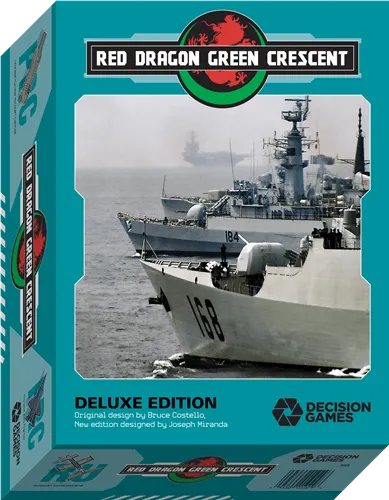
Red Dragon / Green Crescent ist ein Brettspiel aus dem Jahr 2012 für 1–2 Personen, mit 180 Minuten pro Partie und ab 14 Jahren. Entwickelt wurde es von Bruce Costello; die wichtigsten Mechaniken sind Area Movement und Dice Rolling.

Auf Englisch
Red Dragon/Green Crescent (RDGC) is a strategic-level, intermediate-complexity wargame, with operational undertones, covering hypothetical future conflicts around the southern and eastern peripheries of Asia. The timeframe is the near future, between 2013 and 2021. The game has been designed using the CSR Award winning system that first appeared in Strategy & Tactics no. 250. It’s adaptable for two player, multi-player and solitaire play. RDGC expands the original game into a two-mapper covering the Indian Ocean and Middle East, areas strategic to both the US and its allies and the Peoples Republic of China and its allies. In the game, Chinese forces that may be initially deployed into the Indian Ocean area are few, but they also have one solid ally at start: Myanmar. Besides Myanmar, there are other question marks for US planners. For instance, would Pakistan stand idly by if India allied with the US, given the existential threat they perceive of a US-Indian victory in a war with China? And what about Iran: if that country is ever to make a move to achieve dominance in the Persian Gulf, what better time than during a major war while its winners aren’t yet clear? There’s also the rest of the troubled Middle East (Egypt-Syria-Lebanon-Israel). That collective totality makes for a wonderfully varied gaming situation. Besides the main scenarios, there are numerous variants and options, adding new dimensions and giving literally hundreds of new possibilities for play. Most of the ground units in RDGC represent brigades (“brigade combat teams” or “BCT” for the US). The exceptions are the Singaporean, Malaysian, Taiwanese, Philippine, and Yemeni armies. There is additionally one new corps of marines for the PRC. Aircraft are mostly represented by mixed-type combat-wings, though only one aircraft type is shown on each counter. Long-range bombers have their own mono-type units that can’t combine operations with the other ‘tactical’ air wings. Ship units mostly represent mission-oriented groups of vessels such as SAGs, subrons or individual capital ships. Game turns represent varied amounts of “real time,” depending on the “operation” presently being conducted, from one to three days. An entire match encompasses the first month of the wars being examined. Scenarios include partial and two-map games, some centered on the Korean peninsula, others on the Indo-Pakistan area, and others taking in the entire, huge, arcing region from the Red Sea to Alaska.
Laut Katalog unterstützt Red Dragon / Green Crescent 1–2 Personen. Diese Spanne entspricht der vom Verlag angegebenen Spielerzahl, das Spiel lässt sich also für jede Gruppengröße innerhalb dieser Spanne aufbauen. Aufbau, einzelne Regeln und Wertungsdetails können je nach Personenzahl trotzdem abweichen; prüfe daher die genaue Konfiguration in der Anleitung deiner Ausgabe.
Die angegebene Spieldauer für Red Dragon / Green Crescent beträgt 180 Minuten. Das ist die Schätzung des Verlags für eine vollständige Partie. Die tatsächliche Dauer hängt von der Gruppe, der Personenzahl und der Regelkenntnis ab: Erste Partien dauern meist länger, erfahrene Gruppen sind oft schneller fertig. Aufbau und Regelerklärung sind in dieser Schätzung nicht enthalten.
Im Katalog wird Red Dragon / Green Crescent ab 14 Jahren empfohlen. Das ist die Empfehlung des Verlags und berücksichtigt Leseanforderungen, Regelkomplexität und Kleinteile, nicht nur das Thema. Jüngere Kinder können oft mit Hilfe eines Erwachsenen mitspielen; beachte die Altersangabe deiner Ausgabe und die Brettspielerfahrung deiner Gruppe.
Red Dragon / Green Crescent hat bei BoardGameGeek eine Komplexitätswertung von 2,3 von 5 und gilt damit als eher leichtes Spiel. Die Wertung zeigt, wie viel Regelwissen, Planung und Entscheidungen eine typische Partie verlangt. Schwerere Spiele brauchen bei der ersten Erklärung mehr Zeit, daher hilft vor dem Spieleabend eine Vorbereitungsanleitung.
Red Dragon / Green Crescent gehört zu diesen Kategorien: Wargame und Modern Warfare. Die wichtigsten Mechaniken sind Area Movement und Dice Rolling. Kategorien beschreiben Thema und Setting eines Spiels, Mechaniken dagegen, was die Spielenden in ihrem Zug tatsächlich tun. Jede Mechanik führt zu einer Katalogseite mit ähnlichen Spielen, falls du etwas Vergleichbares suchst.
Als Autoren von Red Dragon / Green Crescent sind angegeben: Bruce Costello. Diese Angaben stammen aus den veröffentlichten Spieldaten und nennen die für das Spieldesign verantwortlichen Personen, nicht die Illustratoren oder Verlage. Die Autorenseiten auf MeepleRules sammeln weitere Titel derselben Autoren – praktisch, wenn dir ein Spiel gefällt und du ähnliche Spiele suchst.
Im Katalog ist Red Dragon / Green Crescent als Grundspiel aufgeführt. Es lässt sich eigenständig mit dem Material aus der Schachtel spielen und benötigt keinen weiteren Titel. Erweiterungen, sofern es welche gibt, ergänzen neues Material oder neue Regeln und sind im Katalog separat mit einem Verweis auf dieses Grundspiel aufgeführt.