

- BGG-Rang
- BGG #12.861
- BGG-Bewertung
- 7,3
Red Dragon / Green Crescent
- 1–2 Spieler
- 180 Min.
- Komplexität 2,3/5
- 2012
2008
Regelhilfe für Red Dragon Rising: The Coming War With China
Verständliche Erklärungen zu Spielzügen, Karteneffekten und strittigen Situationen mit Verweisen auf offizielle Quellen und gespeichertem Fragenverlauf.
Was möchtest du wissen?
Antworten stammen aus dem offiziellen Regelheft, mit Seitenangabe zum Nachprüfen.
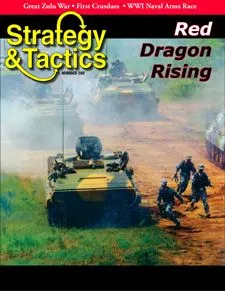
Red Dragon Rising: The Coming War With China ist ein Brettspiel aus dem Jahr 2008 für 1–2 Personen und mit 180 Minuten pro Partie. Entwickelt wurde es von Bruce Costello; die wichtigsten Mechaniken sind Area Movement und Dice Rolling.




Auf Englisch
Publisher's blurb: Red Dragon Rising: The Coming War With China (RDR), is a strategic-level investigation, with operational undertones, of the possibilities inherent in the first 30-or-so days of a hypothetical war between the Peoples Republic of China and a US-led counter-alliance. The time frame is the not-too-distant future, roughly between now and the end of 2014. On the Chinese side, the viewpoint of the player is that of Peking's top-rung national leadership. On the US side, the opposing player represents the top-rung military commander in the Western Pacific theater. The game is easily adaptable for solitaire play. The system – given we're dealing with events that haven't happened and therefore can't be studied in detail after the fact – has been crafted to present the war as a unitary vision rather than a strictly sequenced process. The action can alternately telescope or expand, sometimes moving ahead in whip snake lunges, at other times decelerating to dream-like slow motion. The system is more quantum mechanics than Newtonian, more Escher than Rockwell. Its presents a time-space inter-flow that can only be grasped in totality by the human mind once play is over and the entire war can be looked back on and chronicled in a reconstructed linear fashion (much like day-to-day reality). Three initial assumptions are as follows. First, the Chinese are cast – not unreasonably, we think – as the aggressors. Put in terms as politically correct as possible: they're the "revisionist power" here, the nation wanting to overturn the present-day status quo in the Western Pacific: they're conducting a strategic offensive. Second, the war inevitably starts over Taiwan, as that island is the unavoidably the first strategic block Peking must neutralize on the way to becoming East Asia's hegemon. Third, the war will not begin with a nuclear attack; though the danger of that kind of escalation may not be far off. Most ground units in the game represent brigades ("brigade combat teams" or "BCT" for the US). The exceptions are: 1) the Singaporean army is entirely represented by just one unit-counter; and 2) the Taiwanese and Philippine armies are represented by their corps components. Aircraft units are mostly represented by mixed-type combat wing formations, though only one aircraft type – the predominant one for each such wing – is shown on each counter. Long range bombers have their own mono-type units that can't combine operations with the other tactical air wings in the game. Ship units mostly represent mission-oriented groupings of vessels (Surface Action Groups). Aircraft carriers and cruise missile attack submarines each represent just one such vessel of those types. Other submarines are represented in groups called "Subrons." On the area map, each inch equals approximately 100 miles.
Laut Katalog unterstützt Red Dragon Rising: The Coming War With China 1–2 Personen. Diese Spanne entspricht der vom Verlag angegebenen Spielerzahl, das Spiel lässt sich also für jede Gruppengröße innerhalb dieser Spanne aufbauen. Aufbau, einzelne Regeln und Wertungsdetails können je nach Personenzahl trotzdem abweichen; prüfe daher die genaue Konfiguration in der Anleitung deiner Ausgabe.
Die angegebene Spieldauer für Red Dragon Rising: The Coming War With China beträgt 180 Minuten. Das ist die Schätzung des Verlags für eine vollständige Partie. Die tatsächliche Dauer hängt von der Gruppe, der Personenzahl und der Regelkenntnis ab: Erste Partien dauern meist länger, erfahrene Gruppen sind oft schneller fertig. Aufbau und Regelerklärung sind in dieser Schätzung nicht enthalten.
Red Dragon Rising: The Coming War With China hat bei BoardGameGeek eine Komplexitätswertung von 2,9 von 5 und gilt damit als eher leichtes Spiel. Die Wertung zeigt, wie viel Regelwissen, Planung und Entscheidungen eine typische Partie verlangt. Schwerere Spiele brauchen bei der ersten Erklärung mehr Zeit, daher hilft vor dem Spieleabend eine Vorbereitungsanleitung.
Red Dragon Rising: The Coming War With China gehört zu diesen Kategorien: Wargame und Modern Warfare. Die wichtigsten Mechaniken sind Area Movement und Dice Rolling. Kategorien beschreiben Thema und Setting eines Spiels, Mechaniken dagegen, was die Spielenden in ihrem Zug tatsächlich tun. Jede Mechanik führt zu einer Katalogseite mit ähnlichen Spielen, falls du etwas Vergleichbares suchst.
Als Autoren von Red Dragon Rising: The Coming War With China sind angegeben: Bruce Costello. Diese Angaben stammen aus den veröffentlichten Spieldaten und nennen die für das Spieldesign verantwortlichen Personen, nicht die Illustratoren oder Verlage. Die Autorenseiten auf MeepleRules sammeln weitere Titel derselben Autoren – praktisch, wenn dir ein Spiel gefällt und du ähnliche Spiele suchst.
Im Katalog ist Red Dragon Rising: The Coming War With China als Grundspiel aufgeführt. Es lässt sich eigenständig mit dem Material aus der Schachtel spielen und benötigt keinen weiteren Titel. Erweiterungen, sofern es welche gibt, ergänzen neues Material oder neue Regeln und sind im Katalog separat mit einem Verweis auf dieses Grundspiel aufgeführt.