
- BGG-Rang
- BGG #8.885
- BGG-Bewertung
- 8,0
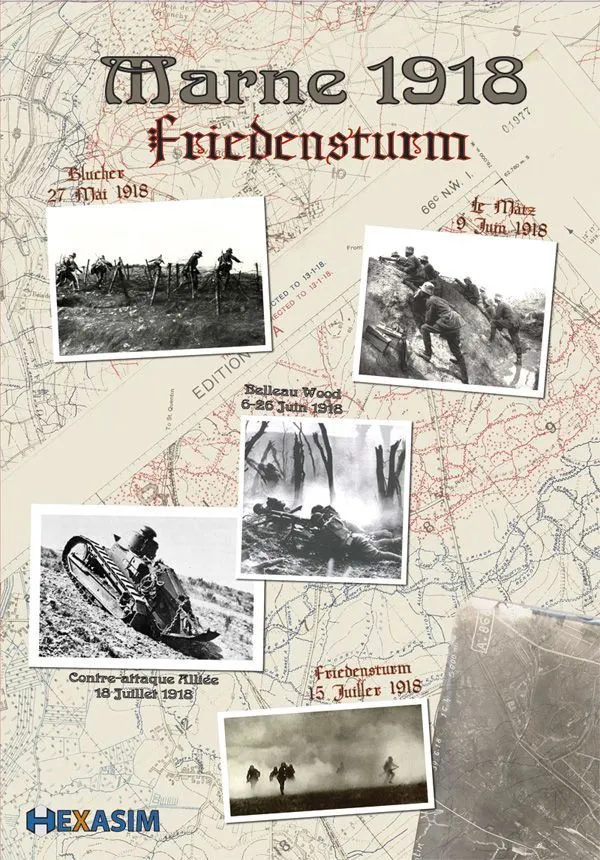
Marne 1918: Friedensturm
- 2 Spieler
- 210–1200 Min.
- Komplexität 3,2/5
- 2006
2012
Regelhilfe für Somme 1918: Bloody Spring
Verständliche Erklärungen zu Spielzügen, Karteneffekten und strittigen Situationen mit Verweisen auf offizielle Quellen und gespeichertem Fragenverlauf.
Für 2 Personen
Was möchtest du wissen?
Antworten stammen aus dem offiziellen Regelheft, mit Seitenangabe zum Nachprüfen.
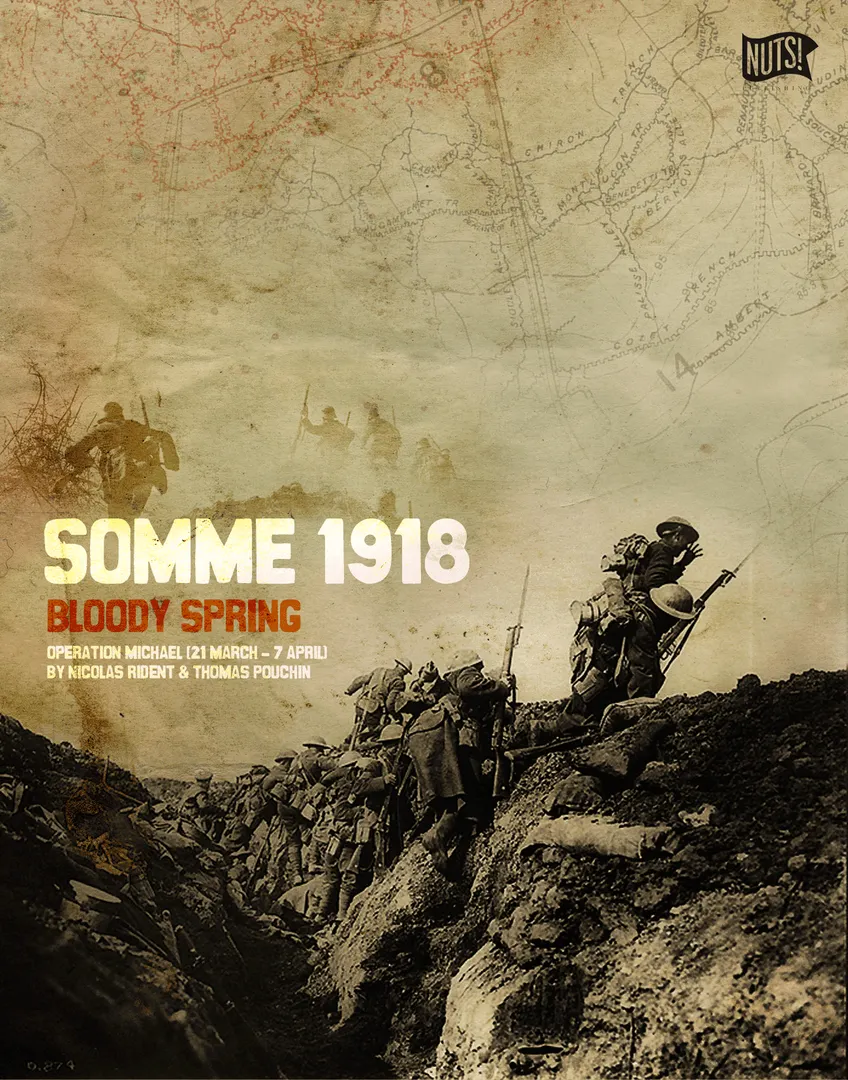
Somme 1918: Bloody Spring ist ein Brettspiel aus dem Jahr 2012 für 2 Personen, mit 240 Minuten pro Partie und ab 14 Jahren. Entwickelt wurde es von Nicolas Rident und Thomas Pouchin; die wichtigsten Mechaniken sind Dice Rolling, Hexagon Grid und Simulation.






Auf Englisch
Somme 1918 is the second game in a series that covers all of the offensives on the Western Front in 1918 and the Sequel to Marne 1918: Friedensturm. Somme 18 is different from Marne 1918 because it covers only one battle, Operation Michael, while Marne 1918 simulated a series of offensives, from Blucher to Friedensturm. The result is a more intense and nerve-wracking game that takes place over eight turns (from the end of March to mid-April), at least half of which are composed of three operational phases. Both players will face difficult challenges. The German player needs to re-create the historic breakthrough and has to put in every effort to reach Amiens. The Allied player has to resist succumbing to panic in the first turns in order to organize an effective defense, and then a counter-attack near the end of the game. While the basic rules in Somme 18 are identical to those in Marne 1918 (with the exception of the air rules, which have been completely revised), the advanced rules will be very different. The principal reason is the length of Operation Michael, about fifteen days, which does not give an opportunity for the campaign management rules of Marne 1918 to be used. So, all of the unit management tracks have disappeared and have been replaced by one table that manages the replacement and re-construction of units. Strategic movement has also been greatly simplified and adapted to the tempo of the game. Somme 1918 will of course be enriched by numerous specific rules, simulating the particularities of this battle. Petain’s Reticence: Simulates the French command’s lack of urgency in supporting their British allies. The arrival of French reinforcements without their artillery support, allowing a quicker deployment of troops coupled with a reduction in their value. Inter-Allied Cooperation: This will be extremely reduced at the beginning of the campaign. Evolution of the use of Stoss: The doctrine of using assault troops had been principally introduced by General von Hutier, in Russia and Italy. At the beginning of Operation Michael, the generals commanding the Second and Seventeenth armies used their Stosstruppen in frontal assaults, wasting these elite forces and provoking fury from Ludendorff. A rule thus simulates the evolution of this doctrine. The Doullens Conference: At the height of the German offensive, while the French Army under Petain prepared to cut its ties with the British, Haig accepted that he be placed under the command of Foch, finally creating an inter-Allied command. This rule simulates this conference, tied to German conquests. It also plays a part in obtaining victory points. In fact, this rule is really the heart of the game and we think that players will be pleased with the proposed system that will bring together the different parameters of this game. • Boxed game • 1 A1 single-sided maps • About 560 counters • 24 pages rules booklet in english • 2 player aids in english • Introductory historical booklet with design notes • 4 dice (from Nuts Publishing website)
Laut Katalog unterstützt Somme 1918: Bloody Spring 2 Personen. Das ist die vom Verlag angegebene Spielerzahl, das Spiel ist also genau für diese Anzahl von Mitspielenden ausgelegt. Varianten für andere Gruppengrößen sind, sofern vorhanden, in der Anleitung deiner Ausgabe beschrieben; prüfe sie, bevor du eine andere Konfiguration aufbaust.
Die angegebene Spieldauer für Somme 1918: Bloody Spring beträgt 240 Minuten. Das ist die Schätzung des Verlags für eine vollständige Partie. Die tatsächliche Dauer hängt von der Gruppe, der Personenzahl und der Regelkenntnis ab: Erste Partien dauern meist länger, erfahrene Gruppen sind oft schneller fertig. Aufbau und Regelerklärung sind in dieser Schätzung nicht enthalten.
Im Katalog wird Somme 1918: Bloody Spring ab 14 Jahren empfohlen. Das ist die Empfehlung des Verlags und berücksichtigt Leseanforderungen, Regelkomplexität und Kleinteile, nicht nur das Thema. Jüngere Kinder können oft mit Hilfe eines Erwachsenen mitspielen; beachte die Altersangabe deiner Ausgabe und die Brettspielerfahrung deiner Gruppe.
Somme 1918: Bloody Spring hat bei BoardGameGeek eine Komplexitätswertung von 3,6 von 5 und gilt damit als mittelschweres Spiel. Die Wertung zeigt, wie viel Regelwissen, Planung und Entscheidungen eine typische Partie verlangt. Schwerere Spiele brauchen bei der ersten Erklärung mehr Zeit, daher hilft vor dem Spieleabend eine Vorbereitungsanleitung.
Somme 1918: Bloody Spring gehört zu diesen Kategorien: Wargame und World War I. Die wichtigsten Mechaniken sind Dice Rolling, Hexagon Grid und Simulation. Kategorien beschreiben Thema und Setting eines Spiels, Mechaniken dagegen, was die Spielenden in ihrem Zug tatsächlich tun. Jede Mechanik führt zu einer Katalogseite mit ähnlichen Spielen, falls du etwas Vergleichbares suchst.
Als Autoren von Somme 1918: Bloody Spring sind angegeben: Nicolas Rident und Thomas Pouchin. Diese Angaben stammen aus den veröffentlichten Spieldaten und nennen die für das Spieldesign verantwortlichen Personen, nicht die Illustratoren oder Verlage. Die Autorenseiten auf MeepleRules sammeln weitere Titel derselben Autoren – praktisch, wenn dir ein Spiel gefällt und du ähnliche Spiele suchst.
Im Katalog ist Somme 1918: Bloody Spring als Grundspiel aufgeführt. Es lässt sich eigenständig mit dem Material aus der Schachtel spielen und benötigt keinen weiteren Titel. Erweiterungen, sofern es welche gibt, ergänzen neues Material oder neue Regeln und sind im Katalog separat mit einem Verweis auf dieses Grundspiel aufgeführt.