
- BGG-Rang
- BGG #8.645
- BGG-Bewertung
- 8,0
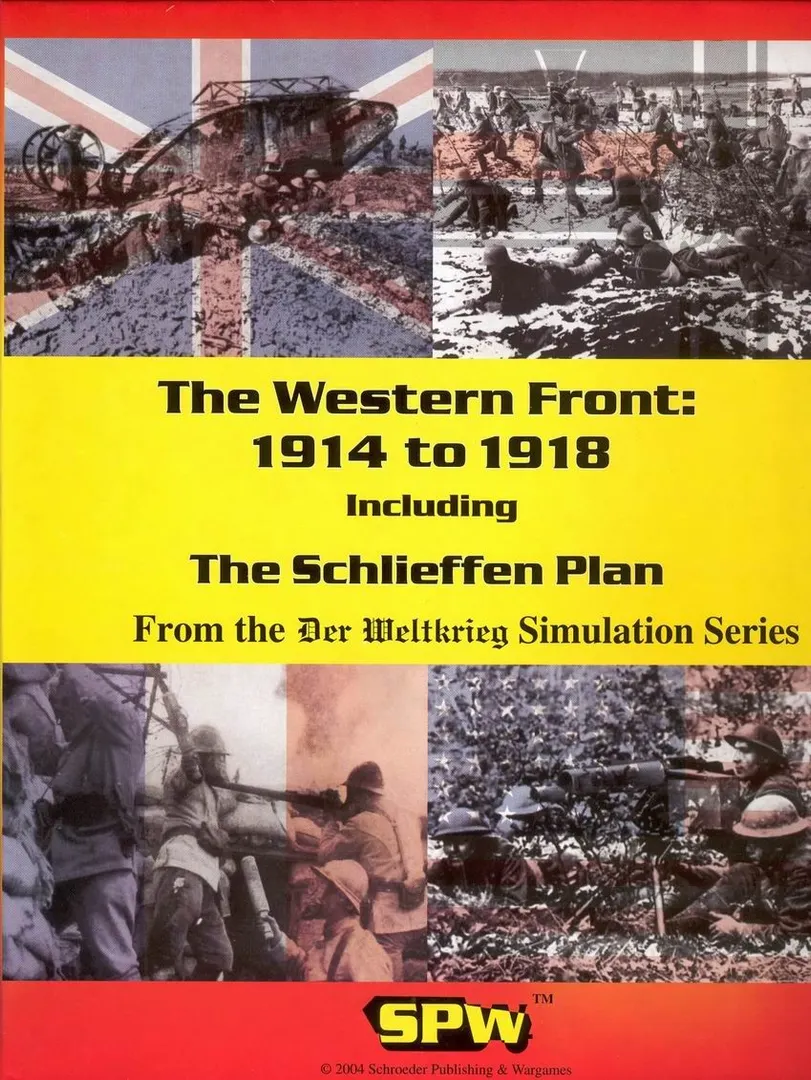
The Western Front: 1914 to 1918
- 2 Spieler
- 360 Min.
- Komplexität 3,4/5
- 2004
Erweiterung für Serbia the Defiant / Romania: Transylvanian Gambit
2001
Regelhilfe für The 1916 Brusilov Offensive / Gorlice-Tarnow Breakthrough
Verständliche Erklärungen zu Spielzügen, Karteneffekten und strittigen Situationen mit Verweisen auf offizielle Quellen und gespeichertem Fragenverlauf.
Was möchtest du wissen?
Antworten stammen aus dem offiziellen Regelheft, mit Seitenangabe zum Nachprüfen.
The 1916 Brusilov Offensive / Gorlice-Tarnow Breakthrough ist eine Erweiterung für Serbia the Defiant / Romania: Transylvanian Gambit aus dem Jahr 2001 für 2 Personen, mit 360 Minuten pro Partie und ab 12 Jahren. Entwickelt wurde es von David Schroeder; die wichtigsten Mechaniken sind Dice Rolling, Hexagon Grid und Simulation.


Auf Englisch
Part of David Schroeder's "Der Weltkrieg" wargame series. Gorlice-Tarnow Breakthrough: May 1915 The head of the German armies, von Falkenhayn, wants the focus of the German operations in the war to be on the western front. Yet to make this a reality, he feels that relief must first be provided to the endangered Austro-Hungarians. Recent Russian pressure had almost cracked the final Austro-Hungarian defensive lines in the Carpathians, and new pressure was being brought to bear on Germany's weak ally by the Italians, who had just entered the war. To help the Austro-Hungarians, a new German army is formed under the capable von Mackensen, and placed in the line east of Crackow. After a furious hurricane barrage, von Mackensen attacks and completely pierces the Russian lines. A Russian retreat ensues that enables the Central Powers' forces to recapture most of Galicia. Von Falkenhayn wanted to stop operations at this point and shift to the west, but pressure from the Kaiser, at the insistance of Hindenburg and Ludendorff, resulted in a widening of the offensive. Attacks were then launched in the northern sector of the eastern front as well. Enveloped on two sides, the Russians reacted with their classic response, a retreat back into Russia, leaving Russian Poland to the Germans. The Central Powers offensive wound down as they struggled to supply troops hundreds of miles past the supply heads. The offensive has saved Austria-Hungary from immediate peril, but it does not knock Russia out of the war. And instead of enabling von Falkenhayn to focus on the west, most of the newly created German forces are fed into the increasing vastness of the eastern front. The Brusilov Offensive: June 1916 In response to French pleas for help to relieve the pressure at Verdun, the Russian STAVKA authorizes a major offensive. General Brusilov plans attacks all along the front of his Southwest Army Group aiming primarily at Austro-Hungarian positions. His belief is that attacks across the width of his front will prevent the enemy from being able to quickly reinforce areas under local attack. The Austro-Hungarians are caught off-guard as their focus is a new offensive of their own in Italy. The Russian attacks achieves numerous breakthroughs in numerous sectors and many Austro-Hungarian units are completely routed. The Russians take hundreds of thousands of prisoners and advance tens of miles, recapturing significant cities. German reinforcements are rushed from the north and from Verdun. The Germans also take over command of almost the entire eastern front, and Austria-Hungary is placed in a subserviant position. The Russian offensive peters out as Brusilov's forces start to experience supply shortages, and Central Powers' resistance stiffens. Brusilov had planned on support from Russian armies to the north to pin down German forces with attacks of their own, but they failed to support him. The losses mount and, after months of fighting, the Russians finally call a halt to further attacks. The Brusilov Offensive did relieve the pressure on the French and it came very close to knocking Austria-Hungary out of the war. Had Brusilov been supported by his peers to the north, and by the Russian Allies (including the hesitant Romanians) the war might well have been won by the Entente in 1916. This game contains 2 scenarios covering the 1915 Gorlice-Tarnow offensive and the 1916 Brusilov Offensive. NOTE: This is not a stand-alone game. It requires the ownership of Tannenberg: Eagles in the East / Galicia: The Forgotten Cauldron and Serbia the Defiant / Romania: Transylvanian Gambit to play. 20km/hex 4 days/turn 560 counters (2 countersheets) 3 small maps (4-5N, 4-5E, 5-5S) Complexity = medium
Laut Katalog unterstützt The 1916 Brusilov Offensive / Gorlice-Tarnow Breakthrough 2 Personen. Das ist die vom Verlag angegebene Spielerzahl, das Spiel ist also genau für diese Anzahl von Mitspielenden ausgelegt. Varianten für andere Gruppengrößen sind, sofern vorhanden, in der Anleitung deiner Ausgabe beschrieben; prüfe sie, bevor du eine andere Konfiguration aufbaust.
Die angegebene Spieldauer für The 1916 Brusilov Offensive / Gorlice-Tarnow Breakthrough beträgt 360 Minuten. Das ist die Schätzung des Verlags für eine vollständige Partie. Die tatsächliche Dauer hängt von der Gruppe, der Personenzahl und der Regelkenntnis ab: Erste Partien dauern meist länger, erfahrene Gruppen sind oft schneller fertig. Aufbau und Regelerklärung sind in dieser Schätzung nicht enthalten.
Im Katalog wird The 1916 Brusilov Offensive / Gorlice-Tarnow Breakthrough ab 12 Jahren empfohlen. Das ist die Empfehlung des Verlags und berücksichtigt Leseanforderungen, Regelkomplexität und Kleinteile, nicht nur das Thema. Jüngere Kinder können oft mit Hilfe eines Erwachsenen mitspielen; beachte die Altersangabe deiner Ausgabe und die Brettspielerfahrung deiner Gruppe.
The 1916 Brusilov Offensive / Gorlice-Tarnow Breakthrough hat bei BoardGameGeek eine Komplexitätswertung von 3,0 von 5 und gilt damit als mittelschweres Spiel. Die Wertung zeigt, wie viel Regelwissen, Planung und Entscheidungen eine typische Partie verlangt. Schwerere Spiele brauchen bei der ersten Erklärung mehr Zeit, daher hilft vor dem Spieleabend eine Vorbereitungsanleitung.
The 1916 Brusilov Offensive / Gorlice-Tarnow Breakthrough gehört zu diesen Kategorien: Wargame, Expansion for Base-game und World War I. Die wichtigsten Mechaniken sind Dice Rolling, Hexagon Grid und Simulation. Kategorien beschreiben Thema und Setting eines Spiels, Mechaniken dagegen, was die Spielenden in ihrem Zug tatsächlich tun. Jede Mechanik führt zu einer Katalogseite mit ähnlichen Spielen, falls du etwas Vergleichbares suchst.
Als Autoren von The 1916 Brusilov Offensive / Gorlice-Tarnow Breakthrough sind angegeben: David Schroeder. Diese Angaben stammen aus den veröffentlichten Spieldaten und nennen die für das Spieldesign verantwortlichen Personen, nicht die Illustratoren oder Verlage. Die Autorenseiten auf MeepleRules sammeln weitere Titel derselben Autoren – praktisch, wenn dir ein Spiel gefällt und du ähnliche Spiele suchst.
Im Katalog ist The 1916 Brusilov Offensive / Gorlice-Tarnow Breakthrough als Erweiterung zu Serbia the Defiant / Romania: Transylvanian Gambit aufgeführt. Erweiterungen ergänzen das Grundspiel um neues Material, neue Regeln oder Szenarien und sind meist nicht eigenständig spielbar; du brauchst also Serbia the Defiant / Romania: Transylvanian Gambit, um sie zu nutzen. Prüfe, ob deine Ausgabe von Serbia the Defiant / Romania: Transylvanian Gambit kompatibel ist, da manche Erweiterungen zwischen den Auflagen überarbeitet wurden.