

- BGG-Rang
- BGG #11.907
- BGG-Bewertung
- 7,0
Ironclad
- 1–3 Spieler
- 45–90 Min.
- Komplexität 3,2/5
- 2018
2016
Regelhilfe für The Daedalus Sentence
Verständliche Erklärungen zu Spielzügen, Karteneffekten und strittigen Situationen mit Verweisen auf offizielle Quellen und gespeichertem Fragenverlauf.
Für 1 Person
Was möchtest du wissen?
Antworten stammen aus dem offiziellen Regelheft, mit Seitenangabe zum Nachprüfen.
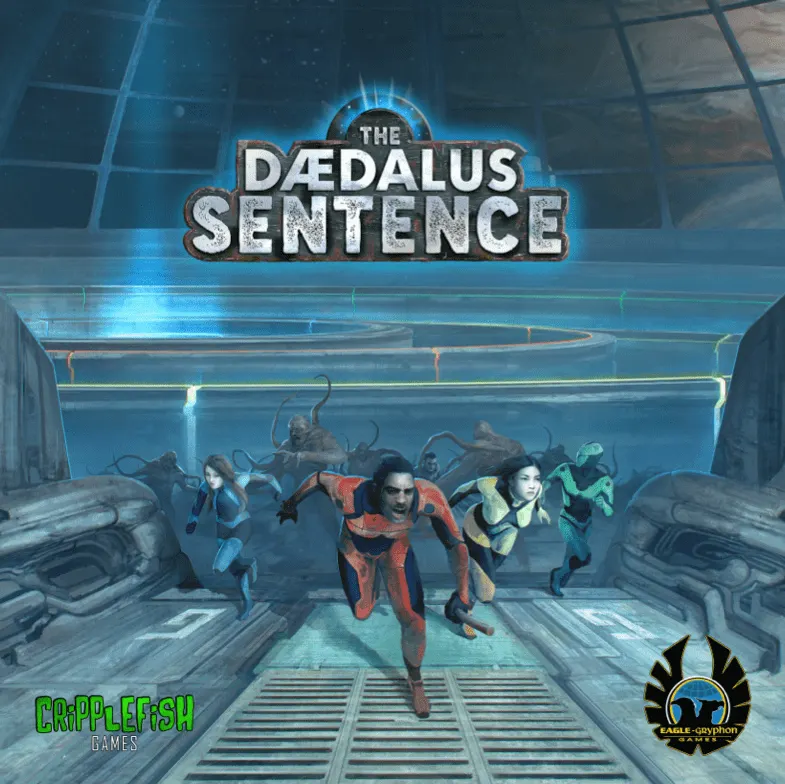
The Daedalus Sentence ist ein Brettspiel aus dem Jahr 2016 für 1–4 Personen, mit 45–60 Minuten pro Partie und ab 10 Jahren. Entwickelt wurde es von Ian Van Gemeren, Tom Bleys und Bart Waeterschoot; die wichtigsten Mechaniken sind Hand Management, Simultaneous Action Selection und Cooperative Game.





Auf Englisch
The Daedalus Sentence is a cooperative escape game that challenges players to use limited actions and effective communication in order to flee from their captors and escape a dangerous and ever-changing prison. Use your actions to explore your surroundings, overcome guards, or change the layout of the prison itself - just be careful that the moves you make to save yourself don't doom a teammate! In the year 2083, an alien race known as the Loctae descended on planet Earth, killing billions and capturing and containing the few million that remained. The survivors were sent to locations throughout the galaxy, to work as slaves or as subjects for genetic experiments. The most infamous of these locations, known as the Hive, is a Loctae space station orbiting Ganymede. Here, prisoners are harvested for their genetic material, which is used by the Loctae to make genetic hybrids engineered for aptitude in any skill the Loctae require. A few have tried to escape, but none have succeeded. Those who are not lost in the station's labyrinthine halls are recaptured by the station's guards and then moved to the front of the list of those who are to be processed. The failed escapees blabber about the twisted and spliced creatures that roam the corridors of the maze, as if they were in the Labyrinth of King Minos. The remaining survivors now call their plight "The Daedalus Sentence", a grim tribute to the facility's designer. As the months in The Hive wear on, fewer and fewer prisoners remain. Fearing their subjects would run out before their experiments were completed, the Loctae have confined the remaining prisoners in regenerative pods, so that the organs and marrow taken from the prisoners will regenerate with time. Though expensive, this set up was proving successful for the Loctae until a rogue meteor struck the station, damaging the ship's AI and releasing the bonds that kept the prisoners contained. Now the prisoners have a chance, likely the last one they'll ever have, to brave the halls of The Hive and escape to freedom. The main feature of the game is its rotating board. The board has four rotating rings, with players starting in the center prison cells and making their way to the outer ring, where they must find the final exit to make their escape. When players start the game, the entire board will be hidden. As they move from the start location, they need to spend actions to flip over tiles in order to discover the layout of each ring. Their main objective is to find the gate to the next ring, but as they explore they will discover tiles both beneficial and perilous. The tiles may allow them to influence the movement of enemies or the maze itself, but they may also spawn additional enemies that will hunt for the players until subdued. If the players can make their way through all four rings, find the final exit, and escape together, they win! Enemies will spawn throughout the course of the game, both as the result of exploring tiles and from drawn cards. Unlike many card-driven games however, the players have a glimpse into their future by way of the Theseus Device, which holds eight cards that determine how the rings and enemies will move in coming rounds. All eight cards start hidden, but through die rolls (and cards played from the hands of players in case of emergency), players see some of the cards to come. This allows for careful planning, as players try to anticipate how rings will line up in future rounds, as well as making sure they are not caught in the patrol of any passing enemies. When the game starts, only two cards will be activated per round, but as the players breach additional rings, the number of cards that will activate increases. When playing the recommended timed game difficulty enhancer, this leads to a frantic rush as players try to evade enemies and find the exit while planning ahead for the next activation sequence. The Daedalus Sentence is designed to be played at a variety of difficulty levels, and players can mix-and-match the optional difficulty enhancers to achieve the perfect intensity level for their group. In addition to a four player co-op game, The Daedalus Sentence can also be played one-versus-all, with a player taking the role of the labyrinth and its minions.
Laut Katalog unterstützt The Daedalus Sentence 1–4 Personen. Diese Spanne entspricht der vom Verlag angegebenen Spielerzahl, das Spiel lässt sich also für jede Gruppengröße innerhalb dieser Spanne aufbauen. Aufbau, einzelne Regeln und Wertungsdetails können je nach Personenzahl trotzdem abweichen; prüfe daher die genaue Konfiguration in der Anleitung deiner Ausgabe.
Die angegebene Spieldauer für The Daedalus Sentence beträgt 45–60 Minuten. Das ist die Schätzung des Verlags für eine vollständige Partie. Die tatsächliche Dauer hängt von der Gruppe, der Personenzahl und der Regelkenntnis ab: Erste Partien dauern meist länger, erfahrene Gruppen sind oft schneller fertig. Aufbau und Regelerklärung sind in dieser Schätzung nicht enthalten.
Im Katalog wird The Daedalus Sentence ab 10 Jahren empfohlen. Das ist die Empfehlung des Verlags und berücksichtigt Leseanforderungen, Regelkomplexität und Kleinteile, nicht nur das Thema. Jüngere Kinder können oft mit Hilfe eines Erwachsenen mitspielen; beachte die Altersangabe deiner Ausgabe und die Brettspielerfahrung deiner Gruppe.
The Daedalus Sentence hat bei BoardGameGeek eine Komplexitätswertung von 2,0 von 5 und gilt damit als eher leichtes Spiel. Die Wertung zeigt, wie viel Regelwissen, Planung und Entscheidungen eine typische Partie verlangt. Schwerere Spiele brauchen bei der ersten Erklärung mehr Zeit, daher hilft vor dem Spieleabend eine Vorbereitungsanleitung.
The Daedalus Sentence gehört zu diesen Kategorien: Adventure und Science Fiction. Die wichtigsten Mechaniken sind Hand Management, Simultaneous Action Selection und Cooperative Game. Kategorien beschreiben Thema und Setting eines Spiels, Mechaniken dagegen, was die Spielenden in ihrem Zug tatsächlich tun. Jede Mechanik führt zu einer Katalogseite mit ähnlichen Spielen, falls du etwas Vergleichbares suchst.
Als Autoren von The Daedalus Sentence sind angegeben: Ian Van Gemeren, Tom Bleys und Bart Waeterschoot. Diese Angaben stammen aus den veröffentlichten Spieldaten und nennen die für das Spieldesign verantwortlichen Personen, nicht die Illustratoren oder Verlage. Die Autorenseiten auf MeepleRules sammeln weitere Titel derselben Autoren – praktisch, wenn dir ein Spiel gefällt und du ähnliche Spiele suchst.
Im Katalog ist The Daedalus Sentence als Grundspiel aufgeführt. Es lässt sich eigenständig mit dem Material aus der Schachtel spielen und benötigt keinen weiteren Titel. Erweiterungen, sofern es welche gibt, ergänzen neues Material oder neue Regeln und sind im Katalog separat mit einem Verweis auf dieses Grundspiel aufgeführt.