
- BGG-Bewertung
- 7,4
Mamluk
- 2 Spieler
- 240 Min.
- Komplexität 3,6/5
- 2006
2004
Regelhilfe für The Devil's Horsemen: The Mongol War Machine
Verständliche Erklärungen zu Spielzügen, Karteneffekten und strittigen Situationen mit Verweisen auf offizielle Quellen und gespeichertem Fragenverlauf.
Für 2 Personen
Was möchtest du wissen?
Antworten stammen aus dem offiziellen Regelheft, mit Seitenangabe zum Nachprüfen.
The Devil's Horsemen: The Mongol War Machine ist ein Brettspiel aus dem Jahr 2004 für 2 Personen, mit 240 Minuten pro Partie und ab 12 Jahren. Entwickelt wurde es von Richard H. Berg und Mark Herman; die wichtigsten Mechaniken sind Hexagon Grid und Simulation.












Auf Englisch
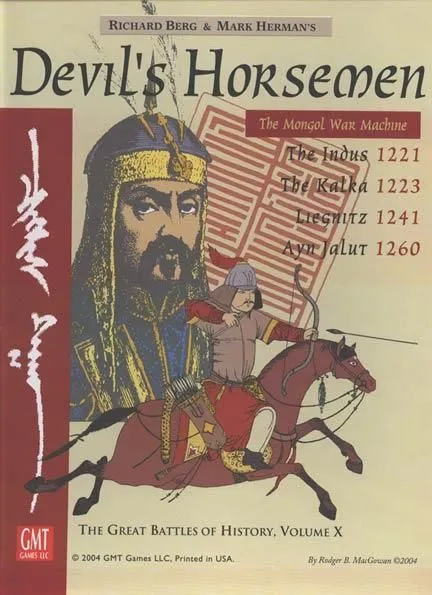
"The Mongol War Machine in the 13th Century" - Volume X in the Great Battles of History Series (GBoH). (from GMT Games website:) The Great Battles of History series is back with Devil's Horsemen, an examination of the military tactics of steppe tribe warfare, as immortalized by the mighty armies of Genghis Khan and the Mongols. The game focuses on cavalry and archery action, featuring mounted archers of exceptional skill. Devil's Horsemen depicts the four major battles of the era - The Indus, The Kalka, Liegnitz and Ayn Jalut. Devil's Horsemen features basic rules for both regular and SimpleGBoH play. The rules bring the system into full flower of mounted archery, with a detailed, augmented set of archery and cavalry mechanics that include various types of Shower Fire (as opposed to plain Volley Fire), Impetuosity and Aggression, Feigned Retreat, Harass and Disperse tactics, and Rally to Standards, with the various armies and units being rated for their ability to use these. Devil's Horsemen presens a truly colorful array of armies for you to lead into battle: there are 10 full tumen (divisions) of Mongols, plus Polovtsians, Galicians, Chernigovians, Kievans, Persian Khwarazmians, Poles, Silesians, Bohemians, the great Teutonic Knights, and the first army to ever significantly defeat the Mongols, The Mamluks. These mighty armies show up in four great battles of the period (ranging from battles needing 1/2 mapsheet to two full-mapsheets). The Indus (Genghis Khan vs. Shah Jalal ad-Din and the Khwarazmian Persians, 1221). One mapsheet in size, this is the battle that gave The Mongols control over all of Central Asia. The Kalka (Prince Subudei vs. the combined Armies of Rus, 1223). Two mapsheets in size, this battle includes two massive (and very nattily dressed) armies, with the Rus suffering under fractured command, and the Mongols giving us a foretaste of the famous Zulu horns of the buffalo tactics. Liegnitz (Prices Baidan and Kaidan vs. Henry the Pious and an army of Eastern Europeans, 1241). A 1/2 mapsheet battle which introduced Europe to the Mongols, and from which we get the famous Christian prayer of the era, From the Fury of the Tartars, oh Lord, Deliver Us. But you do get to use the best European heavy cavalry of the day, the Teutonic knights, under fearsome commander, Poppo. Ayn Jalut (Prince Ketbugha vs. The Mamluks, 1260). A 1/2 mapsheet battle that saw the first real defeat of a Mongol Army, this time by the new Middle East Muslim power, the Mamluks. Granted, this was a second-rate, rear-guard group of Mongols, but the Mamluks showed they were a new force to reckon with. COMPONENTS 979 full-color counters Two full-color double-sided 22x34" mapsheets Rules Book Scenario Book One Player Aid Card One 10-sided die DESIGNERS: Mark Herman and Richard Berg ART DIRECTOR/PACKAGE DESIGN: Rodger B. MacGowan MAP ART: Mark Simonitch COUNTER ART: Mark Simonitch, Rodger B. MacGowan, Mike Lemick
Laut Katalog unterstützt The Devil's Horsemen: The Mongol War Machine 2 Personen. Das ist die vom Verlag angegebene Spielerzahl, das Spiel ist also genau für diese Anzahl von Mitspielenden ausgelegt. Varianten für andere Gruppengrößen sind, sofern vorhanden, in der Anleitung deiner Ausgabe beschrieben; prüfe sie, bevor du eine andere Konfiguration aufbaust.
Die angegebene Spieldauer für The Devil's Horsemen: The Mongol War Machine beträgt 240 Minuten. Das ist die Schätzung des Verlags für eine vollständige Partie. Die tatsächliche Dauer hängt von der Gruppe, der Personenzahl und der Regelkenntnis ab: Erste Partien dauern meist länger, erfahrene Gruppen sind oft schneller fertig. Aufbau und Regelerklärung sind in dieser Schätzung nicht enthalten.
Im Katalog wird The Devil's Horsemen: The Mongol War Machine ab 12 Jahren empfohlen. Das ist die Empfehlung des Verlags und berücksichtigt Leseanforderungen, Regelkomplexität und Kleinteile, nicht nur das Thema. Jüngere Kinder können oft mit Hilfe eines Erwachsenen mitspielen; beachte die Altersangabe deiner Ausgabe und die Brettspielerfahrung deiner Gruppe.
The Devil's Horsemen: The Mongol War Machine hat bei BoardGameGeek eine Komplexitätswertung von 3,4 von 5 und gilt damit als mittelschweres Spiel. Die Wertung zeigt, wie viel Regelwissen, Planung und Entscheidungen eine typische Partie verlangt. Schwerere Spiele brauchen bei der ersten Erklärung mehr Zeit, daher hilft vor dem Spieleabend eine Vorbereitungsanleitung.
The Devil's Horsemen: The Mongol War Machine gehört zu diesen Kategorien: Wargame und Medieval. Die wichtigsten Mechaniken sind Hexagon Grid und Simulation. Kategorien beschreiben Thema und Setting eines Spiels, Mechaniken dagegen, was die Spielenden in ihrem Zug tatsächlich tun. Jede Mechanik führt zu einer Katalogseite mit ähnlichen Spielen, falls du etwas Vergleichbares suchst.
Als Autoren von The Devil's Horsemen: The Mongol War Machine sind angegeben: Richard H. Berg und Mark Herman. Diese Angaben stammen aus den veröffentlichten Spieldaten und nennen die für das Spieldesign verantwortlichen Personen, nicht die Illustratoren oder Verlage. Die Autorenseiten auf MeepleRules sammeln weitere Titel derselben Autoren – praktisch, wenn dir ein Spiel gefällt und du ähnliche Spiele suchst.
Im Katalog ist The Devil's Horsemen: The Mongol War Machine als Grundspiel aufgeführt. Es lässt sich eigenständig mit dem Material aus der Schachtel spielen und benötigt keinen weiteren Titel. Erweiterungen, sofern es welche gibt, ergänzen neues Material oder neue Regeln und sind im Katalog separat mit einem Verweis auf dieses Grundspiel aufgeführt.