- BGG-Bewertung
- 7,4
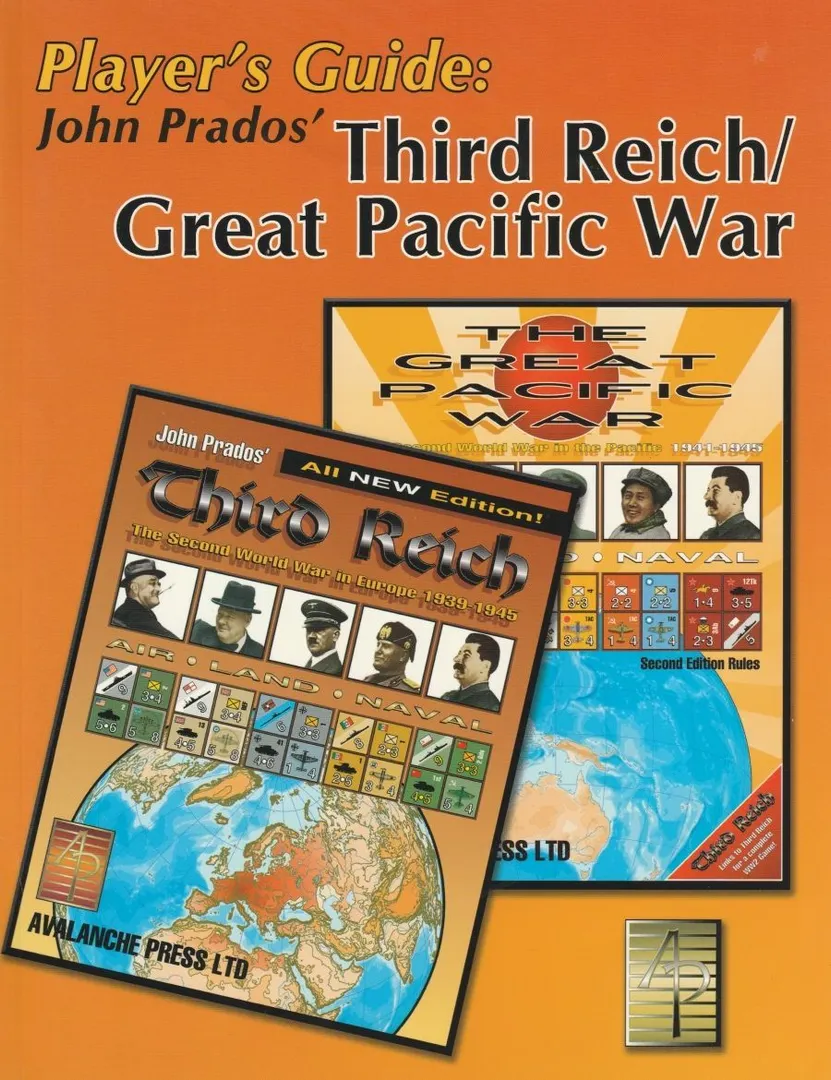
Third Reich/Great Pacific War Player's Guide
- 2–5 Spieler
- 360 Min.
- Komplexität 3,4/5
- 2004
2003
Regelhilfe für The Great Pacific War: The Second World War in the Pacific 1937-1945
Verständliche Erklärungen zu Spielzügen, Karteneffekten und strittigen Situationen mit Verweisen auf offizielle Quellen und gespeichertem Fragenverlauf.
Für 2 Personen
Was möchtest du wissen?
Antworten stammen aus dem offiziellen Regelheft, mit Seitenangabe zum Nachprüfen.
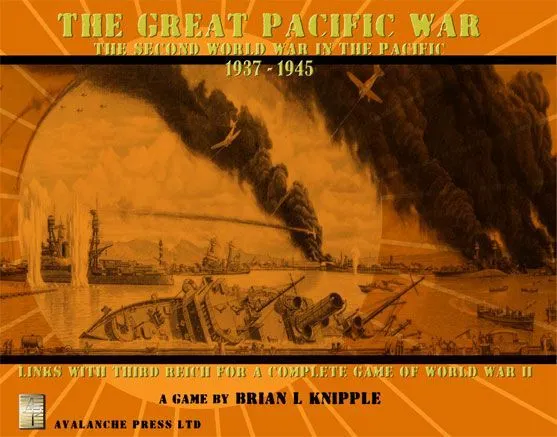
The Great Pacific War: The Second World War in the Pacific 1937-1945 ist ein Brettspiel aus dem Jahr 2003 für 2–5 Personen, mit 240–480 Minuten pro Partie und ab 12 Jahren. Entwickelt wurde es von Brian L. Knipple; die wichtigsten Mechaniken sind Dice Rolling, Grid Movement und Hexagon Grid.



Auf Englisch
Description from the publisher: Great Pacific War is Avalanche Press' strategic-level game of the War in the Pacific. The game covers the entire war from December 1941 through 1946 and includes the forces of all participants. Players are placed in the positions of the commanders of the Japanese, British, Soviet and American forces in World War Two. The system is the same one used in Avalanche Press' game, Third Reich. In addition to five scenarios covering all or part of the War in the Pacific, Great Pacific War includes rules to link it and Third Reich to play the Second World War, a simulation of the entire conflict with up to seven players. Included in the game are five scenarios for the Great Pacific War and three scenarios for the linked Second World War. One of the Great Pacific War scenarios covers a possible 1931 conflict between Japan and America as postulated by the British journalist Hector Bywater in his book of the same title. The facts: Game scale is 60 miles per hex covering the battlefield on three 34" x 22" maps. Units are represented at corps, fleet and air army level. Each turn represents three months of actual time. The game system is built around players drawing impulse "chits" to determine how they can activate their forces. The emphasis is on the interaction of military, political and economic factors (as in Third Reich). The game system from our Third Reich game allows players to control the military, political and economic destinies of their nations in a struggle to dominate the world. Land, air and sea forces battle across almost a third of the earth's surface as the two mightiest navies fight for control of the Pacific. Players manage their economies and build and operate their military forces within the capabilities of their nations' abilities. In Great Pacific War the Japanese player must decide initially whether war with America or the Soviet Union will be his or her strategy. JapanÍs lack of resources make a war with one or the other a necessity. Also possible is a war with Britain and her ally, The Netherlands, who together control the riches of India, Java and Borneo. This strategy has many risks, the greatest being that America will enter the war on Britain's side. Coloring all is the massive Japanese investment in China and the importance of those conquered territories to the Japanese economy. The American player must move a nation unprepared for war to a position of strength, while attempting to support the Nationalist Chinese in their conflict with the Japanese. In the linked game players have also to consider the effects of their actions on the global conflict. A Soviet player desperately defending Moscow in 1941 can little afford a Japanese attack on Vladivostok. Likewise a British player fighting Germany with only a seemingly soon-to-be-defeated Soviet Union as an ally, will not welcome a Japanese attack on his eastern possessions unless it brings America into the war. Historically Japan went to war to obtain the resources denied her by the Allies embargo of steel and oil and because German successes appeared to offer Japan the opportunity to join a victory almost already won. The question is whether you and your allies can do any better than your historical counterparts. Components: 3 34” x 22” maps 2 countersheets consisting of 560 counters 1 rulebook...separated into 2 booklets 2 scenario booklets 1 "Policial Maker Explanations" booklet 1 Off-Map Movement and Sea Zones Chart 11" x 17" 1 Chart with US Entry/Russian Winter Table/Mud Table 1 Chart with Sequence of Play/Alliance & Individual Victory Tables/Construction and Repair Costs 1 Terrain Effects Chart 1 Turn Impulse Track 1 Production Costs 9 Force Pool Charts(Netherlands,Britain,Soviet Union,Nationalist China,Communist China,United States(x2),Japan(x2)) Note: The maps are not mounted like those in JP's Third Reich were. This solves the problem of the maps not adjoining properly (as in Third Reich), but will upset those that like hard mounted maps. The game marries up with JP's Third Reich, but don't expect the maps to do so. When played together, action will be on separate maps to create a monster game of the entire Second World War.
Laut Katalog unterstützt The Great Pacific War: The Second World War in the Pacific 1937-1945 2–5 Personen. Diese Spanne entspricht der vom Verlag angegebenen Spielerzahl, das Spiel lässt sich also für jede Gruppengröße innerhalb dieser Spanne aufbauen. Aufbau, einzelne Regeln und Wertungsdetails können je nach Personenzahl trotzdem abweichen; prüfe daher die genaue Konfiguration in der Anleitung deiner Ausgabe.
Die angegebene Spieldauer für The Great Pacific War: The Second World War in the Pacific 1937-1945 beträgt 240–480 Minuten. Das ist die Schätzung des Verlags für eine vollständige Partie. Die tatsächliche Dauer hängt von der Gruppe, der Personenzahl und der Regelkenntnis ab: Erste Partien dauern meist länger, erfahrene Gruppen sind oft schneller fertig. Aufbau und Regelerklärung sind in dieser Schätzung nicht enthalten.
Im Katalog wird The Great Pacific War: The Second World War in the Pacific 1937-1945 ab 12 Jahren empfohlen. Das ist die Empfehlung des Verlags und berücksichtigt Leseanforderungen, Regelkomplexität und Kleinteile, nicht nur das Thema. Jüngere Kinder können oft mit Hilfe eines Erwachsenen mitspielen; beachte die Altersangabe deiner Ausgabe und die Brettspielerfahrung deiner Gruppe.
The Great Pacific War: The Second World War in the Pacific 1937-1945 hat bei BoardGameGeek eine Komplexitätswertung von 4,0 von 5 und gilt damit als schweres Spiel. Die Wertung zeigt, wie viel Regelwissen, Planung und Entscheidungen eine typische Partie verlangt. Schwerere Spiele brauchen bei der ersten Erklärung mehr Zeit, daher hilft vor dem Spieleabend eine Vorbereitungsanleitung.
The Great Pacific War: The Second World War in the Pacific 1937-1945 gehört zu diesen Kategorien: Wargame und World War II. Die wichtigsten Mechaniken sind Dice Rolling, Grid Movement und Hexagon Grid. Kategorien beschreiben Thema und Setting eines Spiels, Mechaniken dagegen, was die Spielenden in ihrem Zug tatsächlich tun. Jede Mechanik führt zu einer Katalogseite mit ähnlichen Spielen, falls du etwas Vergleichbares suchst.
Als Autoren von The Great Pacific War: The Second World War in the Pacific 1937-1945 sind angegeben: Brian L. Knipple. Diese Angaben stammen aus den veröffentlichten Spieldaten und nennen die für das Spieldesign verantwortlichen Personen, nicht die Illustratoren oder Verlage. Die Autorenseiten auf MeepleRules sammeln weitere Titel derselben Autoren – praktisch, wenn dir ein Spiel gefällt und du ähnliche Spiele suchst.
Im Katalog ist The Great Pacific War: The Second World War in the Pacific 1937-1945 als Grundspiel aufgeführt. Es lässt sich eigenständig mit dem Material aus der Schachtel spielen und benötigt keinen weiteren Titel. Erweiterungen, sofern es welche gibt, ergänzen neues Material oder neue Regeln und sind im Katalog separat mit einem Verweis auf dieses Grundspiel aufgeführt.