

- BGG-Rang
- BGG #15.219
- BGG-Bewertung
- 6,3
Highlander: The Card Game
- 2 Spieler
- 20 Min.
- Komplexität 2,2/5
- 1996
1994
Regelhilfe für Towers in Time
Verständliche Erklärungen zu Spielzügen, Karteneffekten und strittigen Situationen mit Verweisen auf offizielle Quellen und gespeichertem Fragenverlauf.
Für 2 Personen
Was möchtest du wissen?
Antworten stammen aus dem offiziellen Regelheft, mit Seitenangabe zum Nachprüfen.
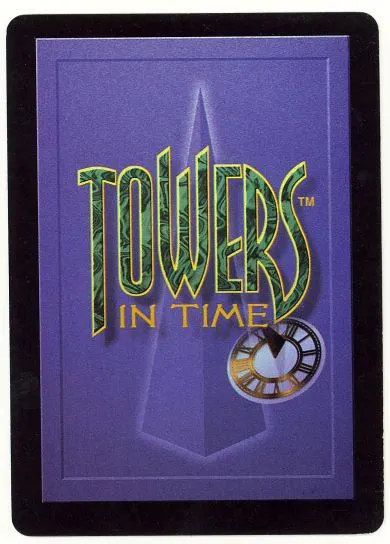
Towers in Time ist ein Brettspiel aus dem Jahr 1994 für 2 Personen, mit 30 Minuten pro Partie und ab 12 Jahren. Entwickelt wurde es von Mike Sager; die wichtigsten Mechaniken sind Hand Management.

Auf Englisch
From the box: In the beginning those that could master going between dimensions thought of it as novelty. There were worlds to discover, creatures to see and most importantly magic to master. But with all these things to keep them busy there was one thing they did not forget, Power. Soon it was easier to take from others than to find it on your own. The only place to hide was in great magical towers that they built between dimensions. All times in your world and in the others are at your disposal. Will you be the last to Reign in Towers in Time? Play overview: Each player represents a spellcaster, dueling with the other players for control of an abstractly defined extradimensional space. Each player has five shields, represented by cards from that player's deck, that serve to anchor the player the dimension within the game's story, and as the player's presence in the game mechanically. The goal is to eliminate the shields of all other players; when a player has no shields remaining, they are banished from the pocket dimension, and out of the game. Victory goes to the last player with shields in play. To combat one another, players play Source cards, representing connections to various natural locations, be they landforms, weather phenomena, or natural disasters. These resource cards allow the player to access Temper, the main resource in Towers in Time, themed to the four elements. Using Temper, players pay the costs to summon creatures to wage war, conjure magical objects and artifacts to enhance the effectiveness of recruited creatures, and cast spells to strengthen their minions and weaken the opposing armies. Additionally, once creatures are in play, most of them can provide Temper as well, although typically less than Source cards; most cards in Towers in Time are resource generators in addition to their other game effects. Source cards serve as the base for the titular Towers of Towers in Time. Each Source has a default file of three ranks atop it, each space of which can be occupied by creatures and the cards they carry. Creatures enter play within Towers, and must match the element represented by the Source atop which it stands (except for Neutral creatures, which may be played into any Tower). There are rules to determine which creatures can enter play in which locations within a Tower, but once in play, most creatures can move between Towers, taking attached cards with them when they move. Turns do not follow the turn format common to many contemporary CCGs. Instead, several phases are completed simultaneously by all players, then players alternate initiating and resolving a single action until both players have passed. Action resolution varies depending on their effect, with some actions initiating a separate resolution phase with its own actions and timing (such as combat) and others are single-step actions (such as playing a card). Additionally, a number of supplemental actions ("free" actions) facilitate utility functions, such as drawing Temper to pay for spells. The opportunity to act first during the action round is determined by the player who won initiative during game setup (for the first turn only), or the player who did not take the last pass action on the previous turn.
Laut Katalog unterstützt Towers in Time 2 Personen. Das ist die vom Verlag angegebene Spielerzahl, das Spiel ist also genau für diese Anzahl von Mitspielenden ausgelegt. Varianten für andere Gruppengrößen sind, sofern vorhanden, in der Anleitung deiner Ausgabe beschrieben; prüfe sie, bevor du eine andere Konfiguration aufbaust.
Die angegebene Spieldauer für Towers in Time beträgt 30 Minuten. Das ist die Schätzung des Verlags für eine vollständige Partie. Die tatsächliche Dauer hängt von der Gruppe, der Personenzahl und der Regelkenntnis ab: Erste Partien dauern meist länger, erfahrene Gruppen sind oft schneller fertig. Aufbau und Regelerklärung sind in dieser Schätzung nicht enthalten.
Im Katalog wird Towers in Time ab 12 Jahren empfohlen. Das ist die Empfehlung des Verlags und berücksichtigt Leseanforderungen, Regelkomplexität und Kleinteile, nicht nur das Thema. Jüngere Kinder können oft mit Hilfe eines Erwachsenen mitspielen; beachte die Altersangabe deiner Ausgabe und die Brettspielerfahrung deiner Gruppe.
Towers in Time hat bei BoardGameGeek eine Komplexitätswertung von 2,3 von 5 und gilt damit als eher leichtes Spiel. Die Wertung zeigt, wie viel Regelwissen, Planung und Entscheidungen eine typische Partie verlangt. Schwerere Spiele brauchen bei der ersten Erklärung mehr Zeit, daher hilft vor dem Spieleabend eine Vorbereitungsanleitung.
Towers in Time gehört zu diesen Kategorien: Card Game, Fantasy und Collectible Components. Die wichtigsten Mechaniken sind Hand Management. Kategorien beschreiben Thema und Setting eines Spiels, Mechaniken dagegen, was die Spielenden in ihrem Zug tatsächlich tun. Jede Mechanik führt zu einer Katalogseite mit ähnlichen Spielen, falls du etwas Vergleichbares suchst.
Als Autoren von Towers in Time sind angegeben: Mike Sager. Diese Angaben stammen aus den veröffentlichten Spieldaten und nennen die für das Spieldesign verantwortlichen Personen, nicht die Illustratoren oder Verlage. Die Autorenseiten auf MeepleRules sammeln weitere Titel derselben Autoren – praktisch, wenn dir ein Spiel gefällt und du ähnliche Spiele suchst.
Im Katalog ist Towers in Time als Grundspiel aufgeführt. Es lässt sich eigenständig mit dem Material aus der Schachtel spielen und benötigt keinen weiteren Titel. Erweiterungen, sofern es welche gibt, ergänzen neues Material oder neue Regeln und sind im Katalog separat mit einem Verweis auf dieses Grundspiel aufgeführt.